
30-year-old fossil discovery reveals possible new species of ancestral mosasaur


Research in Japan has brought to light mosasaur bones that had been hidden for decades, indicating the likely existence of an unprecedented species. Fossils collected in Osaka more than 30 years ago have revealed four previously unidentified bones of a giant Cretaceous mosasaur. Among the pieces is the first premaxilla, the front part of the upper jaw, already confirmed in a Japanese mosasaur specimen. Unusual aspects of the skull suggest that these remains may belong to a species not yet documented by science.
Hidden mosasaur fossils hint at potential unknown species
Teams from Okayama University of Science, Tokyo City University, Kishiwada City Museum of Natural History and other entities identified four fossilized bones that had been unrecognized for approximately thirty years. The finds were embedded in rocks that already contained traces of mosasaurs, collected in the Kishiwada region of Osaka Prefecture.
Among the recently recognized fossils, the premaxilla stands out, which makes up the front portion of the upper jaw. This discovery marks the first confirmation of a premaxilla in a mosasaur fossil found in Japanese territory. Furthermore, the researchers noticed anatomical particularities in the remains that do not align with already catalogued mosasaur species, increasing the likelihood of this being a new classification.
Ancient remains of marine reptiles undergo new analysis
Mosasaurs were large marine reptiles that dominated the global oceans during the Late Cretaceous period, approximately 98 to 66 million years ago.
The fossilized pieces that are the subject of this study were found between 1990 and 1992, in the town of Sobura, in Kaizuka, Osaka Prefecture. After collection, they were stored at the Kishiwada Natural History Museum. A recent reevaluation of rock fragments that had not yet been fully examined led to the revelation of four fossilized bones that remained encapsulated in the surrounding material.
Among the new findings, the premaxilla is considered of great relevance. It represents the first confirmed record of this skull section in a mosasaur specimen unearthed in Japan.
At the time of the original discovery of the fossils, the scientific community had a limited number of mosasaur specimens available for comparative purposes, which made it difficult to accurately identify the species to which the bones belonged. Over the following decades, there was a significant accumulation of anatomical data and an expansion of global fossil collections. Such progress enabled the current team to identify the bone as a premaxilla.
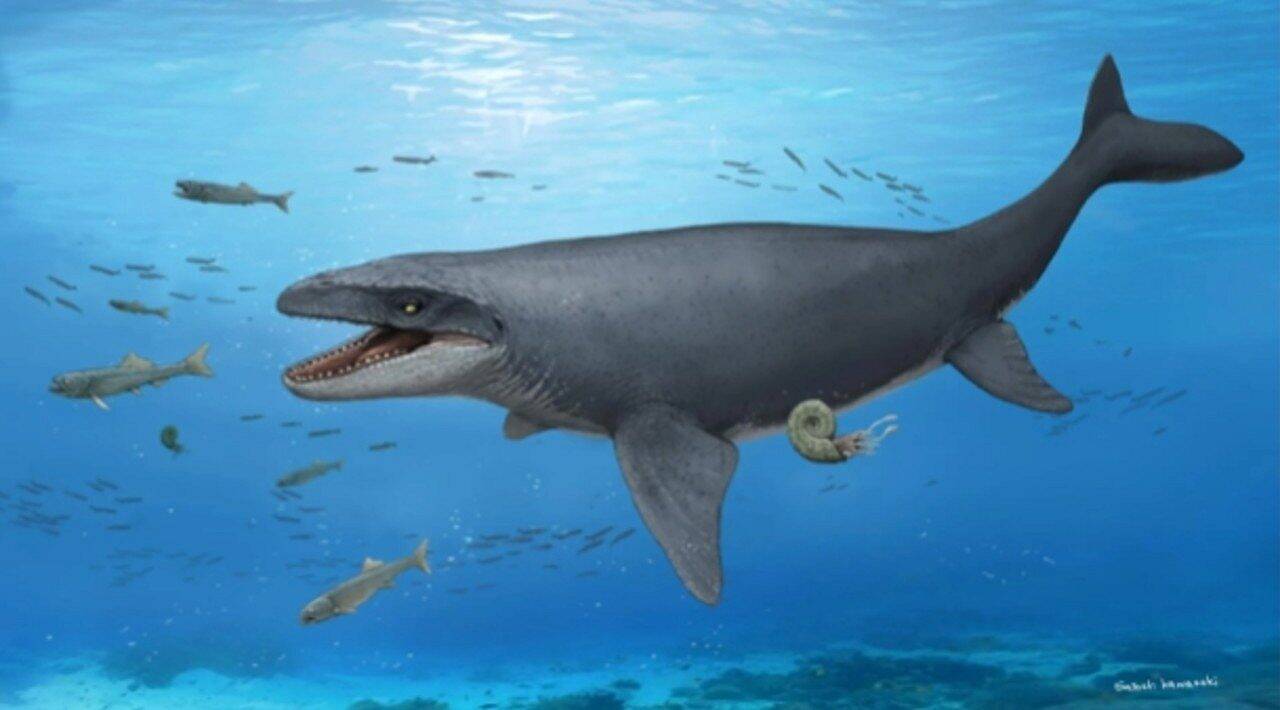
Unique traces on fossil skull suggest unprecedented discovery
Scholars also investigated the basisphenoid, a bone located close to the braincase, where they noticed the presence of several unique characteristics.
The basisphenoid has short projections that resemble horns and lacks a ventral median groove. These specificities distinguish the fossil from characteristics recorded in other species of mosasaurs. The particularity of these combined traits reinforces the chance that the specimen is from a species that has not yet been catalogued.
This research highlights the great value of re-examining unprocessed specimens stored in museums and scientific collections. Fossils preserved for decades may still reveal significant bones or other evidence not identified in their initial collection. The find may also contribute to a more precise understanding of the marine ecosystems of the Pacific Northwest in the Cretaceous era. Further investigations will be essential to confirm whether the specimen actually corresponds to a new species of mosasaur.




