

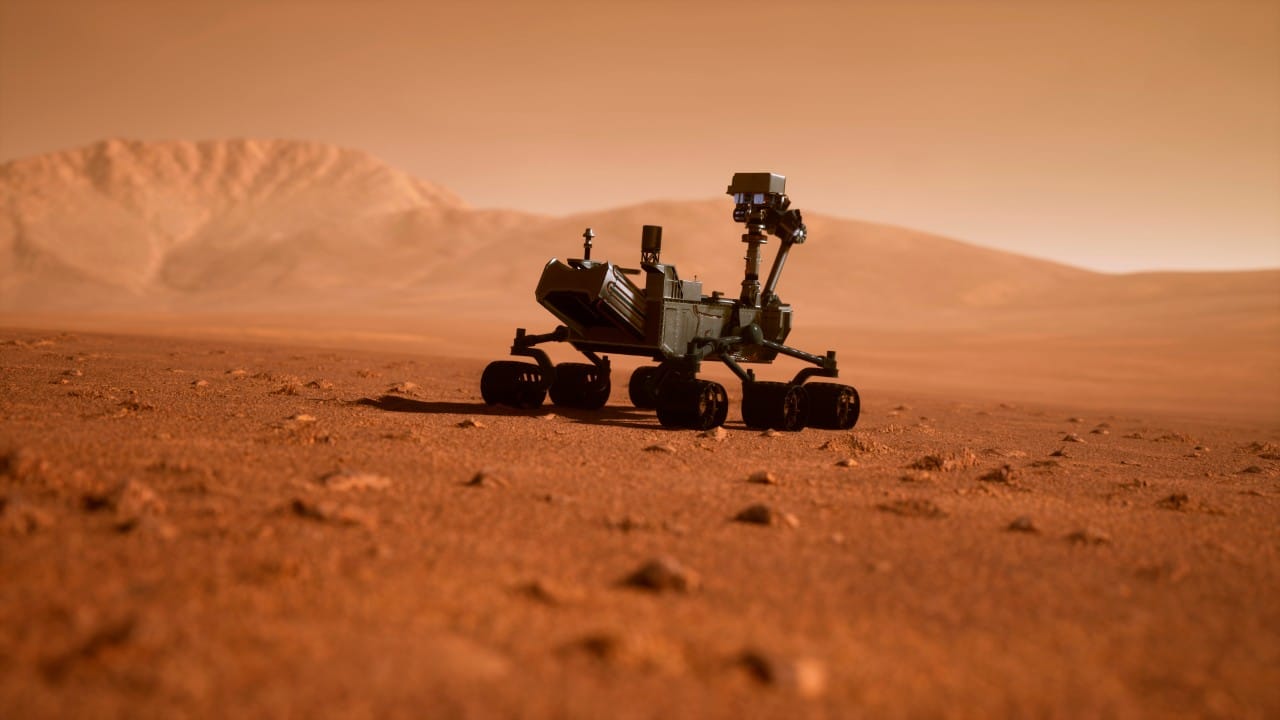
The Curiosity rover, operated by NASA, identified a large terrain full of geometric shapes that resemble beehives in the Martian region of Valle Grande. Despite the enthusiasm about the scientific finding, photographic records captured by the robot on July 23, 2026 showed that one of its aluminum wheels suffered severe damage during the journey.
The journey to this point began when mission controllers directed the machine to a specific sector of the valley. Observations previously made from the planet’s orbit and through the equipment’s own lenses indicated that the soil there had a lighter color and a texture apparently free of dangerous obstacles.
As soon as they reached the stipulated coordinates, the group of scientists responsible for control came across an intriguing geological scenario. The surface of the red planet was covered in highly peculiar polygonal designs, creating a visual pattern that directly refers to the internal structure built by bees.
Next to these geometric contours, the ground displayed a layer of small stones with very dark tones. As Mars’ atmosphere is extremely thin compared to Earth’s, offering little resistance against incoming space objects, experts believe that these fragments fell from space and accumulated on local dust after strong impacts.
The researchers highlighted in an official statement that the exact origin of this rocky material still requires in-depth studies, working with some main hypotheses to explain the phenomenon:
- Pieces of the Martian crust itself that have detached from higher geological layers.
- Debris thrown up by violent collisions that occurred far from the boundaries of Gale Crater.
- Meteorites from other parts of the solar system that survived the fall.
Chemical assessments of dark rocks found on past expeditions have shown a high concentration of nickel, a substance abundant on invading celestial bodies but rare in native geology. It now remains to confirm whether all these new dark boulders share the same extraterrestrial chemical signature, which will require additional analyzes in the coming months.
More on this story: Discovery of organic molecules by NASA robot on Mars points to potential habitability
Continuing to climb the slopes of the valley, the machinery continued recording the polygonal cracks up to the limit of the visible horizon. Even though the robot has already come across similar textures in other phases of the expedition, engineers reported that the colossal extension of this geometric field is something completely unprecedented in the mission.
Ashwin Vasavada, a leading scientist at NASA’s Jet Propulsion Laboratory located in Southern California, expressed great surprise at the images received. The expert stated that, despite all the geological beauty already documented by the equipment, the vastness of this ocean of polygons left the entire team amazed.
The exact dimensions and chemical composition of these marks have been catalogued, with the expectation that the numbers will reveal the secrets of their formation. Each geometric figure measures between four and eight centimeters in diameter, and the pattern was repeated even on the slopes of a solitary six-meter-high elevation, which scientists affectionately named Miraflores.
Research into the genesis of these marks continues, but geologists suggest they may be ancient dried mud cracks. Because Gale Crater was home to a huge lake of liquid water billions of years ago, the extreme warming and cooling cycle of the Martian climate may have driven moisture out of the sediments, sculpting the soil in this peculiar way.
The atmosphere of scientific celebration, however, was overshadowed by a routine procedure focused on vehicle maintenance. Periodically, operators order the cameras to look at the robot’s metal structure itself, with the aim of inspecting the wear of the parts after years of rolling over sharp rocks.
On the same topic: Curiosity robot photographs 20-centimeter cylindrical object on Mars and mobilizes scientists
The photographs received on Earth on July 23, 2026 brought a worrying warning about the physical integrity of one of the traction wheels. The holes in the aluminum have widened significantly, although the degradation does not represent a catastrophic leap from the state documented in March of the same year.
The American space agency has not announced any emergency maneuvers to repair the component, because physical repairs are impossible millions of kilometers away. However, engineers have an arsenal of virtual and navigational strategies to ensure the veteran explorer continues his scientific journey without fatal interruptions.
The primary tactic, which is already in place, consists of mapping alternative routes that avoid sharp terrain, saving worn metal. In addition, the machine has an operating system update sent in 2017, specifically designed to deal with the roughness of the alien terrain.
The computer program uses an advanced traction control algorithm that monitors terrain in real time. This technology adjusts the individual rotation of each axle, relieving the weight and mechanical pressure that stones exert on the chassis during daily commutes.
The intelligent system can read variations in the suspension to understand exactly where each tire is touching the ground. With this data in hand, the on-board computer calibrates the ideal turning speed, preventing dangerous skidding and maximizing grip on dusty ground.
Space Agency’s Extreme Strategies to Save Robot Mobility
If metal degradation reaches a critical point, flight controllers could take drastic measures to survive. The maneuver consists of deliberately forcing the internal structure of the affected wheel to break, discarding the compromised part so that the rest of the cylinder continues to rotate freely.
Learn more: Curiosity rover finds unprecedented traces of complex organic molecules in Martian soil
Mission technical documents explain that continued wear and tear is an inevitable consequence of exploring in such a hostile environment. However, the engineering design ensures that a single drive piece can withstand an extreme level of destruction before the vehicle’s ability to move is definitively compromised.
Exhaustive simulations carried out at the agency’s testing yard in California, using a twin model called Scarecrow, proved the feasibility of this mechanical amputation. Tests demonstrated that the equipment can run indefinitely supported only by the remains of the rim, as long as the loose fragments are ejected without causing short circuits.
Original traction is guaranteed by small metal ridges molded into the surface of the cylinder. The great current danger is that, if all of these elevations break simultaneously, the inner aluminum ring could come loose uncontrollably and end up cutting the power cables that feed the electric motors.
To avoid an electrical breakdown that would end the mission, the engineering team plans to use Mars’ own geography to their advantage. The ideal tactic involves securing the loose part to a firm rock and using the vehicle’s motive power to rip out the defective piece in a clean and controlled manner.
Two complex steering maneuvers, called “Twist and Shout” and “Pigeon Toe”, were extensively rehearsed on Earth for this purpose. The strategy requires virtual drivers to find a perfectly shaped rock to anchor the damaged wheel, accelerating the other three axles until the mechanical tension breaks the diseased metal once and for all.
Scientists remain optimistic that such aggressive measures will not need to be taken in the short term. In any case, the existence of a contingency plan brings relief to researchers, ensuring that the machine continues to reveal the mysteries of the neighboring planet even after almost fourteen years of uninterrupted operation.