

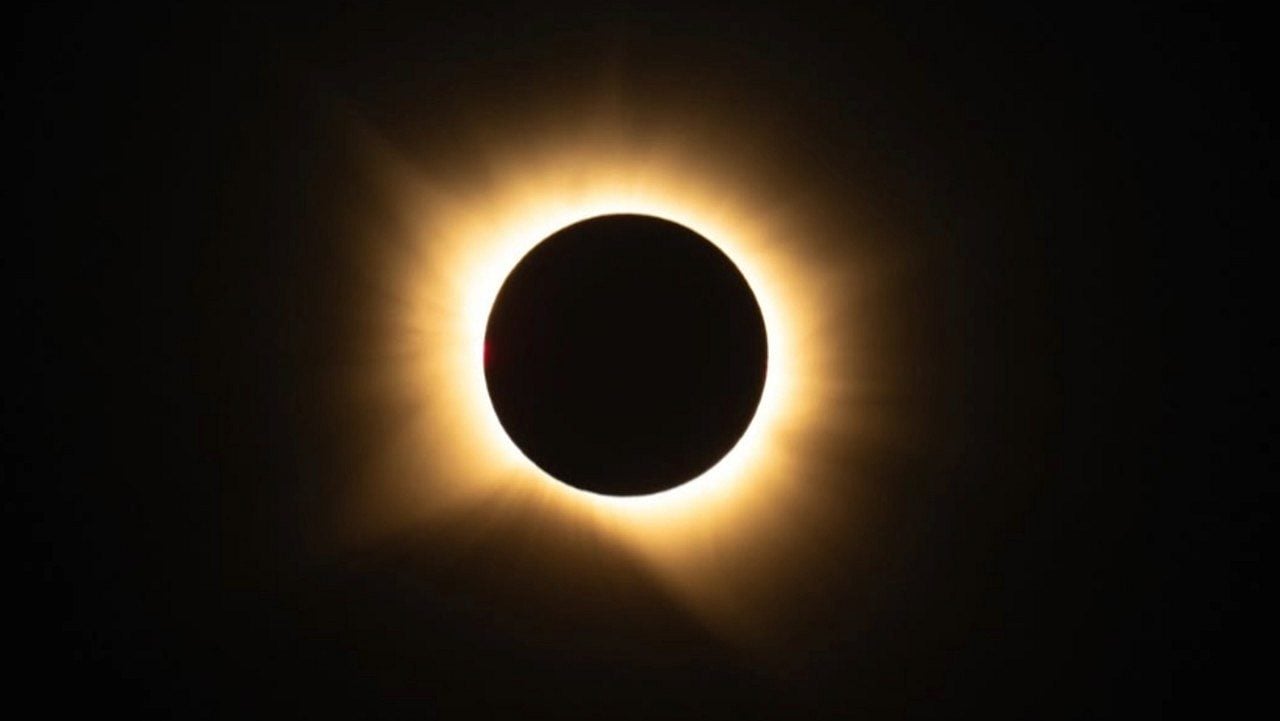
A high-intensity partial lunar eclipse is set to light up the planet’s skies two weeks after a total solar eclipse in Europe. Between August 27th and 28th, 2026, 93% of the Moon’s disk should plunge into the densest portion of the Earth’s shadow, known as the umbra, resulting in an almost total phenomenon. The remaining narrow strip of the natural satellite’s upper edge will be covered by penumbra, the outermost area of our planet’s shadow.
The shadow of the umbra will be visible covering and then revealing the lunar disk across virtually the entire continental United States, the eastern two-thirds of Canada, and throughout South America. Observers in the northwestern United States and Canada will see the partial eclipse already underway when the Moon rises. For those in Europe, Africa and the Middle East, the Moon will set while the event is still in the partial phase.
On the same topic: August’s Full Sturgeon Moon passes through Earth’s shadow on August 27, 2026
During the eclipse, the Earth’s shadow will progressively advance over the surface of the full Moon, until the satellite acquires an intense shade of orange or red. Subsequently, the sequence of events will reverse, and the shadow will completely disappear from the lunar disk, restoring the Moon’s maximum brightness.
Best times to observe the August eclipse
Unlike a total solar eclipse, whose visibility is restricted to a limited swath of the Earth’s surface, a lunar eclipse can be admired from the entire nighttime hemisphere facing the Moon. These lunar events also last longer than solar events, giving viewers plenty of time—well over an hour—to enjoy it.
Full coverage: Latest News (EN)
In North America, the majority of the eclipse will occur on the evening of August 27, with times varying by local time zone. For example, on the East Coast, the partial phase will begin at 10:33 pm Eastern Daylight Time; the height of the darkening will be just after midnight (00:13) on August 28; and the Moon will leave the umbra at 1:52 am. On the West Coast, the corresponding times in the Pacific will be 7:33 pm, 9:13 pm and 10:52 pm, all on the night of August 27, according to data from the US Naval Observatory.
- First visible dim light: Around 10pm (EDT), 9pm (CDT), 8pm (MDT), 7pm (PDT), 6pm (AKDT), 4pm (HAST)
- Partial eclipse begins: 10:33 pm (EDT), 9:33 pm (CDT), 8:33 pm (MDT), 7:33 pm (PDT), 6:33 pm (AKDT), 4:33 pm (HAST)
- Greatest eclipse: 00:13 (EDT), 23:13 (CDT), 22:13 (MDT), 21:13 (PDT), 20:13 (AKDT), 18:13 (HAST)
- End of partial eclipse: 1:52 am (EDT), 00:52 am (CDT), 11:52 pm (MDT), 10:52 pm (PDT), 9:52 pm (AKDT), 7:52 pm (HAST)
- Penumbra last seen: Around 2:15 am (EDT), 1:15 am (CDT), 12:15 am (MDT), 11:15 pm (PDT), 10:15 pm (AKDT), 8:15 pm (HAST)

Important details about the observation phases
A lunar eclipse happens when the Sun, Earth and full Moon align almost perfectly in space, an astronomical phenomenon known as syzygy. In this process, the Moon gradually moves into the Earth’s shadow, causing most of its disk to turn from a silvery gray to a mysterious, soft orange or red. Subsequently, events reverse until the satellite regains its maximum brightness.
To observe the spectacle, you will only need your eyes, without the need for specialized eye protection. However, associate editor Edwin L. Aguirre suggests that “the eclipsed Moon will be even more impressive viewed through binoculars or a small telescope.”
- The initial edge of the Moon penetrates the pale outer fringe of the Earth’s shadow, the penumbra. It is likely that the observer will not notice anything until the Moon is approximately halfway through dim light, noticing a slight darkening at the front edge. The shadowing of the penumbra intensifies as the Moon advances into its interior.
- Then the front edge of the Moon enters the umbra, the central cone of Earth’s shadow. At this point, a noticeable darkening is expected on the lower left edge of the lunar disk when viewed from North America. With a telescope, it is possible to follow the edge of the umbra by slowly crossing the lunar features.
- The trailing edge of the Moon slides into the umbra at the beginning of maximum eclipse. The Moon will then shine a coppery red or intense orange. Meg Thacher, associate editor, explains that “this reddish light comes from all the sunrises and sunsets around the edge of the Earth at the time of the eclipse.” In a total lunar eclipse, the entire satellite turns red and faint. In this deep partial eclipse, a small portion of the upper edge of the lunar disk will still maintain its brightness, even at the peak of the phenomenon.
- As the Moon proceeds in its orbit, the band of light will expand and grow downward.
- When the Moon is completely out of the umbra, only the last, light penumbral shadow will remain. About 45 minutes later, no unusual phenomena will be visible in the sky.
After this intense partial lunar eclipse, the Western Hemisphere will face a long period without total eclipses. The next such events will not occur until New Year’s Eve 2028 for Alaska and far western Canada, and on June 26, 2029 for the rest of the Americas.