
Fossils of two prehistoric sharks emerge inside Mammoth Cave


Paleontologists identified the fossilized remains of two previously unknown prehistoric shark species dating back more than 325 million years inside limestone strata at Mammoth Cave National Park on September 9, 2026, revealing critical evidence about ancient marine ecosystems that flourished long before modern oceans formed. The specimens provide new details about Paleozoic biodiversity.
Classified within the extinct ctenacanth order, the specimens belong to the newly named species Troglocladodus trimblei and Glikmanius careforum.
Subterranean waterways cut through sedimentary layers between 340 and 325 million years old. These exposed rocks preserve remnants of ancient mollusks, corals, and shell-covered organisms.
A paleontological survey documented over 70 ancient fish species within the cavern system, with cartilaginous species representing roughly 90% of the total records.
Predators that roamed an interconnected marine passageway
An expansive maritime corridor linked present-day Kentucky and Alabama to areas that now form northern Africa and Europe more than 325 million years ago. This shallow seaway covered the interior of the continent.
Geologists identified Troglocladodus trimblei from juvenile and adult teeth gathered within the Bangor Formation along with the St. Louis and Ste. Genevieve Formations.
These sharks were large. Adult specimens measured between 3 and 3.7 meters, roughly matching the body length of contemporary oceanic whitetip sharks.
Investigations into Glikmanius careforum relied on dental fossils retrieved across Alabama and Mammoth Cave, where teams also salvaged jaw parts and gill structures from a juvenile.
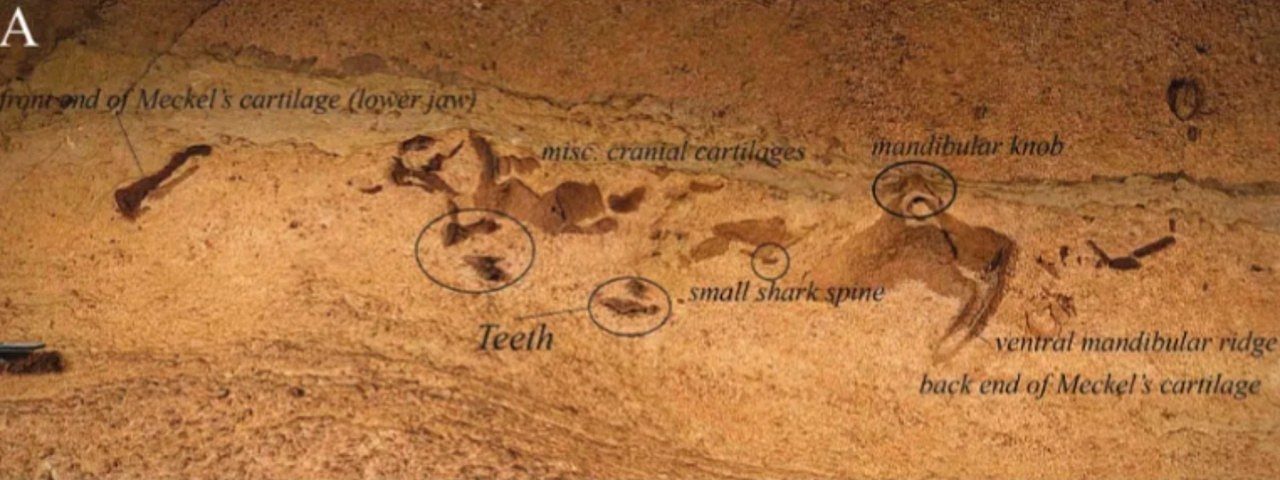
Fossil evidence rewrites timeline for extinct marine hunters
Data recovered from Glikmanius careforum altered existing records regarding the emergence of this predator group. The structural evidence suggests an earlier presence than previously calculated.
Paleontologists stated that the discovery extends the evolutionary origin of this shark group backward by more than 50 million years.
The 3 to 3.7-meter hunter possessed jaws adapted for catching bony fish, smaller sharks, and squid-like orthocones. These species inhabited coastal environments during the Carboniferous period.
Mammoth Cave National Park Superintendent Barclay Trimble noted the collaborative efforts behind the paleontological work.
“Every new discovery at Mammoth Cave is possible due to collaborations. Our park team is honored to work alongside the National Park Service Paleontology Program and now the University of Alabama Geological Sciences Department whose coordinated efforts have made this latest announcement possible,” Trimble stated.
Prehistoric marine environment locked within subterranean rock
Limestone walls inside the cavern preserve evidence of diverse marine life where primitive sharks shared habitats with small invertebrates.
The identification of Troglocladodus trimblei and Glikmanius careforum confirms that the Mammoth Cave system retains uncataloged fossil deposits. Field teams continue to survey the deepest geological strata for additional Paleozoic remains.





