
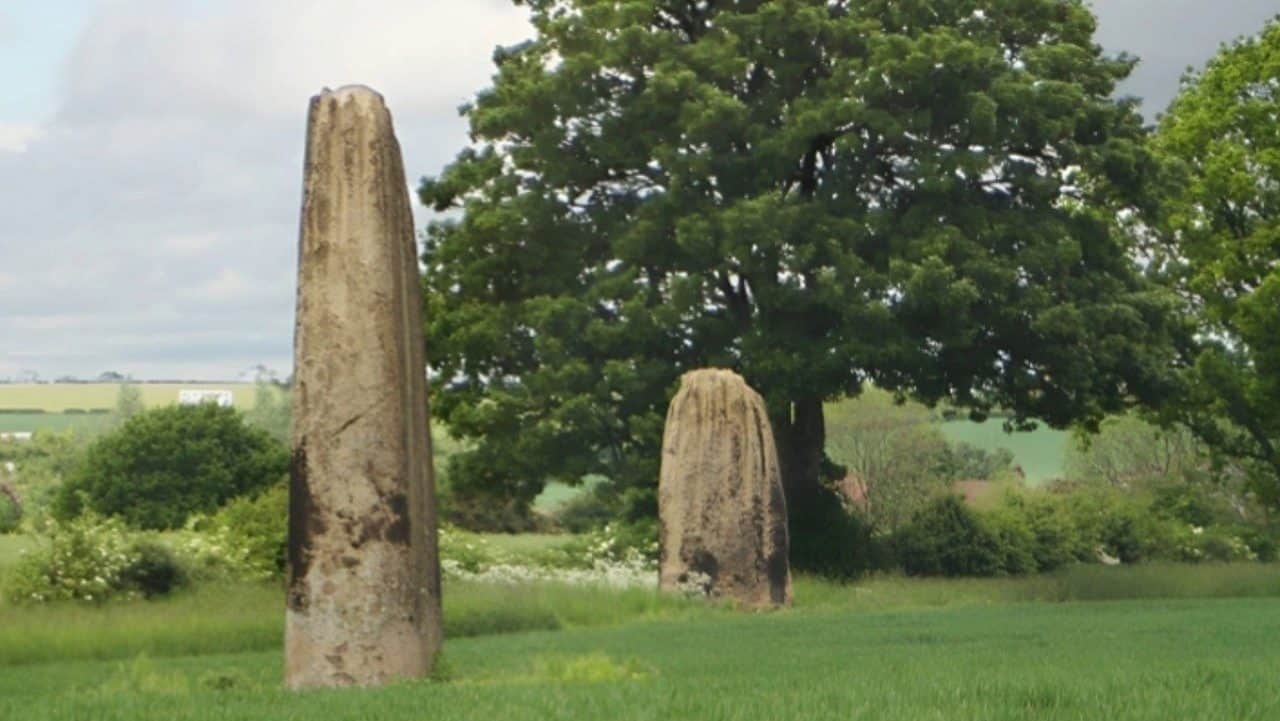
Ancient builders erected the Devil’s Arrows in northern England around 4,000 years ago using 25-tonne stones transported across a distance of at least 18 kilometers from Brimham Rocks. The finding demonstrates an extraordinary degree of prehistoric planning while indicating that spiritual or cultural priorities determined the selection of the distant geological site.
Geological origin of northern England monument identified
A scientific investigation answered a longstanding question regarding the origins of Britain’s tallest surviving prehistoric stone alignment.
Prehistoric teams transported individual blocks weighing 25 tonnes, or roughly 55,000 pounds, over a span of 18 kilometers, which equals 11 miles, to construct the monument. The effort established the highest surviving alignment of standing stones in Britain.
A research team led by Curtin University alongside the University of York identified the original geological deposit at Brimham Rocks, located within North Yorkshire.
Located near Boroughbridge in North Yorkshire, the surviving giant monoliths stand up to seven meters, or 23 feet, tall across an open lowland landscape where researchers had long struggled to pinpoint the exact geological outcrops that supplied the massive building project. The row forms an uncommon configuration within the surrounding flat countryside.
Archaeologists date the transport and erection of the monoliths to the Late Neolithic or Early Bronze Age, approximately 2000 BC.
Prehistoric builders selected rock formations located far away
Dr. Anthony Clarke, the lead author from the Timescales of Mineral Systems Group inside the School of Earth and Planetary Sciences at Curtin University, explained that the outcome alters earlier theories concerning ancient monument design. The evidence redefines the criteria ancient populations used when selecting raw materials.
“Our research shows these stones weren’t simply taken from the nearest available source — they were deliberately chosen from a challenging landscape 18 kilometers away,” Dr. Clarke said.
Earlier assessments considered Plumpton Rocks, an outcrop closer to the site, as the likely origin. The new analysis shifted the provenance to Brimham Rocks, confirming that crews moved the pillars across a much greater distance.
“Each stone weighs more than 25 tonnes, so moving them would have required incredible planning, coordination and engineering skill,” Dr. Clarke said.
“This tells us prehistoric people placed real importance on the landscape itself,” Dr. Clarke said. “It wasn’t just about convenience — the location the stones came from likely held meaning for them.”
The terrain surrounding Brimham Rocks probably carried profound spiritual, symbolic, or communal significance rather than serving merely as an accessible stone supply.
Study co-author Dr. Jim Leary of the University of York explained that the conclusions transform the modern understanding of ancient construction practices. The findings offer fresh perspective on early social priorities.
“These results show that ancient communities were making deliberate and meaningful choices about where their stones came from,” Dr. Leary said.
“It highlights the importance of landscape and shared belief systems,” Dr. Leary said. “It also reflects the remarkable effort involved in transporting and raising stones of this size.”
Adhesive tape method confirms exact mineral signatures
Scientists gathered minute mineral fragments without inflicting physical damage on the standing stones by employing a low-impact sampling protocol based on adhesive tape.
Laboratories evaluated the specific chronological signatures embedded within the recovered grains. Analysts compared those profiles directly against geological samples taken from potential bedrock locations across the region. The resulting data established a direct match connecting the Devil’s Arrows to Brimham Rocks.
Glacial drift was ruled out. The geochemical match confirmed that human labor drove the transportation of the monoliths directly to their final location.
Researchers plan future excavations at both heritage sites
The research group intends to deploy the non-destructive sampling method across other mysterious megaliths while preparing targeted archaeological excavations at both the Devil’s Arrows alignment and Brimham Rocks.
“These next steps could help us better understand when the stones were moved,” Dr. Clarke said. “They will also reveal how these extraordinary monuments were constructed.”
Justin Scully, the National Trust General Manager for Fountains Abbey & Studley Royal and Brimham Rocks, affirmed that the findings forge an explicit physical link between two prominent Yorkshire landmarks.
“We’re incredibly grateful to the researchers for helping us uncover this new chapter in the stones’ story,” Mr. Scully said. “Their work deepens our understanding of the people who shaped this landscape thousands of years ago.”
“The Devil’s Arrows are deeply cherished by local communities, and we’re delighted that this discovery adds a new chapter to their story,” Mr. Scully said.
The formal research paper appeared under the title Deliberate Prehistoric Sourcing of the Devil’s Arrows, Britain’s Tallest Stone Row. Scientific findings were documented in the Proceedings of the Royal Society A.