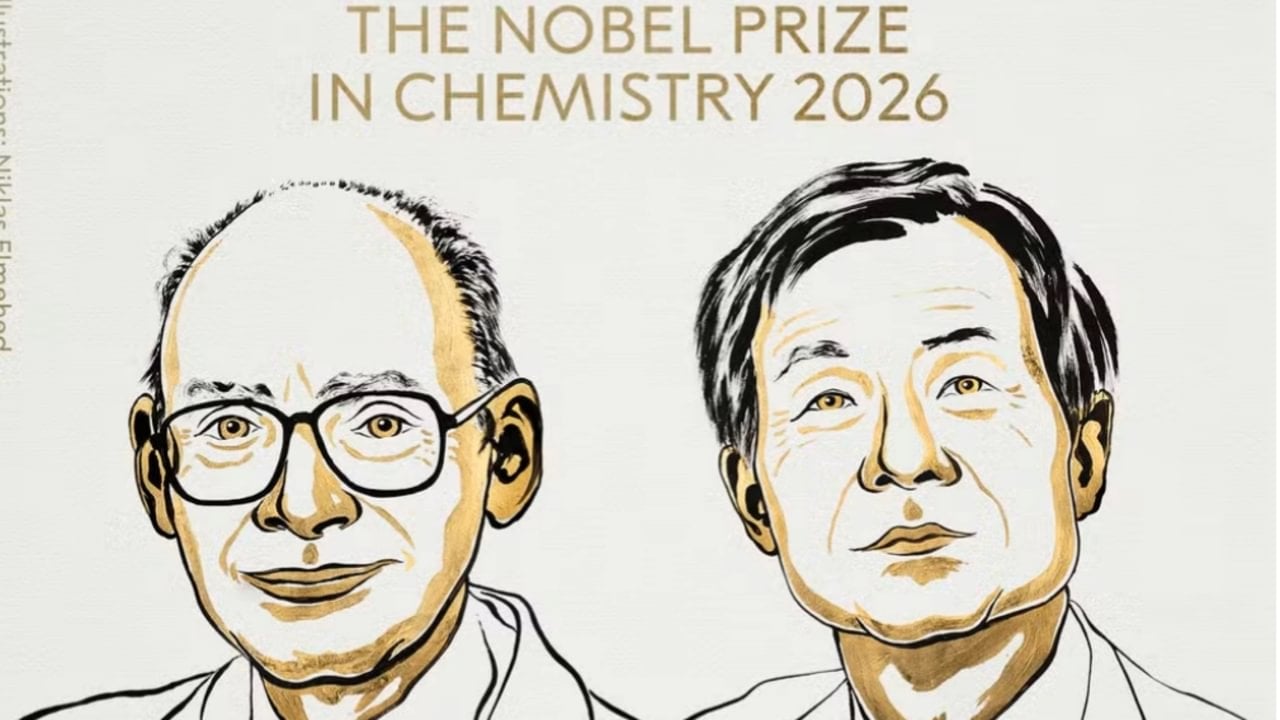
The Royal Swedish Academy of Sciences awarded the 2026 Nobel Prize in Chemistry to researchers Henri B. Kagan and Kenso Soai on Wednesday, October 7, 2026. The committee selected the pair for uncovering nonlinear effects and autocatalysis in asymmetric organic synthesis, resolving an intellectual puzzle that had stumped researchers for over a century while reshaping modern pharmaceutical manufacturing.
The laureates will equally share the cash purse of 12 million Swedish kronor, which corresponds to approximately $1.2 million, providing 6 million kronor to each scientist. Academy representatives formally revealed the decision at the organization’s headquarters in Stockholm, Sweden, conducting the 117th chemistry prize announcement since the foundation launched the global program in 1901.
Molecular chirality puzzle yields to asymmetric catalysis research
The prize-winning discoveries examine how key organic molecules appear across nature in two counterpart structures that reflect each other like left and right hands. This geometric phenomenon, termed chirality in chemical terminology, exhibits a striking biological trait known as homochirality, in which living organisms depend almost exclusively on a single structural orientation.
Laboratory researchers spent decades attempting to determine how such uniform asymmetry developed naturally and how synthetic chemists could deliberately manufacture only one mirror form. The pharmaceutical sector treats this geometric separation as vital, because one spatial arrangement of a molecule can deliver therapeutic relief while its inverted counterpart remains inert or causes harmful toxicity.
“Henri Kagan and Kenso Soai have provided a solution to a chemical mystery that is over a century old: how homochirality can emerge spontaneously,” said Heiner Linke, chair of the Nobel Committee for Chemistry, during the presentation event in Stockholm. Linke characterized the chemical pathways created by the pair as spectacular demonstrations of experimental precision.
Peter Somfai, a professor at Lund University and member of the Nobel Committee for Chemistry, detailed how this conceptual advance protects patients receiving commercial therapeutics. “The left-handed version of the drug can have one effect and the right-handed version can have another effect, and then we need methods to prepare them selectively,” Somfai said, praising the breakthrough as one of the standout achievements in modern organic chemistry.
Learn more: Tropical Storm Isaias heads toward Gulf Coast with hurricane watches expected
Nonlinear mechanisms and the Soai reaction transform medicine production
French chemist Henri B. Kagan, currently 95 years old and professor emeritus at Université Paris-Saclay, initiated this transformative branch of research in 1986. Kagan identified nonlinear effects within asymmetric catalysis, proving that subtle optical imbalances in a starting mixture could be magnified by controlled processes to yield a vastly dominant share of the desired molecular variant.
Japanese chemist Kenso Soai, 76, a professor at the Tokyo University of Science, later devised the benchmark transformation recognized internationally as the Soai reaction. The technique established the first confirmed framework for efficient asymmetric autocatalysis, an extraordinary process where the synthesized compound directly catalyzes its own replication in an exponential chain reaction.
When the Swedish selection committee placed its notification call, Soai was running errands away from his home. “This is the most exciting day of my life, I am very happy to share this prize with Professor Henri Kagan,” Soai said by telephone during the official press conference, explaining that he had stepped out to purchase groceries near his residence when the call came through.
See also: Quark ripples in primordial plasma confirm liquid state at CERN
Nobel week progression and upcoming ceremony dates in Stockholm
The honor presented to Kagan and Soai follows the 2025 chemistry award, when researchers Susumu Kitagawa, Richard Robson, and Omar M. Yaghi earned recognition for pioneering metal-organic frameworks used in gas storage and water harvesting. Established through the final testament of Swedish inventor Alfred Nobel, the chemistry laurel follows the annual announcements for physiology or medicine and physics.
The Royal Swedish Academy of Sciences and collaborating prize committees will announce the remaining 2026 laureates across several upcoming milestones. The calendar completes the annual presentation series before the formal winter gathering:
- Thursday, October 8, 2026: announcement of the Nobel Prize in Literature in Stockholm
- Friday, October 9, 2026: announcement of the Nobel Peace Prize in Oslo
- Monday, October 12, 2026: announcement of the Sveriges Riksbank Prize in Economic Sciences in Memory of Alfred Nobel
- Thursday, December 10, 2026: formal presentation ceremony for medals and diplomas in Stockholm
The December convocation will bring together laureates from every prize discipline in the Swedish capital. The gathering coincides with the anniversary of Alfred Nobel’s death, concluding the formal cycle of annual recognitions.