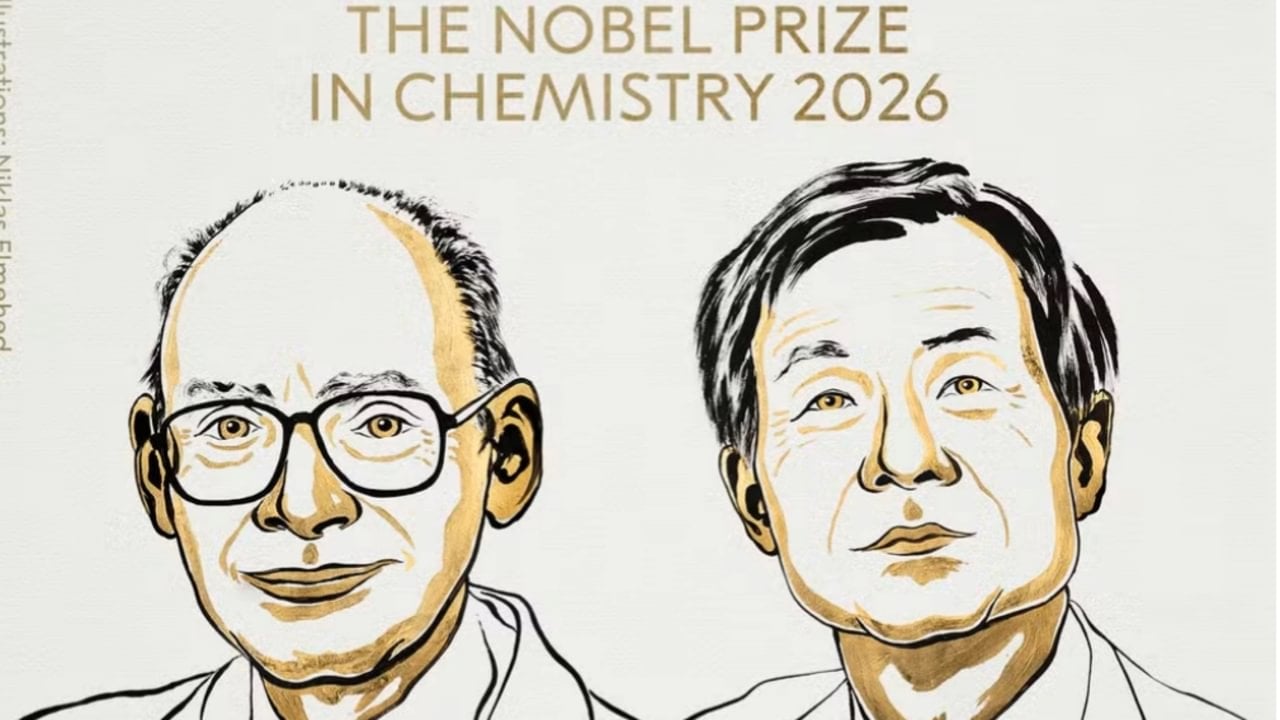
The Royal Swedish Academy of Sciences selected researchers Henri B. Kagan and Kenso Soai as the winners of the 2026 Nobel Prize in Chemistry on Wednesday (7). The committee recognized their discovery of non-linear effects and autocatalysis in asymmetric organic synthesis, resolving a century-old fundamental scientific puzzle and transforming the modern pharmaceutical industry.
Both laureates will evenly split the cash award of 12 million Swedish kronor, roughly equivalent to 1.2 million dollars, granting 6 million kronor to each recipient. The announcement took place at the academy headquarters in Stockholm, Sweden, representing the 117th time that the chemistry prize has been bestowed since the initial awards in 1901.
Breakthrough research explains how living organisms select single mirror-image molecules
The award-winning research focuses on fundamental chemical structures that exist naturally as two identical forms that mirror each other, much like a person’s left and right hands. Known scientifically as chirality, this molecular arrangement holds a puzzling biological characteristic, as living systems almost exclusively rely on only one of these mirror images, a condition described as homochirality.
Scientists spent decades trying to identify the mechanisms that allowed this single-handed orientation to develop spontaneously on Earth and how laboratories could replicate the imbalance deliberately. In the manufacturing of pharmaceuticals, separating these twin shapes is critical, because one version of a drug molecule may cure an illness while its opposite reflection can prove therapeutically ineffective or provoke severe toxic complications inside human tissue.
“Henri Kagan and Kenso Soai have provided a solution to a chemical mystery that is over a century old: how homochirality can emerge spontaneously. The chemical reactions they have developed are spectacular,” stated Heiner Linke, chair of the Nobel Committee for Chemistry, during the presentation ceremony in Stockholm. Linke highlighted that their findings unlocked new avenues for creating essential materials with absolute chemical precision.
Peter Somfai, a professor at Lund University and a voting member of the chemistry committee, stressed the direct practical significance of their laboratory techniques for therapeutic medicine. “The left-handed version of a drug can have one effect and the right-handed version can have another effect, and so we need methods to make them selectively,” Somfai explained, describing the experimental design as one of the most elegant achievements in the history of organic chemistry.
See also: Quark ripples in primordial plasma confirm liquid state at CERN
Laboratory discoveries behind non-linear amplification and the landmark Soai reaction
French chemist Henri B. Kagan, who is 95 years old and serves as professor emeritus at Paris-Saclay University, initiated the foundational scientific shift in 1986. His experiments demonstrated the reality of non-linear effects during asymmetric synthesis, showing that minute optical imbalances present in a starting compound could be multiplied by precise reaction mechanisms to yield a massive surplus of one targeted molecular shape.
Building upon those principles, Japanese chemist Kenso Soai, 76, from the Tokyo University of Science, developed the landmark process formally recognized worldwide as the Soai reaction. That innovation provided the first verifiable model of asymmetric autocatalysis, an extraordinary chain reaction where the resulting molecular product acts directly as its own catalyst, accelerating its own exclusive generation at an exponential rate.
Speaking by phone during the Stockholm press briefing, Soai explained that the congratulatory phone call reached him while he was away from home running daily errands. “This is the most exciting day of my life, I am so happy to share this prize with Professor Henri Kagan,” the Tokyo researcher said, noting that he was shopping in his local neighborhood when academy officials contacted him to deliver the historic news.
Check out: Rotating black hole Sagittarius A* powers extreme cosmic rays via neutron decay
Previous laureates in molecular architecture and the remaining schedule for the 2026 honors
The honor granted to Kagan and Soai follows the 2025 chemistry prize, which recognized Susumu Kitagawa, Richard Robson, and Omar M. Yaghi for designing metal-organic frameworks that capture atmospheric gases and assist with water security. Established through the final testament of Swedish industrialist Alfred Nobel, the chemistry category consistently forms the midpoint of Nobel week, following the medicine and physics announcements earlier in the cycle.
The Royal Swedish Academy of Sciences and corresponding Nobel assemblies will conclude their round of announcements over the coming days according to an established timetable. These upcoming dates encompass multiple disciplines across Sweden and Norway prior to the end of the announcement calendar:
- Thursday, October 8, 2026: Announcement of the Nobel Prize in Literature in Stockholm
- Friday, October 9, 2026: Announcement of the Nobel Peace Prize in Oslo
- Monday, October 12, 2026: Announcement of the Sveriges Riksbank Prize in Economic Sciences in Memory of Alfred Nobel
- Thursday, December 10, 2026: Official medal and diploma presentation ceremony in Stockholm
The formal award ceremony in December will gather all 2026 laureates in Sweden’s capital to receive their Nobel medals and commemorative diplomas from the monarch. That gathering falls on the anniversary of Alfred Nobel’s death, closing out the international prize cycle for the year.