
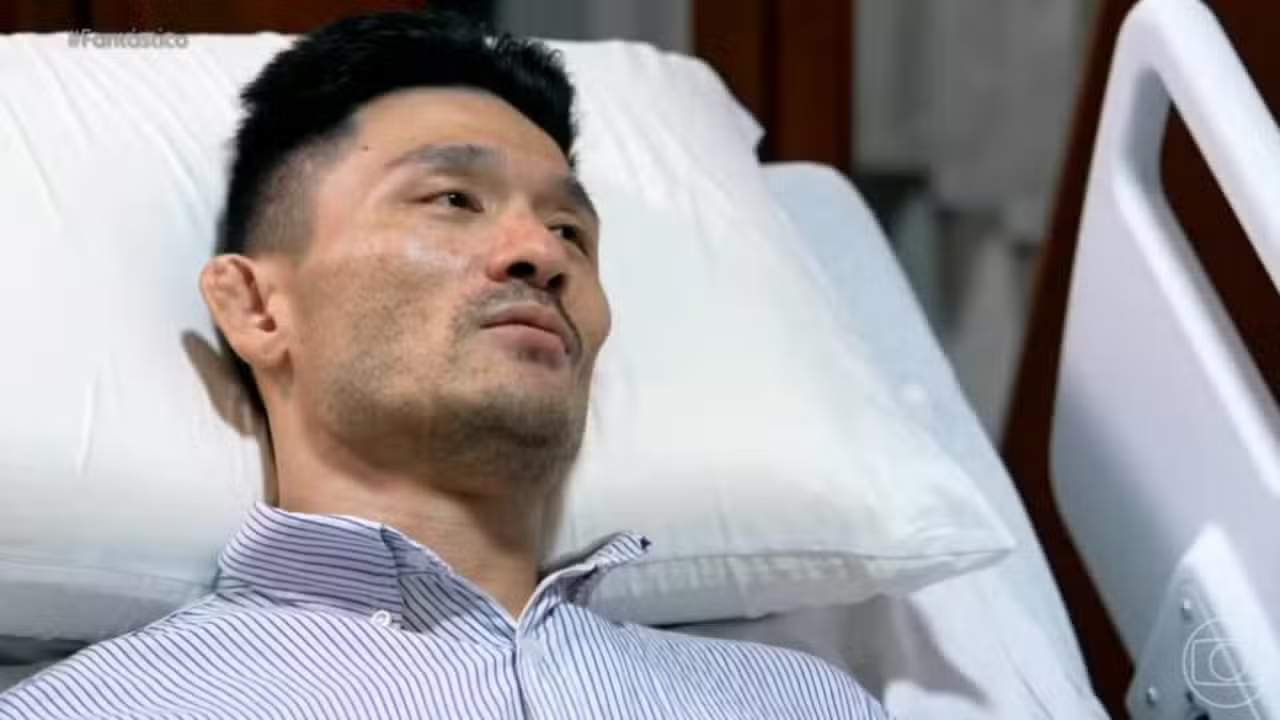
Black belt athlete Willian “Kabuto” Hiroyuki Masuda returned to his residence in Londrina and initiated motor rehabilitation routines this Sunday (11). The 37-year-old fighter suffered immediate loss of motor capacity and sensory feeling from the neck down following an irregular technique during a martial arts tournament in northern Paraná, enduring intensive hospital care and major surgical procedures before securing authorization for home-based medical monitoring.
The competitor is undergoing comprehensive home hospitalization supported around the clock by nursing specialists, medical supervisors, and daily physical therapy sessions. “Before I could slip underneath, out of nowhere, I blacked out,” Masuda stated while describing the moments immediately after the impact on the mat. “When I realized what happened, I was lying on the floor, unable to move anything in my body.”
Emergency logistics and medical interventions following the arena collision
The severe injury triggered urgent emergency protocols on the competition floor and required subsequent hospital transfers across the healthcare network in Londrina. Providing continuous care at home forced his family to execute fast architectural adaptations throughout their private residence to accommodate vital clinical gear and daily therapy beds.

- Competition venue: Ginásio de Esportes Moringão, located in Londrina, Paraná
- Official tournament: Super Pro Jiu-Jitsu, open-weight division without gi
- Emergency surgery: Cervical spine reconstruction and stabilization lasting roughly 10 hours
- Current care model: Continuous home hospitalization backed by specialized nursing and physical therapy
Trauma mechanics and severe vertebral damage sustained on the mat
The incident occurred during an open-weight clash without traditional kimonos at the Super Pro Jiu-Jitsu event held inside the Ginásio de Esportes Moringão. Masuda was matched against heavyweight competitor Juliano Di Pelli Machado when he was subjected to an overhead slam maneuver, a technique where a fighter elevates their rival and drives them vertically downward onto the mat with blunt mechanical force directed at the head or upper spine.
The violent collision against the competition floor caused an immediate joint dislocation and bone fractures between the fifth and sixth cervical vertebrae, designated anatomically as C5 and C6. That structural destruction crushed the cervical spinal cord canal, cutting off the transmission of electrical nerve impulses and causing instant paralysis and sensory deprivation in all four limbs. Because the neck column was left mechanically compromised, orthopedic and neurological surgical teams placed the athlete through an emergency stabilization procedure that extended over approximately 10 hours to align bone fragments and decompress central nerve roots.
Following weeks in acute hospital wards and the conclusion of surgical interventions, medical directors cleared the fighter to transition his treatment into a domestic setting surrounded by relatives. The residential property where he stays was already undergoing structural works and had to be quickly adapted, receiving expanded interior doors, external access ramps, a multi-position medical bed, and respiratory support systems. “It is one day at a time, but I cannot deny that some days are extremely tough,” the competitor explained regarding his day-to-day struggle with severe physical limitations.
Chronological sequence of clinical procedures and formal legal steps
Official records track the case from an earlier civil court ruling against the opposing fighter up to the victim’s public remarks concerning his health:
- 2016: Juliano Di Pelli Machado receives a civil court ruling ordering payment of moral damages after choking and slapping a woman in an unrelated dispute
- August 22, 2026: Willian Masuda suffers a severe cervical fracture and dislocation during a match at the Super Pro Jiu-Jitsu tournament in Ginásio Moringão
- September 28, 2026: The injured athlete is formally discharged from the hospital facility and transitions into a home care protocol
- October 11, 2026: The martial artist speaks publicly regarding his physical rehabilitation hurdles and life after returning home
Paraná detectives examine eventual malice in the criminal investigation
A formal criminal inquiry was initiated by the Civil Police of Paraná following a formal legal petition lodged by state prosecutor Renato Castro, a member of the Public Prosecutor’s Office of Paraná who also trains jiu-jitsu. After examining video recordings of the match that circulated among regional martial arts practitioners, the prosecutor determined that the technique displayed probable criminal misconduct outside accepted sports standards and requested immediate police involvement.
The investigation is supervised by detective Roberto Fernandes, who is pursuing the matter under charges of grievous bodily harm committed through eventual malice. Under Brazilian criminal law doctrine, eventual malice occurs when an individual intentionally acts in a manner that consciously assumes the clear risk of producing a catastrophic outcome. Investigators are collecting sworn testimonies to establish how the exchange developed and evaluate whether the maneuver blatantly contradicted guidelines enforced by international combat sports organizations.
“So far we have questioned 10 witnesses, and with the exception of one, every person stated that the technique executed during the bout was completely prohibited in jiu-jitsu,” detective Roberto Fernandes explained regarding the evidence collected by investigators. The police chief also clarified the legal foundation underpinning the current proceedings: “He took the conscious risk of producing a severe bodily injury, which jurisprudence identifies as eventual malice.”
Background background checks conducted by investigators revealed that Machado had previously been ordered by a civil court in 2016 to pay financial damages for assaulting a woman through physical battery, which involved a headlock chokehold and a strike to her face.
Technical regulations and statements from organizers and defense counsel
The slam maneuver, widely referred to in international combat sports as a spike or piledriver, is expressly prohibited by the regulatory framework of the Brazilian Jiu-Jitsu Confederation and governing federations due to the lethal threat of spinal collapse, irreversible quadriplegia, or immediate death. Safety codes demand that any competitor who lifts an opponent off the canvas must maintain deliberate control and return the athlete safely to the floor without driving their skull or cervical vertebrae directly into the mat.
Under the open-weight format, combatants face each other without standard bodyweight limitations, which generated a size gap of approximately 40 kg between the two participants inside Ginásio Moringão. Masuda stepped onto the mat weighing roughly 70 kg, whereas Machado entered with substantially heavier mass, multiplying the kinetic force and momentum that crashed against Masuda’s cervical spine during the fall.
Cleber Takeuchi, the event organizer responsible for Super Pro Jiu-Jitsu, maintained that tournament staff followed official operating rules and stated that the referee could not halt the action prior to the physical crash while both men remained airborne. “The official cannot anticipate the action because sports rules dictate that dynamic, so there was nothing he could preemptively do,” Takeuchi said. “What the referee was required to do once the collision occurred was executed immediately, which was calling medical personnel for initial assistance and disqualifying the competitor.”
The Brazilian Jiu-Jitsu Confederation stated that technical committees consistently re-evaluate safety regulations to safeguard the health and physical well-being of registered participants. Masuda observed that his rival showed no outward concern on the mat immediately after the impact: “He said nothing to me, just glanced at me and kept staring blankly at the ceiling without showing any reaction.”
The defense counsel for Juliano Di Pelli Machado, represented by attorney Felipe de Melo, maintains that the incident represents an unintended sports accident. Legal counsel stated that the competitor attempted to place his limbs on the canvas to maintain balance and later tried reaching the victim’s instructors to offer support. Machado stated publicly that he was performing a defensive maneuver without seeing where the opponent’s head was positioned, claiming he lacked sufficient reaction time to prevent the collision.
Medical outlook regarding spinal nerve recovery and functional mobility
The clinical team overseeing Masuda’s recovery in Londrina stated that no definitive medical prognosis exists regarding whether the spinal cord trauma is reversible or if the paralysis will remain permanent. Because severe spinal lesions require prolonged intervals to assess cellular healing and nerve rewiring, specialists avoid giving advance timelines regarding the level of motor recovery the fighter might regain over months of therapy.
The criminal inquiry managed by the Civil Police of Paraná continues forward with expert witness depositions before detectives submit their final investigative conclusions to the state judiciary. Masuda remains focused on his intensive domestic rehabilitation routine in Londrina, keeping his goals centered on fundamental mobility: “The absolute priority is simply being able to have my life back.”