
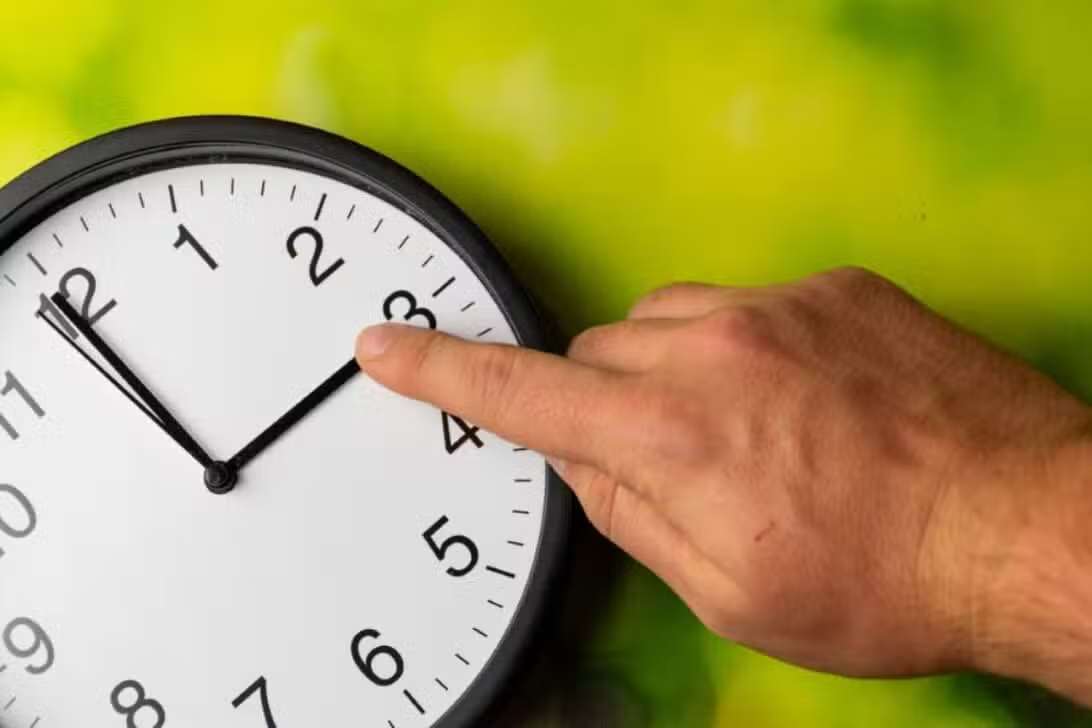
Most of the United States returns to standard time on November 1, 2026, when clocks move back one hour to mark the end of daylight saving time. The shift takes place at 2 a.m. local time, turning the clock back to 1 a.m. across participating states. This seasonal system is designed to align waking hours with natural sunlight during the warmer months of the year.
The 2026 daylight saving period began on March 8, 2026, when clocks moved ahead by one hour. Because federal rules set the autumn transition for the first Sunday of the month, November 1 represents the earliest possible calendar date for the return to standard time. Not every part of the country participates: Hawaii, most of Arizona, and U.S. territories such as Puerto Rico and Guam remain on standard time throughout the entire year.
How the 2 a.m. clock transition works for households
Internet-connected electronics, including smartphones, computers, and smartwatches, perform the 2 a.m. adjustment automatically on November 1. Household analog clocks, wall timers, and older kitchen appliances require manual resetting before bedtime on October 31. Moving the hands back gives residents an extra hour of sleep on that night, while shifting sunrise and sunset roughly one hour earlier on the clock for the remainder of autumn and winter.
States and territories that keep standard time all year
Federal law permits states to opt out of the seasonal switch and maintain standard time permanently, a path chosen by two states and five territories to avoid twice-yearly schedule disruptions. The jurisdictions that do not change their clocks on November 1 are:
- Hawaii, which experiences minimal variation in daylight hours between summer and winter due to its proximity to the equator.
- Arizona, with the exception of the Navajo Nation in the northeastern part of the state, which observes daylight saving time to keep uniform hours with neighboring communities in Utah, Colorado, and New Mexico for trade and transportation.
- The U.S. territories of Puerto Rico, Guam, American Samoa, the U.S. Virgin Islands, and the Northern Mariana Islands in the Caribbean and the Pacific.
House passes Sunshine Protection Act in 2026, but Senate stalls
Efforts to eliminate the biannual clock change gained momentum in Congress during 2026, though not in time to cancel the November 1 transition. On July 14, 2026, the U.S. House of Representatives passed the Sunshine Protection Act (H.R. 139), introduced by U.S. Representative Vern Buchanan of Florida, by a bipartisan vote of 308 to 117. The measure proposes making daylight saving time the permanent, year-round standard across the nation while allowing already exempt states to remain on standard time.
Read also: Donald Trump cancels Pentagon livestream of Nidal Malik Hasan execution
The legislative stalemate reverses the scenario seen in 2022, when the U.S. Senate approved an earlier version of the Sunshine Protection Act by unanimous consent only for the bill to expire in the House. After the measure was reintroduced in 2025 with 45 co-sponsors and passed the lower chamber in July 2026, President Donald Trump stated he would sign the bill if it reached his desk. In October 2026, however, Senate Majority Leader John Thune stated that the upper chamber still lacked the consensus required to bring the legislation to a final vote.
At the state level, roughly 30 legislatures have debated bills to end the twice-yearly adjustments, and states such as Florida and Texas have pushed local measures to lock their clocks, which cannot take effect without an amendment to federal law. Opponents of permanent daylight saving time point to health risks linked to darker winter mornings, including sleep disorders and cardiovascular problems, whereas business groups argue that extra evening light boosts retail sales and tourism. The U.S. Department of Transportation has overseen national time zones and daylight saving compliance since 1966.
From World War I energy rules to the 238-day schedule
The idea of shifting daily schedules to match sunlight dates back to 1784, when American Founding Father Benjamin Franklin wrote a satirical essay suggesting that waking earlier would save candle wax. Germany became the first country to enact formal clock changes in 1916 during World War I to conserve fuel, and the United States followed suit in 1918. Congress repealed the unpopular wartime law after the conflict ended, then reinstated continuous daylight time during World War II.
To end the patchwork of local schedules that followed the war, Congress passed the Uniform Time Act of 1966, establishing standard national start and end dates. In 2005, lawmakers approved the Energy Policy Act, which took effect in 2007 and expanded the daylight saving calendar to run from the second Sunday in March to the first Sunday in November. Under this rule, daylight saving time remains in place for 238 days—roughly eight months, or 65% of the year—leaving about four months of standard time.
Keep reading: Donald Trump declares energy ceasefire as Russia bombards Ukrainian grid
Energy consumption and daylight differences from north to south
Although energy conservation has historically been the primary justification for shifting clocks, studies by the U.S. Department of Energy indicate that the practice reduces total national electricity consumption by less than 0.5%. In warmer southern states, extended afternoon heat during the spring and summer months can even drive up residential electricity demand as households run air conditioning later into the evening.
Geography also shapes how residents experience the autumn transition. In northern states, the return to standard time coincides with rapidly shrinking days ahead of the winter solstice on December 21, when daylight lasts about nine hours. Closer to the equator, day length remains nearly constant throughout the year, reducing the practical effect of moving the clock back and reinforcing the decision of tropical jurisdictions to stay on standard time year-round.