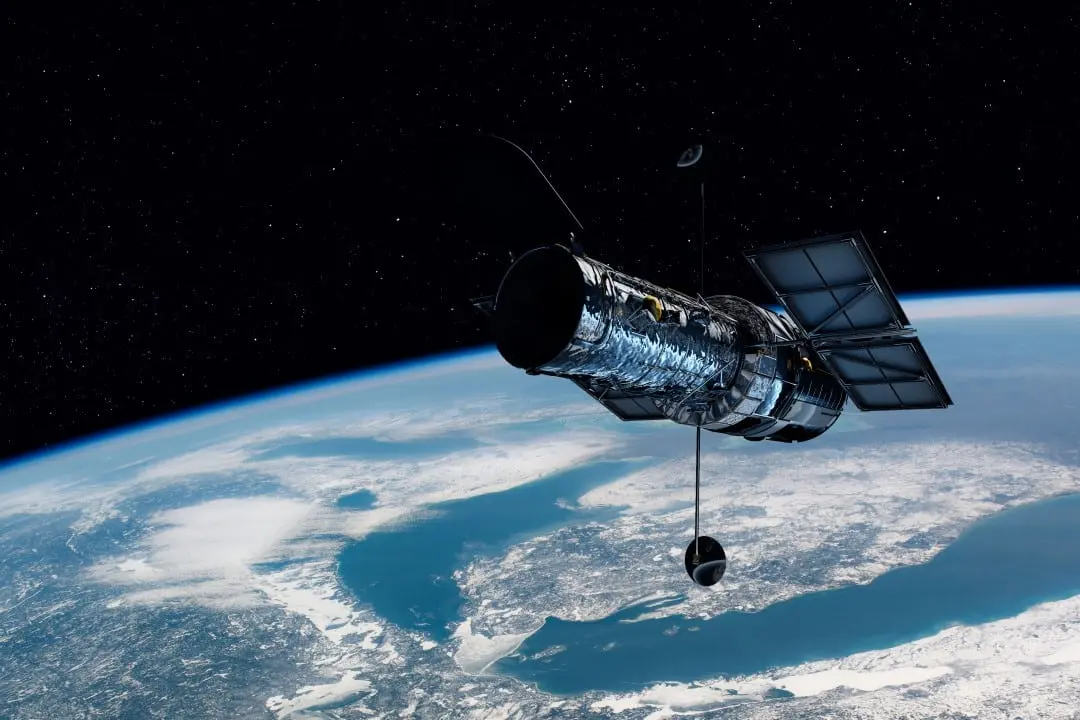
Hubble and JUICE reveal interstellar comet 3I/ATLAS in intense phase of gas and dust emission
Telescópio Espacial Hubble captured new images of the interstellar comet 3I/ATLAS on November 30, 2025, revealing a celestial body in a phase of intense activity. At the time, the object was 286 million kilometers away from Terra, offering a detailed view of its structure and behavior.
The observations were carried out with the Wide Field Camera 3 (WFC3), which highlighted a distinctly bluish coma with dark streaks in the center. Essas features indicate streams of gas being expelled from the comet’s nucleus, a phenomenon crucial to understanding its nature.
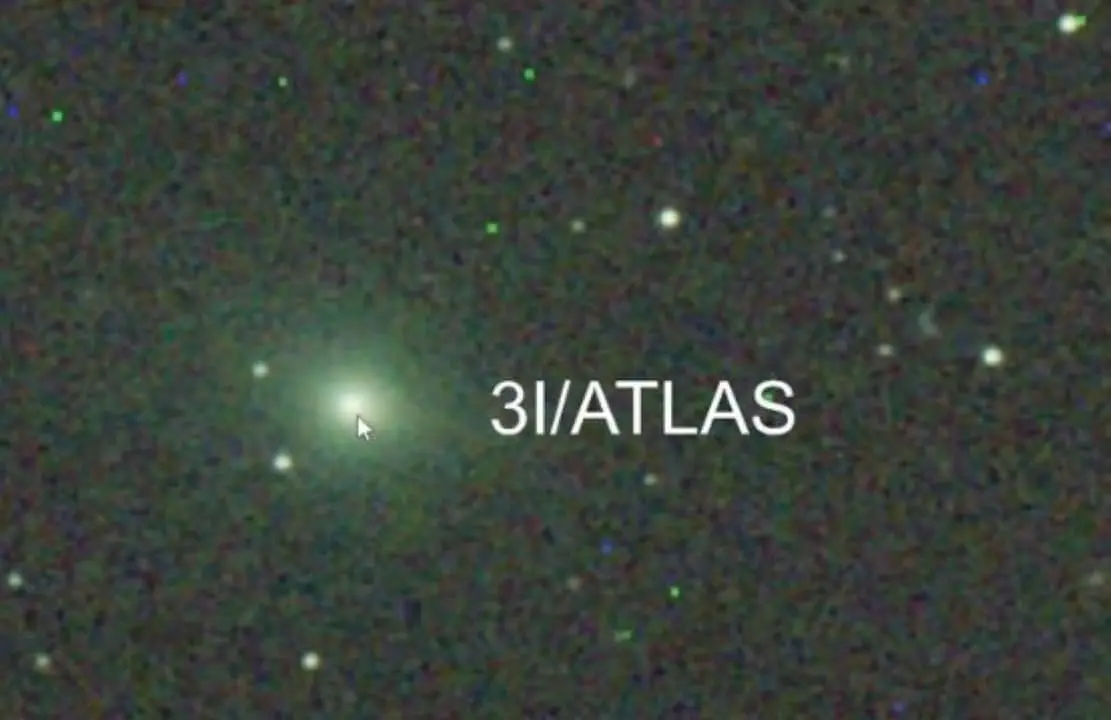
The initial detection of comet 3I/ATLAS occurred on July 1, 2025, by the ATLAS telescope on Chile, confirming it as the third interstellar object ever identified. Esta discovery is part of a collaborative effort between NASA and ESA, which seek to catalog and study visitors from other star systems.
[[_0]
Observations of Hubble and their importance
The images provided by Hubble on November 30, 2025 are crucial for analyzing the dynamics of comet 3I/ATLAS. Elas clearly showed the dark streaks in the bluish coma, which are direct evidence of the release of volatile material from the nucleus.
This intense activity, especially the gas ejection, suggests that the comet is undergoing a significant warming period. The comet’s proximity to Sol in October 2025 and its subsequent approach to Terra in December 2025 contribute to the intensification of these phenomena, making it an exceptional study target.
The JUICE probe and its discoveries
The Agência Espacial Europeia JUICE mission took its own images of the comet on November 2, 2025, from a distance of 66 million kilometers. Embora the probe’s NavCam is not optimized for comet science, it managed to record two distinct tails.
One of the tails was composed predominantly of gas, while the other was formed of dust, indicating different processes of sublimation and ejection of material. The data collected by JUICE’s five scientific instruments is being analyzed and the first results are expected in February 2026.
Records from other missions
Other NASA missions, such as PUNCH and STEREO, also observed comet 3I/ATLAS between September and October 2025. Essas observations complement the data from Hubble, revealing the evolution of the comet’s activity over a longer period.
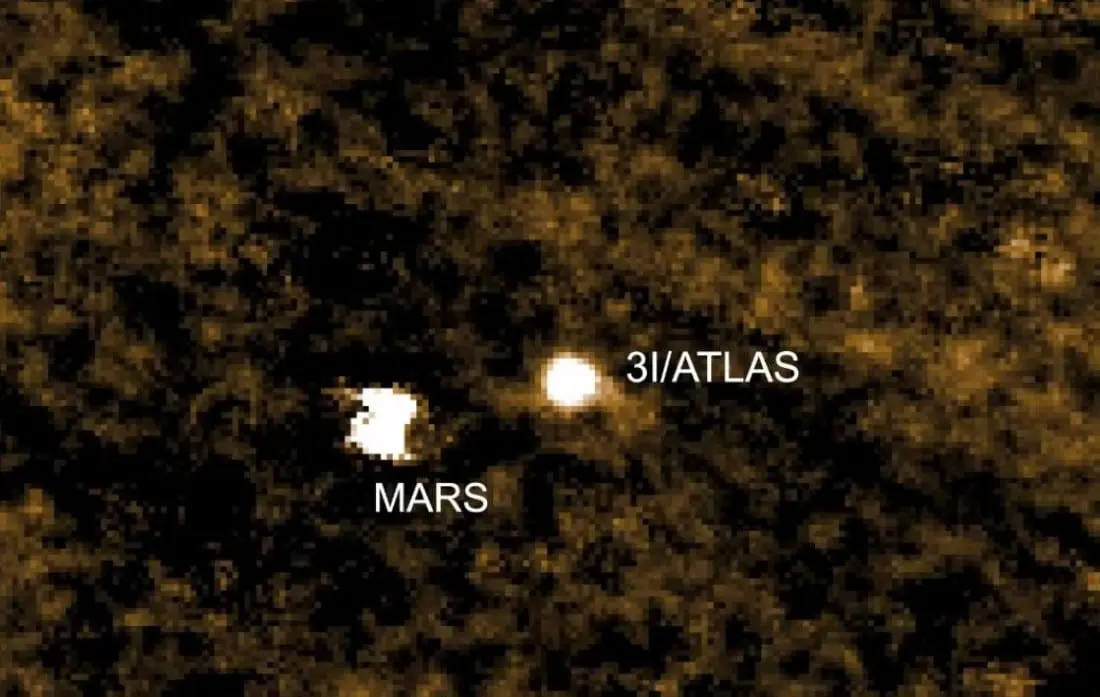
Records from these space missions indicated significant variations in the comet’s luminosity and dust ejection rate. The object’s proximity to Marte on October 3, 2025, at 290 million kilometers, allowed more detailed terrestrial observations to be carried out, enriching the data set.
Preliminary analyzes pointed to the expulsion of up to 60 kilograms of dust per second, a considerable volume for an object of its size. Este data reinforces the idea that 3I/ATLAS is a highly active comet, releasing large amounts of material along its path.
Chemical composition of 3I/ATLAS
Spectroscopic analysis of comet 3I/ATLAS revealed the presence of high levels of cyanogen and methanol, chemical compounds common in comets in our solar system. Esta chemical similarity suggests an origin from a planet-forming disk, albeit from a distinct star system.
The persistence of streaks in the coma, formed by dust, is an indication that the comet’s nucleus may be fragmented or undergoing fissure processes. Esse dynamical behavior offers valuable clues about the formation and evolution of interstellar objects.
The features observed in 3I/ATLAS challenge some assumptions about the composition and behavior of comets coming from outside our system. Sua activity and the presence of certain chemical elements make it a natural laboratory for astrophysics.
Visibility and current trajectory
Comet 3I/ATLAS continues its movement through space at a speed of approximately 30 kilometers per second, having already passed through the inner solar system. Sua maximum approach to Terra is scheduled for December 19, 2025, when it will be around 69 million kilometers away.
Although it is not expected to be visible to the naked eye, amateur astronomers will be able to observe it with suitable equipment. On December 6, the comet will have a magnitude of 11.5 in the constellations of Gêmeos and Órion, making it accessible to smaller telescopes.
Terrestrial observations of the comet should remain active until January 2026, allowing prolonged monitoring of its evolution. Esta extended observation window is crucial to collecting as much data as possible about this cosmic visitor.
Analysis of ground-based observatories
Images taken by the Gemini-North telescope, with its Subaru-Cam camera, between November 22 and 27, 2025, revealed complex details of the comet’s dust trails. Estas tracks are consistent with the hypothesis of a fragmenting nucleus.
Analysis of these ground-based observations confirmed that 3I/ATLAS is not a known object in our solar system, but rather an active interstellar comet. Research into this data continues to deepen our understanding of the interaction of external celestial bodies with the local environment.
Future research perspectives
Comet 3I/ATLAS offers a unique opportunity to model the ejection of dust from interstellar objects, providing unprecedented information. Data collection by international missions is underway, aiming to map its trajectory and composition.