International team of astronomers detects anomalous sound frequency in the collapse of distant supermassive star
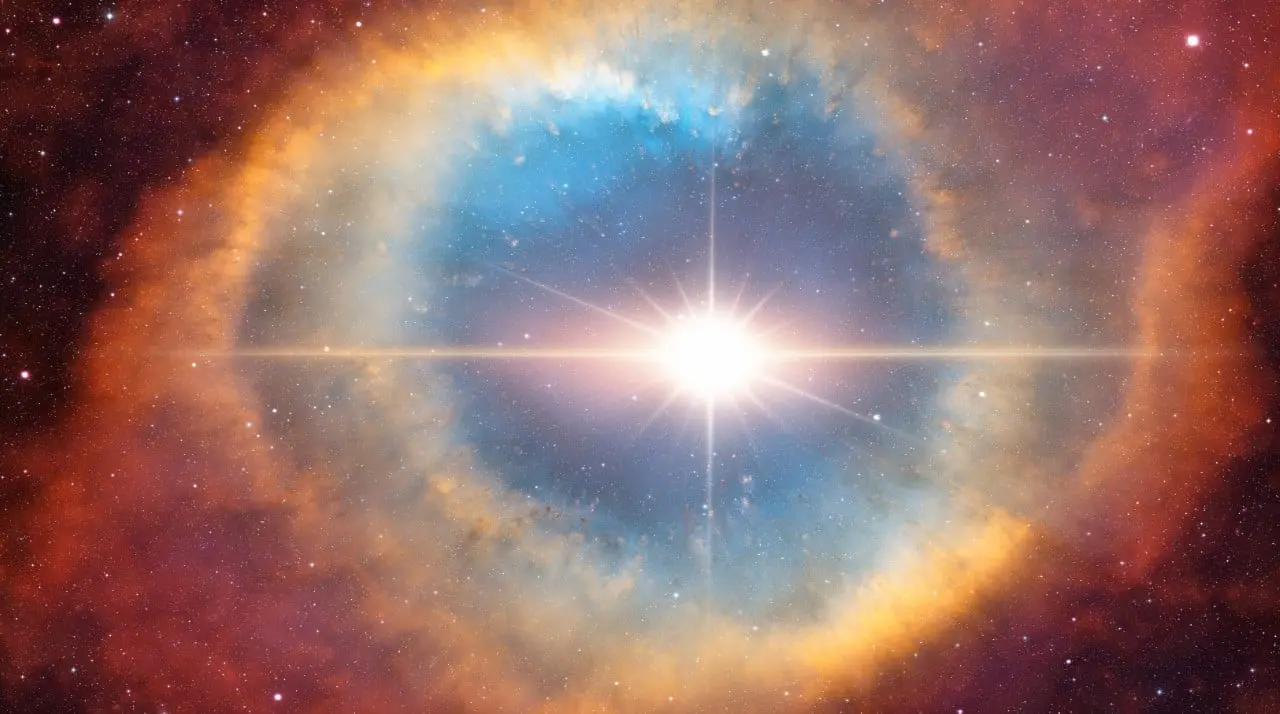
An international team of researchers has identified an acoustic anomaly, technically described as a rapid variation in frequency, originating from the explosion of a massive star located millions of light years from Terra. The phenomenon, captured by an integrated network of gravitational wave observatories and radio telescopes, represents a significant departure from established theoretical models for supernova dynamics. Detection of this specific signal requires a reassessment of the physical forces operating during the final stages of stellar evolution. The data collected indicates that the collapse of the stellar core harbors processes of extreme complexity, possibly involving resonances of nuclear matter under conditions of pressure and temperature unattainable in terrestrial laboratories. The multi-messenger approach adopted by scientists allowed for precise triangulation of the emitting source, validating the authenticity of the recording amid the vast background noise of the cosmos. Este isolated event provides an unprecedented empirical basis for studying the formation of compact objects such as neutron stars and black holes. Continuous analysis of this information sets a new benchmark for high-energy astrophysics. The scientific community is now directing its efforts to decode the internal structure of this anomalous emission.
The particularity of the record lies in its frequency curve and duration time, characteristics that do not align with standard mathematical predictions for electromagnetic emissions associated with cosmic explosions. Essa discrepancy suggests the occurrence of asymmetric instabilities at the exact moment of the implosion of the progenitor star’s core. Accurately identifying this pattern requires highly specialized filtering algorithms.
Processing the massive volume of astronomical data required months of calibration in the supercomputing systems of the institutions involved. The isolation of the unique signature of this event proves the effectiveness of new laser interferometry techniques applied to deep space observation.
Technical analysis of gravitational emission
High-energy physics uses extreme events in the universe to test the limits of general relativity and quantum mechanics on macroscopic scales. The rapid frequency variation detected acts as a direct marker of the structural changes that occur within the star during its final milliseconds. Experts point out that the colossal release of energy generates ripples in the fabric of space-time that travel at the speed of light until they reach terrestrial detectors.
Unlike traditional electromagnetic radiation, which can be blocked or dispersed by clouds of interstellar gas and dust, gravitational waves pass through matter without suffering significant degradation. Essa fundamental property allows observatories to record the behavior of the stellar core with unprecedented clarity. Decoding this specific signal provides exact metrics on the density and rotation rate of the collapsing material.
Stellar core dynamics
Three-dimensional hydrodynamic models are being updated to incorporate the new variables extracted from this recent observation. Simulating stellar collapse requires the integration of complex equations that describe the behavior of superdense fluids under extreme gravity.
The presence of the anomalous signal indicates that the transition from ordinary matter to degenerate states occurs in a turbulent and irregular manner. Essa internal turbulence generates the frequency fluctuations that were captured by the measuring instruments in the Terra.
The detailed study of these fluctuations helps to map the distribution of mass in the moments before the final explosion of the supernova. The data point to a pronounced asymmetry in the ejection of the star’s outer layers.
Black hole formation mechanisms
The transition from a supermassive star to a black hole constitutes one of the most violent and least understood processes in modern astrophysics. Quando the nuclear fuel runs out, the radiation pressure supporting the star abruptly ceases, allowing gravity to crush the core to a point of infinite density. The newly discovered signal acts as a direct observational probe of this critical moment of transition. Theorists suggest that the frequency variation corresponds to the oscillations of a newly formed event horizon or the vibration of a hypermassive neutron star that holds out for fractions of a second before collapsing completely. The precision of current data allows us to constrain the equations of state that govern nuclear matter, eliminating theoretical hypotheses that do not align with empirical observation. Continuing these measurements will establish a catalog of gravitational signatures essential for classifying future cosmic events.
Investigation of waves and frequencies
Searching for similar patterns in data files from previous observations has become a priority for astronomical data analysis teams. Reviewing old records may reveal that this type of emission occurs more frequently than initially estimated.
To optimize this search, new artificial intelligence protocols are being trained specifically to recognize the acoustic signature of collapsing stars. The automated classification system is based on the following operational parameters:
* Calibração of detectors for ultra-low and high frequencies.
* Sincronização of atomic clocks between different global observatories.
* Filtragem of seismic noise and local anthropogenic interference.
Implementing these technical guidelines exponentially increases the sensitivity of the observation network. The precision achieved makes it possible to distinguish between the merger of binary black holes and the isolated collapse of a single star.
Advanced Observation Instruments
The success of this detection is based on the infrastructure of observatories such as LIGO and Virgo, which operate with subatomic precision laser interferometers. Esses equipment measures distortions in space-time equivalent to a fraction of the diameter of a proton.
The engineering behind these detectors involves mirrors suspended in ultra-high vacuum and multi-stage seismic isolation systems. The maintenance and continuous improvement of these facilities ensures the ability to record cosmic events occurring billions of light years away.
Validation of astronomical data
Confirming a discovery of this magnitude requires independent corroboration by multiple research facilities around the world. Multi-messenger astronomy relies on rapid communication between observatories to point optical and X-ray telescopes at the same region of the sky.
Cross-referencing gravitational information with the electromagnetic spectrum provides a complete picture of the supernova explosion. Essa rigorous methodology eliminates the possibility of false positives and consolidates the integrity of the scientific method applied to astrophysics.
Expansion of the telescope network
The construction of new gravitational wave detectors at Ásia and the future implementation of space observatories will expand sky coverage and directional sensitivity. Integrating these new units into the existing global network will enable the near-instantaneous location of supernovae, facilitating the real-time study of high-energy physics in the universe.