Lagoon Nebula visible to the naked eye appears in detail by Hubble with structures sculpted by stars
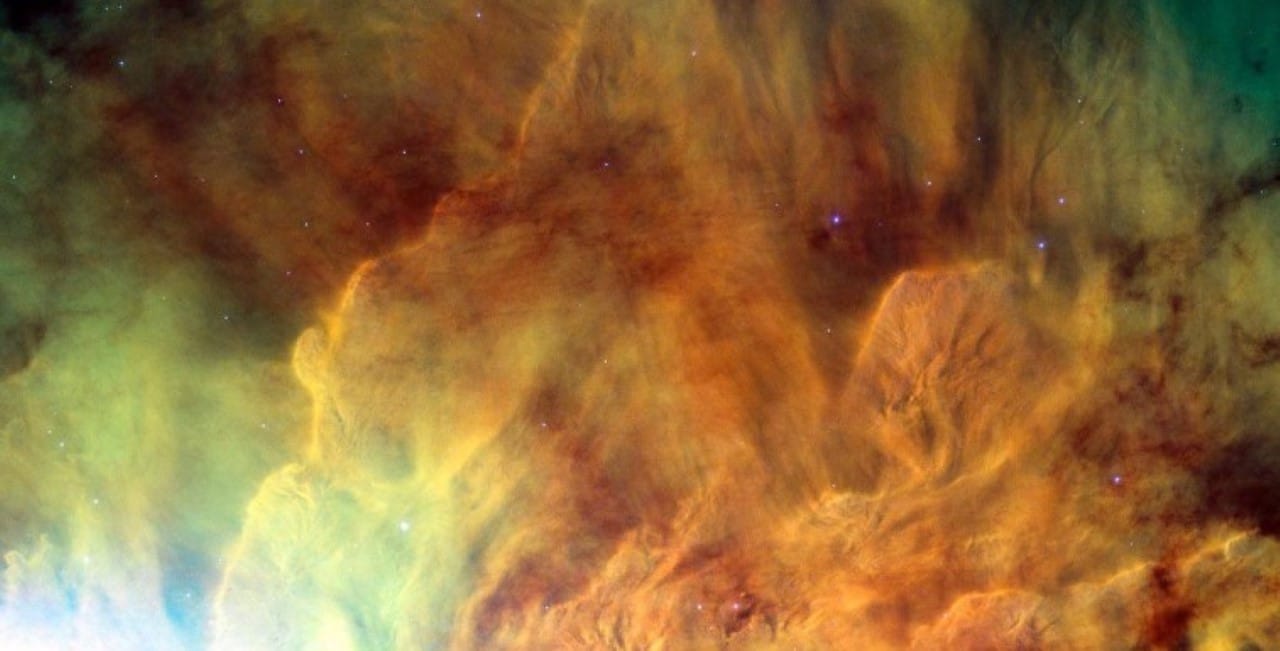
Nebulosa of Lagoa, also known as M8, was captured in an image enlarged by Câmera Avançada to Pesquisas of Telescópio Espacial Hubble. The photo highlights the central area of this emission nebula located in the constellation Sagitário. The estimated distance varies between 4,000 and 5,000 light years from Terra.
This nebula stands out for being visible to the naked eye on clear summer nights in Hemisfério Norte. Ela functions as a stellar cradle where young, massive stars ionize the surrounding gas with ultraviolet radiation. The result is the emission of light that makes the region bright.
- The image uses false colors to map specific elements.
- Hydrogen emission lines appear in red.
- Ionized nitrogen is represented in green.
- Visible light at a wavelength of 550 nm appears blue.
Wait for it…! Wavelength makes a big difference when looking at the Lagoon Nebula. Near-infrared light emitted by distant stars is able to pass through the dense clouds of the nebula to reach Hubble, revealing a very different scene. Credit: NASA, ESA, STScI.pic.twitter.com/t8wAvqpyFj
—Hubble Space Telescope (@HubbleTelescope)August 24, 2023
Technical details of capture by Hubble
Câmera Avançada to Pesquisas recorded the central region of Nebulosa from Lagoa with high resolution. The columnar structures and spiral shapes indicate erosion caused by intense radiation from newly formed stars. Esse process sculpts the surrounding gas and dust in a continuous manner.
Astronomers compare Nebulosa of Lagoa with Nebulosa of Órion, another star-forming region visible to the naked eye. Enquanto to Nebulosa of Órion measures approximately 24 light-years in diameter, Nebulosa of The difference in scale reinforces the massive nature of this nebula.
The activity inside contrasts with the calm name of “Lagoa”. Estrelas masses in the center release intense winds and radiation that disperse the surrounding material. The images show only a small fraction of the complete nebula, but they reveal the density of young stars in the central region.
Comparison with other known emission nebulae
Nebulosa and Lagoa share characteristics with other famous emission nebulae. Ambas, and Nebulosa of Órion, are nurseries where gas is ionized by hot, young stars. Essa ionization causes the material to emit its own light and become visible even at interstellar distances.
Observers at mid-latitudes of Hemisfério Norte locate Nebulosa and Lagoa in the summer night sky. Nebulosa of Órion, in turn, appears in winter. The two regions allow detailed studies of the star formation cycle in Via Láctea.
Images from ground-based telescopes, such as the one from Observatório Vera Rubin, show Nebulosa and Lagoa next to Nebulosa Trífida. Essas larger field captures contextualize the position of M8 within an area rich in star formation in the constellation of Sagitário.
Physical characteristics and dimensions of the nebula
Nebulosa from Lagoa encompasses an extensive region of gas and dust. Seu size greater than 100 light years allows astronomers to investigate large-scale star birth processes. Ultraviolet radiation from young stars shapes complex structures visible in Hubble images.
Massive stars within the nebula generate powerful stellar winds. Esses winds interact with the surrounding material and create cavities and columns of gas. The process represents a dynamic phase where the formation of new stars occurs continuously.
Research indicates that Nebulosa and Lagoa contain clusters of young stars. The interaction between these stars and the interstellar medium drives the evolution of the region over millions of years. Dados of multiple observations help map the distribution of chemical elements at the site.
Importance of observation at multiple wavelengths
The Hubble image combines different wavelengths to reveal hidden details. False color representation makes it easier to identify ionized hydrogen and other elements. Essa technique allows scientists to analyze the chemical composition of the nebula with precision.
Complementary observations from ground-based and space telescopes enrich the understanding of Nebulosa and Lagoa. The central region, densely populated with stars, serves as a natural laboratory for studying the impact of stellar radiation on the interstellar medium.
Astronomers continue to monitor similar areas on Via Láctea. Nebulosa from Lagoa provides opportunities to investigate how massive stars influence the life cycle of molecular gas and the formation of new stellar generations.
Structures sculpted by stellar radiation
The columns and spiral shapes in Nebulosa and Lagoa result from the erosive action of radiation. Estrelas young, hot people in the center of the region release energy that shapes the surrounding gas. The Esse phenomenon creates complex cosmic landscapes captured in high resolution by the Hubble.
The presence of dark dust contrasts with the bright areas of emission. Essa combination reveals the internal dynamics of the nebula, where processes of creation and dispersion of material occur simultaneously. The images highlight the intensity of stellar activity in the heart of M8.
Detailed studies of the central region contribute to star formation models. Nebulosa from Lagoa demonstrates how giant molecular clouds form into star clusters over time.
Capture by Telescópio Espacial Hubble continues to provide valuable data about Nebulosa from Lagoa. The enlarged image of the central area reveals details that complement previous observations and encourage new analyzes of stellar nurseries in Via Láctea.