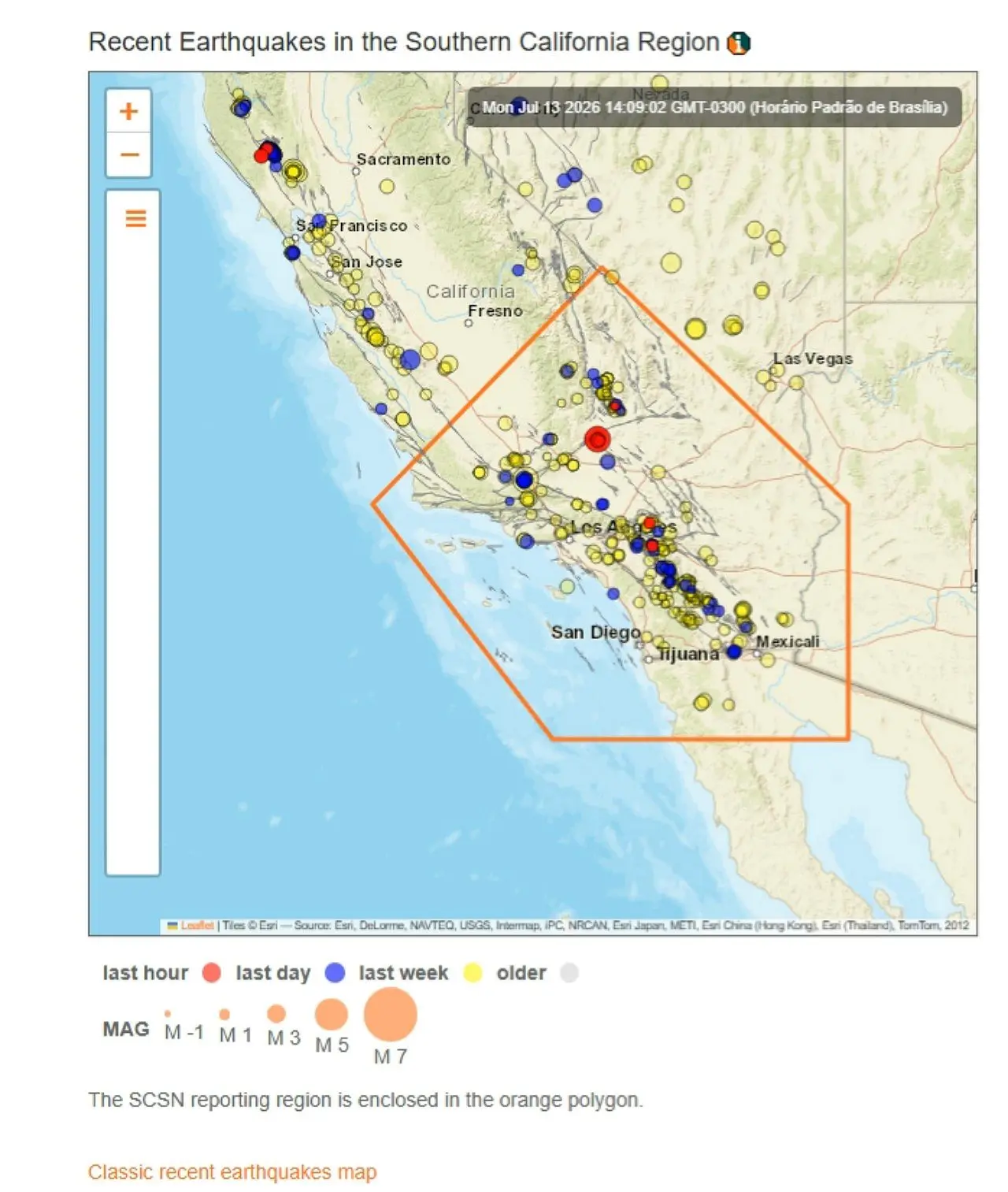
California records earthquake now measuring 4.3 magnitude near Los Angeles on Monday

An earthquake of magnitude 4.3 was recorded on Monday, July 13, 2026, in California, United States. The epicenter of the earthquake was located approximately 26 kilometers from California City, with the event occurring at 1:40 pm local California time. The seismic activity was reported by the U.S. Geological Survey (USGS) and monitored by the Southern California Earthquake Data Center (SCEDC), generating attention in the metropolitan region of Los Angeles, where the shaking could be noticed by many residents.
Understand the frequent seismic activity in the region
The Southern California region is known worldwide for its intense seismic activity, the result of the complex interaction of several geological faults, including the famous San Andreas Fault. Tremors of different magnitudes are common, with specialized agencies carrying out continuous monitoring to record and analyze each event. This frequency of earthquakes is an inherent geographic aspect of the location, requiring constant vigilance and preparation.
Records of minor tremors in a week
Over the past seven days, from July 6 to July 13, 2026, south-central California and Nevada have recorded a series of lower-intensity tremors. The data collected shows dozens of earthquakes with magnitudes ranging from 0.5 to 2.2. Places such as Redlands, Loma Linda, Corona, Glendale and Mojave have had multiple events, highlighting the daily geological instability in the area. These small tremors are part of the region’s seismological routine.
Constant monitoring by specialized agencies
Monitoring these phenomena is an ongoing task, being led by institutions such as the U.S. Geological Survey (USGS) and the Southern California Earthquake Data Center (SCEDC). These entities are responsible for collecting and disseminating detailed information about earthquakes, including location, depth and magnitude. It is important to note that official reports on new tremors may be delayed due to the complexity of data analysis.
Importance of preparation in seismic zones
In regions like California, where the occurrence of earthquakes is a constant reality, preparing the population and infrastructure is essential. Safety measures, such as evacuation plans, constructing buildings with anti-seismic standards and disseminating information on how to act during and after an earthquake, are crucial to minimizing risks and protecting lives. The readiness of communities is an essential pillar for coexisting with local geological dynamics.