

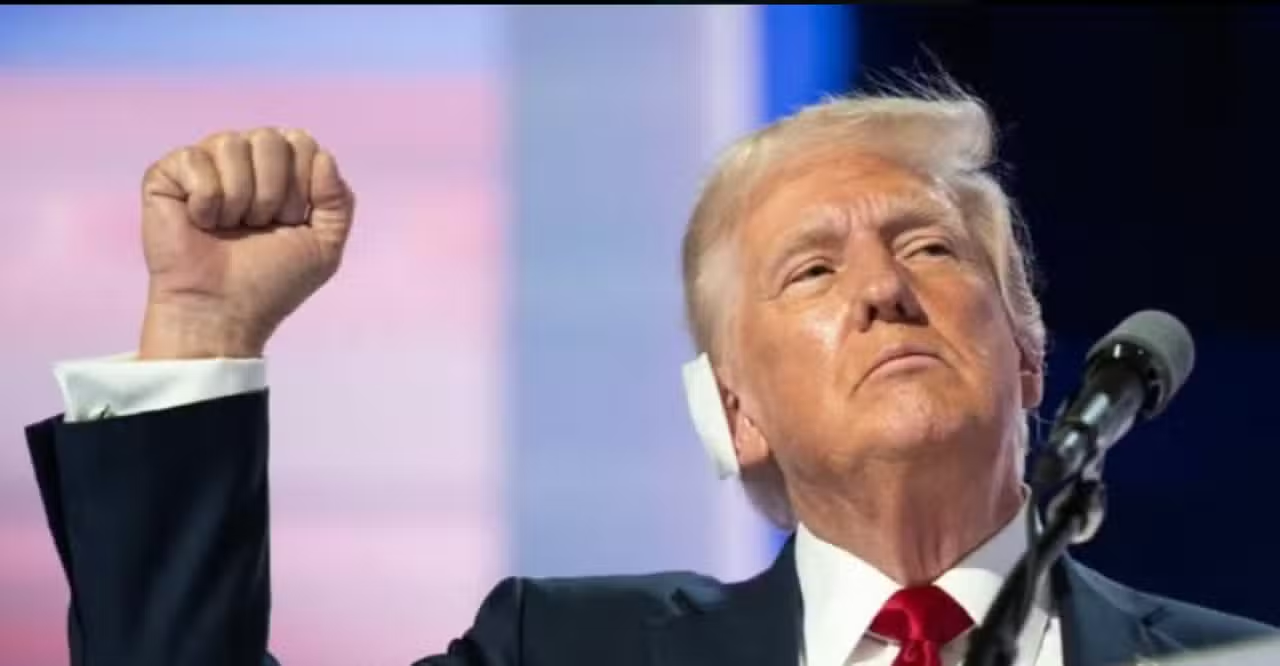
On the night of March 4, 2025, President Donald Trump took the stage at the U.S. Capitol in Washington for his first address of his second term, a speech marked by political tension and bold promises, including a proposal to designate English as the official language of the United States. Before a joint session packed with lawmakers, Supreme Court justices, and special guests, Trump championed the move as part of his vision to “unify the nation” and strengthen American identity, arguing that linguistic diversity hampers social cohesion and government efficiency. Broadcast live, the address drew fervent applause from Republicans and protests from Democrats, reflecting the polarization defining his administration, as he outlined a plan that could affect over 67 million speakers of other languages nationwide, according to recent census data. The proposal, requiring congressional approval, reignited debates over immigration, education, and cultural rights in a historically multicultural country.
The push to make English the official language, though not new, emerged as a priority six weeks into Trump’s second term, following his January 2025 inauguration. He tied the measure to broader policies like Elon Musk-led spending cuts and mass deportations, claiming it would save an estimated $2 billion annually in translation and multilingual services. In the gallery, First Lady Melania Trump, a Slovenian-born polyglot fluent in five languages, watched alongside figures like Musk, while the chamber saw disruptions, including Representative Al Green’s ejection for shouting against the president. The plan has already galvanized supporters who see it as a defense of American culture and critics fearing the exclusion of immigrant communities, such as the 25 million Spanish speakers across the U.S.
Trump’s speech unfolded under global scrutiny, with world leaders tuning in for cues on foreign policy and economic direction. He framed English as the official language as a step to “make America great again,” asserting that 80% of Americans back the idea, though recent polls peg support closer to 65%. As Republicans like Marjorie Taylor Greene cheered, Democrats brandished protest signs, spotlighting potential impacts in states like California and Texas, where over 30% of residents speak another language at home. If passed, the measure could reshape everything from official documents to public education, reviving a decades-long debate in American history.
Roots of the push: English as a unifying symbol
Trump stepped into the chamber at 9 p.m. EST to thunderous Republican applause, but the mood shifted as Democrats sat silently, with House Minority Leader Hakeem Jeffries notably absent from the traditional escort committee. Three minutes in, as he touted his sweep of seven swing states and the popular vote in November 2024, Trump introduced the English-only proposal, linking it to his narrative of a mandate for a unified America.
The concept traces back to the 1980s, when conservative groups pressed for an official language to curb growing immigrant populations. In the U.S., 21% of 330 million people speak another language at home, with Spanish leading at 13%, followed by Chinese at 1% and French at 0.6%. Trump argued that multilingual services cost $2 billion yearly, pointing to courtroom translations and healthcare as examples of “waste” he aims to eliminate.
Instant backlash: chaos erupts during the speech
The proposal met immediate resistance, with Representative Al Green of Texas interrupting by shouting, “You don’t have a mandate!”—sparking chaos that ended with his removal by order of House Speaker Mike Johnson. Republicans like Marjorie Taylor Greene and Nancy Mace countered with “USA” chants, while Vice President JD Vance, presiding over the Senate, reinforced decorum, showcasing GOP solidarity behind Trump’s plan.
Potential fallout: education and services at stake
Trump’s English-only proposal could overhaul key sectors. In education, where 10% of 50 million public school students are English learners, states like California (1.4 million) and Texas (1 million) would face major shifts, with bilingual programs costing $1 billion annually potentially axed. In public services, federal documents, currently offered in 20 languages, would be English-only, impacting 5 million immigrants reliant on translations in hospitals and courts.
Democrats warn that 15% of essential workers—like nurses and firefighters—speak another primary language, and the policy could hinder emergency communication. Republicans, however, see linguistic unification as a boost to assimilation, with 65% of Americans supporting an official language in a 2024 survey, though 30% oppose it over inclusion concerns.
Debate timeline: key moments in Trump’s proposal
The push for English as the official language has evolved over time. Here are the major milestones:
- 1981: First formal proposal in Congress to make English official.
- 2016: Trump backs the idea during his campaign but doesn’t pursue it in his first term.
- March 4, 2025: Trump relaunches the proposal in his congressional address.
- March 5, 2025: Republicans plan to introduce legislation.
This timeline traces how the issue rose to prominence under Trump’s leadership.
Trump’s case: unity and cost savings in focus
Trump framed the measure as vital for national identity, stating, “One language unites a people” while slashing administrative costs. He cited judicial translations, costing $500 million yearly, and multilingual healthcare services, at $800 million, vowing to redirect those funds to security and infrastructure. In the speech, he overstated public support at 80%, against the 65% from recent polls, amplifying his pitch for unity.
The proposal aligns with his broader agenda, including $9 billion in cuts led by Elon Musk’s DOGE and deportations projected at $20 billion annually, reinforcing his efficiency and “America First” narrative. In the gallery, Musk and Melania Trump symbolized this vision’s backing, while Supreme Court justices watched stoically.
Democratic defiance: diversity under fire
Opposition flared beyond Green’s ejection, with over a dozen House Democrats, including Pramila Jayapal and Joaquin Castro, raising signs reading “FALSE” and “SAVE DIVERSITY,” while women lawmakers donned pink in protest. In Texas, where 35% of 29 million residents speak Spanish, local leaders estimate 500,000 students could lose bilingual education access, and in California, 40% of the population might face barriers to essential services.
Elizabeth Warren brought an immigrant guest to spotlight the 5 million reliant on translations, while signs like “NO KING” decried a cultural rollback. The pushback reflects fears for the 67 million speakers of other languages—20% of the U.S. population—per the 2020 census.
Global echoes: policy ripples abroad
World leaders tuned in, noting the proposal’s impact on the U.S.’s multicultural image. Nations like Canada (20% Francophone) and Mexico (92% Spanish-speaking) view it as a sign of closure, while European allies worry about trade deals requiring multilingual communication, worth $1 trillion yearly. The WHO exit, already enacted, saved $500 million, but linguistic unification could strain global health and education partnerships.
Domestically, Trump tied the policy to deportations, suggesting immigrants must assimilate or leave—a stance that’s expelled 50,000 since January. The move also aligns with his rapport with leaders like Vladimir Putin, bolstering a nationalist vision that unsettles NATO allies.
Practical shifts: what English-only could mean
If enacted, the law would affect:
- Official documents: End to translations in 20 languages, saving $300 million yearly.
- Education: $1 billion cut from bilingual programs for 5 million students.
- Healthcare: $800 million reduction in multilingual services, impacting 3 million patients.
- Workforce: Barriers for 15% of 10 million essential workers not fluent in English.
These changes would hit diverse states like New York (30% speak another language) and Florida (25%) hardest.
Road ahead: challenges and next steps
The proposal faces a divided Congress, with Republicans holding slim majorities—221-214 in the House and 53-47 in the Senate—but needing 60 Senate votes to overcome Democratic filibusters. Legislation is slated for introduction on March 5, spearheaded by allies like Mike Johnson, while opponents vow resistance, citing the 25 million Spanish speakers and 5 million bilingual students. California’s governor has signaled legal action if it passes, alleging state rights violations. With 65% American support but 30% opposition, Trump’s English-only bid could reshape national identity, though the legislative fight promises to be protracted and fierce.