Pope John Paul II: how the pilgrim marked history with his travels and defense of the family

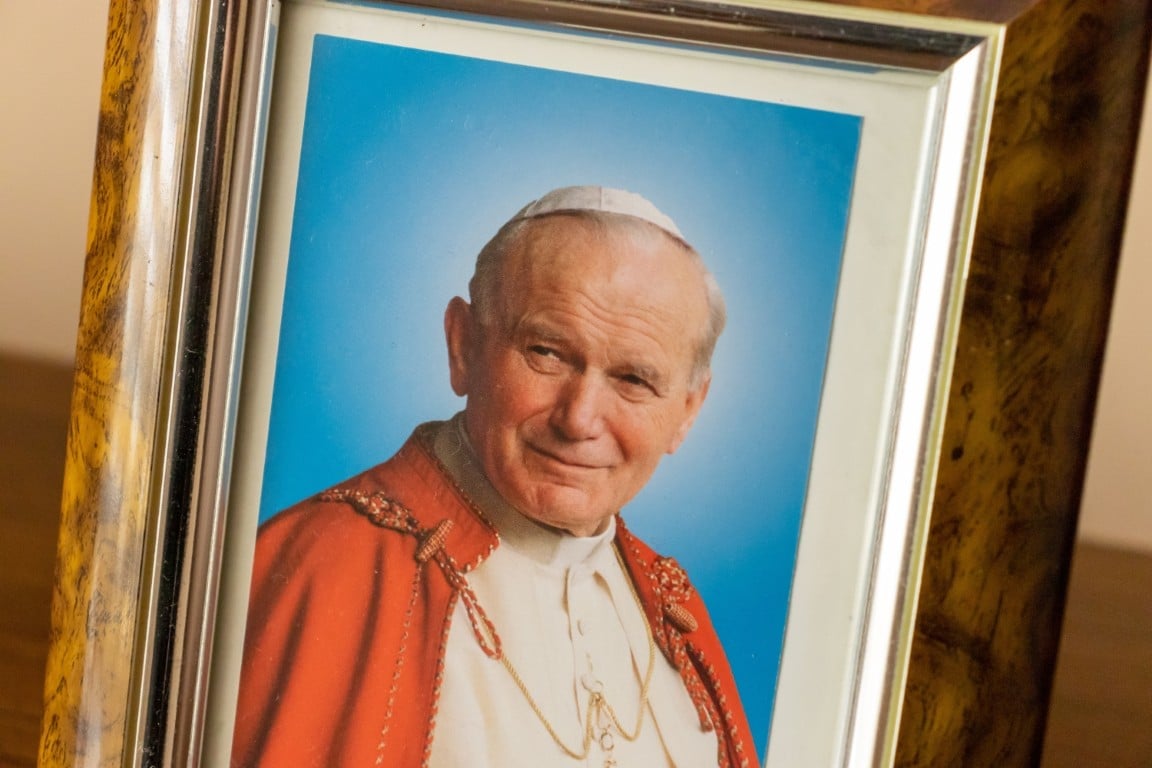
Karol Józef Wojtyła, known worldwide as Saint John Paul II, was born on May 18, 1920, in Wadowice, Poland, and became one of the most influential leaders of the 20th century. Elected pope on October 16, 1978, he was the first non-Italian pontiff in 455 years and the first Pole in history. His 26-year, 5-month, and 17-day pontificate is the third longest in the Catholic Church, surpassed only by Saint Peter and Pius IX. During his papacy, John Paul II visited 129 countries, promoted interfaith dialogue, fought communism, and defended human dignity. Under the motto “Totus Tuus” (Totally Yours, Mary), he led the Church with a blend of charisma, spirituality, and resolve, tackling challenges like the Cold War, secularization, and the rise of materialism. His death on April 2, 2005, marked the end of an era, but his legacy endures, with his canonization in 2014 by Pope Francis.
John Paul II’s journey began in a Poland scarred by conflict and occupation. The son of Karol Wojtyła, an army officer, and Emilia Kaczorowska, he lost his mother at 9, his brother at 12, and his father at 21, facing solitude early in life. During World War II, he worked in a quarry and a chemical factory to avoid deportation by the Nazis while studying in a clandestine seminary. His priestly vocation, inspired by his father’s faith, flourished amid adversity, leading to his ordination as a priest in 1946.
Wojtyła’s rise in the Church was swift. Appointed auxiliary bishop of Krakow in 1958, archbishop in 1964, and cardinal in 1967, he actively participated in the Second Vatican Council, contributing to the drafting of the constitution Gaudium et Spes. His election as pope at 58 surprised the world, breaking the tradition of Italian popes and bringing new energy to the Church. His papacy was marked by bold gestures, such as forgiving the gunman who attempted to assassinate him in 1981 and creating the World Youth Days, which mobilized millions of young people.
Milestones of the pontificate
John Paul II led the Church during a period of global transformation. His influence extended beyond the Vatican, shaping historical events and ethical debates. Key contributions include:
- Fall of communism: Supported Poland’s Solidarity movement, contributing to the end of the communist regime in 1989.
- Interfaith dialogue: Became the first pope to visit a synagogue and a mosque, promoting peace among religions.
- Defense of life: Reaffirmed Catholic doctrine against abortion, euthanasia, and birth control with encyclicals like Evangelium Vitae.
- Youth engagement: Created the World Youth Days, gathering millions of young people in events like Manila in 1995, with 5 million attendees.
Youth marked by loss and resistance
Karol Wojtyła grew up in a deeply Catholic Poland under constant threat from neighboring powers. His childhood was shaken by the early death of his mother, Emilia, in 1929, due to health issues after a high-risk pregnancy. Three years later, his brother Edmund, a doctor, died of scarlet fever while treating patients during an epidemic. The loss of his father in 1941 left Karol, at 21, as the last surviving member of his family. He described this phase as a time of deep reflection: “By 20, I had already lost everyone I loved.”
The Nazi invasion of Poland in 1939 brought new challenges. The Jagiellonian University, where Karol studied Polish philology, was shut down, and many professors were deported to concentration camps. To survive, he worked in a quarry and the Solvay chemical factory, securing a document that protected him from deportation. Concurrently, he engaged with the clandestine Rhapsodic Theater, using art as a form of cultural resistance against the occupation. His decision to enter the seminary in 1942 was influenced by Archbishop Adam Stefan Sapieha, who recognized his exceptional spiritual potential.
During these years, Karol developed a love for literature and philosophy. He published poetry and plays under pseudonyms like Andrzej Jawień, separating his artistic work from his theological writings. His intellectual formation, coupled with resilience in the face of hardship, shaped the leader who would later become a global symbol of hope and resistance.
Rise in the Church and the Second Vatican Council
Ordained a priest on November 1, 1946, Karol Wojtyła quickly stood out for his intelligence and charisma. After earning a doctorate in theology in Rome, he returned to Poland in 1948, serving as an assistant pastor in Niegowić and later as a university chaplain in Krakow. He taught ethics at the Jagiellonian University and the Catholic University of Lublin, gathering young people in prayer and reflection groups called Rodzinka (little family). These activities, which included hiking, skiing, and kayaking, strengthened his bond with youth, a hallmark of his papacy.
In 1958, at 38, he was named auxiliary bishop of Krakow, becoming the youngest member of the Polish episcopate. His promotion to archbishop in 1964 and cardinal in 1967 solidified his influence. During the Second Vatican Council (1962-1965), Wojtyła contributed to the Church’s modernization, advocating for religious freedom and dialogue with the contemporary world. His role in drafting Gaudium et Spes highlighted his vision of a Church engaged with modern social and ethical challenges.
His experience under Poland’s communist regime shaped his firm stance against oppression. As archbishop, he faced government restrictions, promoting church construction and lay formation. His ability to blend theology, pastoral care, and political resistance made him an unexpected but ideal candidate for the papacy after the death of John Paul I in 1978.
Surprising election and early papacy
Karol Wojtyła’s election as pope on October 16, 1978, was a historic milestone. After the death of Paul VI and the brief 33-day pontificate of John Paul I, the conclave faced divisions between Cardinals Giuseppe Siri, a conservative, and Giovanni Benelli, a progressive. Wojtyła, proposed by Cardinal Franz König as a consensus candidate, won on the eighth ballot with 99 of 111 votes. At 58, he became one of the youngest popes in history, taking the name John Paul II in honor of his predecessors.
At his inaugural Mass on October 22, he broke protocol by forgoing the traditional coronation, opting for a simple investiture. His gesture of embracing Cardinal Stefan Wyszyński, Poland’s primate, instead of allowing a ring-kiss, symbolized his humility. In his first address, he urged: “Do not be afraid! Open wide the doors to Christ!” These words, spoken in a world divided by the Cold War, resonated as a call to hope and freedom.
The early months of his papacy were intense. In 1979, John Paul II made his first trip to Poland, drawing crowds of up to 300,000. His presence galvanized resistance to communism, inspiring the formation of the Solidarity movement led by Lech Wałęsa. The visit, which the communist government tried to control, became a turning point, demonstrating his spiritual and political influence.
The 1981 assassination attempt and forgiveness
On May 13, 1981, John Paul II was the target of an assassination attempt in St. Peter’s Square. While greeting the faithful in an open car, he was shot by Mehmet Ali Agça, a Turkish gunman linked to the extremist group Gray Wolves. Two bullets hit his abdomen, and he underwent five hours of surgery, wearing a scapular of Our Lady of Mount Carmel during the procedure. The pope attributed his survival to the intercession of Our Lady of Fatima, as the attack occurred on her feast day.
After recovering, John Paul II visited Agça in prison in 1983, forgiving him in a gesture that stunned the world. The bullet that struck him was placed in the crown of the Fatima statue in Portugal as a sign of gratitude. A second attempt in 1982 in Fatima, when a Spanish priest tried to stab him, was thwarted. These events reinforced the pope’s image as a resilient leader willing to face danger for his mission.
Suspicions of communist government involvement, such as Bulgaria’s, in the 1981 attempt were never confirmed. However, John Paul II’s collaboration with Western intelligence, including the CIA, was documented. He provided information on Polish resistance and received strategic data, such as satellite photos, aiding pressure against the Soviet bloc.
Milestones in the fight against communism
John Paul II’s role in the fall of communism is widely acknowledged. His discreet alliance with leaders like Ronald Reagan and Margaret Thatcher was strategic. During the 1980s, he met at least 15 times with CIA representatives, sharing information gathered by Poland’s network of bishops and priests. His 1979 Poland trip weakened the communist regime, which feared popular uprisings.
In 1989, Poland’s elections saw a landslide victory for Solidarity, which won 261 of 262 senate seats. Two months later, the communist government collapsed, sparking democratization across Eastern Europe. Dictator Wojciech Jaruzelski attributed the defeat to the Church, saying: “The Church is to blame.” The fall of the Berlin Wall that year symbolized communism’s collapse, a process in which John Paul II played a central role.
- Poland visits: Made nine trips to the country, mobilizing millions of faithful.
- Solidarity support: Encouraged Lech Wałęsa and other movement leaders.
- Secret diplomacy: Collaborated with the U.S. to destabilize communist regimes.
- Freedom message: His homilies inspired nonviolent resistance.
Interfaith dialogue and ecumenism
John Paul II pioneered dialogue among religions. In 1986, he organized the Assisi Meeting, gathering Christian, Jewish, Muslim, Buddhist, and Hindu leaders to pray for peace. He was the first pope to visit a synagogue in Rome in 1986 and a mosque in Damascus in 2001. These gestures broke centuries of mistrust, fostering peaceful coexistence.
His outreach to the Orthodox Church and Anglicanism aimed to bridge historical divides, though it faced resistance. In 2000, during the Great Jubilee, he sought forgiveness for the Church’s past errors, like the Crusades and Inquisition, acknowledging historical intolerance. This act, controversial among conservatives, bolstered his image as a leader willing to confront the past to build a future of dialogue.
The pope also condemned antisemitism and strengthened ties with Judaism. His 2000 visit to Israel included a prayer at the Western Wall, a historic gesture of respect. These initiatives, paired with his critiques of violence and materialism, cemented his influence as a global advocate for peace.
Defense of family and life
John Paul II’s vision of the family as a “sanctuary of life” was central to his teachings. His encyclicals, such as Laborem Exercens (1981), Centesimus Annus (1991), and Evangelium Vitae (1995), reaffirmed Catholic doctrine against abortion, euthanasia, and artificial contraception. He developed the Theology of the Body, a series of catecheses exploring human sexuality in light of faith, emphasizing love and responsibility in marriage.
In 1994, he established the World Meetings of Families, with the second edition held in Rio de Janeiro in 1997. His opposition to women’s ordination and priests’ political involvement drew criticism from progressives, but he defended tradition as essential to the Church’s identity. His stance against Liberation Theology, which he saw as Marxist-influenced, particularly in Latin America, was also firm.
Despite controversies, John Paul II earned admiration for his consistency. His 14 encyclicals, 15 apostolic exhortations, 11 apostolic constitutions, and 45 apostolic letters form one of the largest doctrinal bodies of any pope, addressing topics like work, social justice, and human dignity.
World Youth Days
John Paul II’s connection with youth was a defining feature of his papacy. In 1985, he created the World Youth Days (WYD), a biennial event that gathered millions of young people in cities like Rome, Manila, and Rio de Janeiro. The 1995 edition in the Philippines drew 5 million people, the largest human gathering ever recorded at the time.
The WYDs combined liturgical celebrations, catecheses, and cultural encounters, strengthening participants’ faith. John Paul II, dubbed the “pope of youth,” inspired with his energy and closeness, even in his later years when weakened by Parkinson’s. In 2013, the Rio de Janeiro WYD drew 3 million people, showing the enduring impact of his initiative.
- First WYD: Held in Rome in 1985 with 300,000 youth.
- Largest event: Manila, 1995, with 5 million attendees.
- Legacy: WYDs continue to attract millions, as in Lisbon, 2023.
- Message: “Do not be afraid to be saints,” repeated at multiple events.
Battle with Parkinson’s and final years
In the 1990s, John Paul II began showing signs of Parkinson’s disease, which affected his speech and mobility. Despite his frailty, he refused to step down, viewing his suffering as an offering to God. In 2005, his health deteriorated rapidly. After a urinary infection and respiratory complications, he died on April 2 at 9:37 p.m. in the Apostolic Palace, on the eve of Divine Mercy Sunday, which he had instituted.
His funeral on April 8 drew over 3 million pilgrims to Rome and 200 world leaders. The crowd in St. Peter’s Square chanted “Santo Subito!” (Saint Immediately), calling for his canonization. On April 28, Benedict XVI opened the beatification process, waiving the usual five-year wait. The miraculous cure of a French nun with Parkinson’s was attributed to his intercession, leading to his beatification on May 1, 2011.
His canonization on April 27, 2014, led by Francis, declared him Saint John Paul II. His liturgical memorial is celebrated on October 22, the day of his papal investiture. The process, one of the fastest in modern history, reflected global devotion to the “pilgrim pope.”
Pontificate timeline
John Paul II’s papacy was marked by events that shaped the Church and the world. Below is a summary of key dates:
- October 16, 1978: Elected pope.
- May 13, 1981: Assassination attempt in St. Peter’s Square.
- 1985: First World Youth Day in Rome.
- 1989: Fall of communism in Poland.
- 2000: Great Jubilee and apology for Church errors.
- April 2, 2005: Death in the Vatican.
- April 27, 2014: Canonization by Francis.
Enduring legacy
John Paul II’s impact transcends religion. His 104 apostolic journeys, covering 1.1 million kilometers, brought the Gospel to every continent. In Brazil, he visited four times (1980, 1991, 1997, and 2000), drawing crowds in cities like Rio de Janeiro, São Paulo, and Recife. His habit of kissing the ground upon arrival in each country became a symbol of respect and blessing.
The creation of the Catechism of the Catholic Church in 1992 and the reform of the Code of Canon Law in 1983 modernized the Church’s structure. He appointed 231 cardinals, beatified 1,338 people, and canonized 482 saints, more than all previous popes combined. His emphasis on holiness as a universal calling inspired generations, especially youth, to live their faith boldly.
Despite criticism for his conservative stance on issues like homosexuality and celibacy, John Paul II was admired for his consistency and dedication. His public battle with Parkinson’s showed the dignity of suffering, while his devotion to Mary, expressed in the motto “Totus Tuus,” underscored his Marian spirituality.
Curiosities about Saint John Paul II
John Paul II’s life is filled with facts revealing his humanity and sanctity. Some highlights include:
- Polyglot: Spoke 11 languages fluently, including Latin, Polish, Italian, and Portuguese.
- Athlete: Enjoyed skiing, kayaking, and hiking in his youth.
- Artist: Wrote poetry and plays under pseudonyms.
- First pope in parliament: Visited the Italian parliament in 2002, a first in 150 years.
Global influence and memory
John Paul II’s global presence was unmatched. His critiques of materialism and political oppression resonated in nations under authoritarian regimes. He mediated conflicts, like the Argentina-Chile dispute in the 1980s, and condemned wars, such as the Gulf War in 1991. His 1995 Philippines visit drew the largest crowd in history at 5 million, surpassed only by Francis in 2015.
In the social sphere, his encyclical Centesimus Annus analyzed capitalism and socialism, advocating an ethical economy. He also championed social justice, condemning poverty and inequality. His cultural influence endures in initiatives like the WYDs and World Meetings of Families, which continue to draw millions.
Poland, his homeland, preserves his memory in museums, like in Wadowice, and shrines, like Częstochowa. In the Vatican, his canonization solidified his place as one of the most beloved saints of the modern era. His message of “do not be afraid” continues to inspire Catholics and non-Catholics, echoing as a call to courage and faith.