
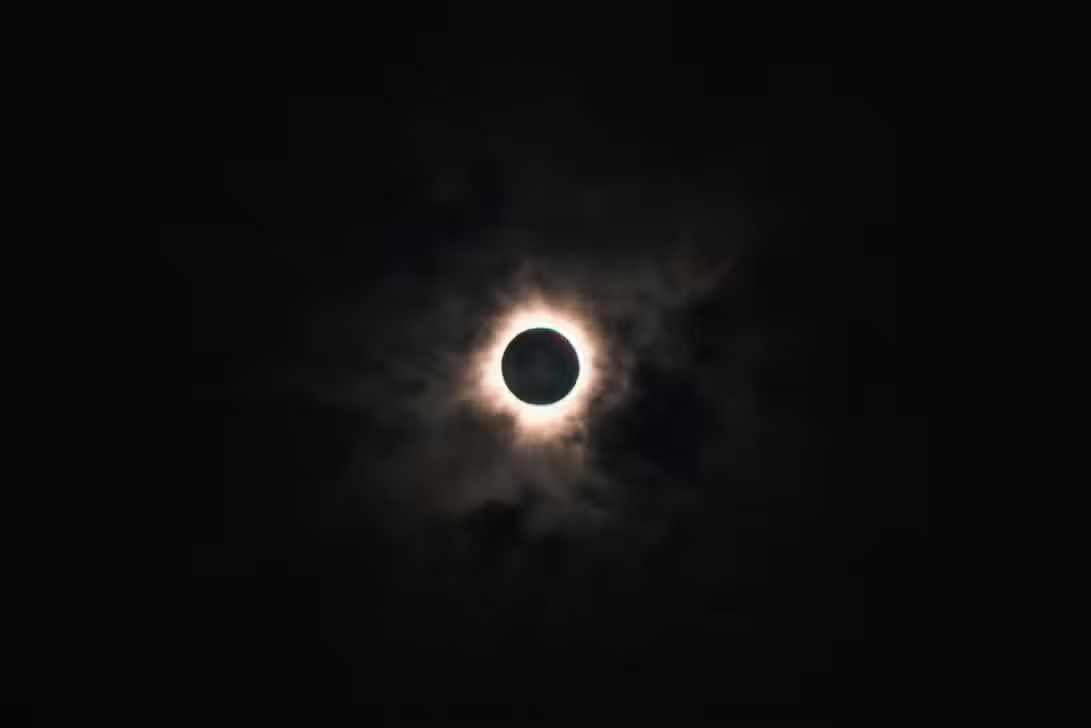
On August 23, 2025, the night sky will host an unusual astronomical event known as a Black Moon, a phenomenon that, while invisible to the naked eye, captivates due to its rarity. Occurring at 2:06 a.m. Brasília time, the new moon will be positioned in the constellation Leo, just one degree north of the sun, making it undetectable due to its proximity to sunlight. This event, classified as a seasonal Black Moon, is the third new moon in a season that exceptionally contains four new moons, something that happens only every 33 months. The last seasonal Black Moon was recorded on May 19, 2023. The moon’s invisibility provides dark nights ideal for observing stars and fainter celestial objects, such as the dense core of the Milky Way. The phenomenon also marks the start of a lunar phase that, in the following days, will reveal a delicate crescent moon visible just after sunset.
The term “Black Moon” is not an official astronomical term but describes rare events related to the lunar cycle. Besides the seasonal definition, a Black Moon can also be the second new moon in a single month, which won’t occur again until August 31, 2027. The August 23 Black Moon stands out for its uniqueness in the 2025 lunar calendar, which already included new moons on June 25, July 23, and August 3, culminating in the fourth on September 21.
- What makes the Black Moon special? It’s a rare event occurring only every 33 months.
- Why can’t we see it? The new moon is aligned with the sun, with its lit side facing away from Earth.
- What to observe afterward? On August 24 and 25, the crescent moon will be visible at dusk.
Rare phenomenon in the lunar calendar
The seasonal Black Moon on August 23 occurs because the lunar cycle, lasting about 29.5 days, does not perfectly align with the seasonal calendar. In 2025, the Northern Hemisphere’s summer, which began on June 20, features four new moons, an unusual event. Typically, each season has three new moons, but occasionally a fourth slips in, and the third in that sequence is called a Black Moon. This misalignment creates a unique opportunity for skywatchers, as the moon’s absence results in exceptionally dark nights.
The Black Moon is invisible, but its occurrence is a milestone for amateur and professional astronomers. During the new moon, the dark sky allows observation of celestial objects that are obscured in other lunar phases. The Milky Way, for instance, stands out, especially its dense core, which can be seen with telescopes or even the naked eye in areas with low light pollution.
How to make the most of the Black Moon
While the Black Moon itself cannot be seen, the days surrounding it offer unique opportunities for astronomy enthusiasts. In the days following the event, the crescent moon begins to appear, creating a visual spectacle in the sky at dusk. To fully enjoy it, choosing the right time and place is essential.
- Ideal time: 30 to 40 minutes after sunset on August 24 and 25.
- Location: Look toward the western horizon, where the crescent moon will appear as a silver arc.
- Equipment: Binoculars or telescopes can help capture crescent details.
- Conditions: Areas with low light pollution are ideal for observation.
Additionally, the dark nights of the new moon are perfect for observing galaxies, nebulae, and star clusters. Astronomers recommend locations far from urban centers for a clearer, more immersive experience.
Differences between Black Moon and other lunar events
The Black Moon differs from events like supermoons or lunar eclipses, which are visible and attract significant attention. While a supermoon occurs when the full moon is at its closest point to Earth, the Black Moon is marked by its invisibility. Lunar eclipses happen when Earth casts its shadow on the moon, creating a visual spectacle. The Black Moon, on the other hand, is a subtle event, appreciated more for its rarity than its appearance.
Another type of Black Moon, the monthly one, occurs when there are two new moons in the same month. This phenomenon is even rarer and is not expected until 2027. The seasonal Black Moon, like the one on August 23, depends on the number of new moons in a season, making it a less frequent but equally fascinating astronomical event.
- Supermoon: Full moon at perigee, visible and bright.
- Lunar eclipse: Earth’s shadow covers the moon, creating reddish hues.
- Seasonal Black Moon: Third new moon in a season with four.
- Monthly Black Moon: Second new moon in a single month.
Impact of the Black Moon on astronomical observation
The Black Moon creates ideal conditions for observing fainter celestial objects. During the new moon, the absence of lunar light reduces interference in the night sky, allowing stars, galaxies, and nebulae to be seen with greater clarity. Amateur astronomers take advantage of this time to explore summer constellations like Sagittarius and Scorpius, which house the Milky Way’s core.
For those looking to photograph the sky, the Black Moon offers a chance to capture sharp images of distant objects. Telescopes like the Celestron NexStar 8SE are recommended for beginners, offering ease of use and quality for detailed observations. Choosing a location with minimal light pollution is crucial to maximize the experience.
Fascinating facts about the Black Moon
The Black Moon, despite its invisibility, is surrounded by intriguing facts that captivate both curious minds and astronomers. Its rarity and the conditions it creates in the night sky make it a highlight in the astronomical calendar.
- Frequency: The seasonal Black Moon occurs every 33 months, while the monthly one is even rarer.
- Naming: The term “Black Moon” is inspired by the “blue moon,” which describes a second full moon in the same month.
- Culture: In some traditions, the Black Moon is associated with renewal and introspection.
- Observation: Dark nights are ideal for astrophotography and studying constellations.
The August 23 event, though invisible, underscores the beauty of lunar cycles and their influence on sky observation.