Downdetector reports WhatsApp issues on Wednesday (24): instability affects millions of users (91)
Users across various regions of the country woke up to unwelcome surprises when trying to access WhatsApp Web. The platform, essential for professional and personal communications, began experiencing issues early in the morning. Reports indicate that the problem intensified around 9 a.m., affecting page loading and the sending of multimedia content.
The outage spared no one, from professionals working from home to students exchanging quick messages. Many encountered error messages like “unable to load the page,” disrupting workflows and daily conversations. The impact extended beyond computer screens, affecting the pace of activities reliant on the tool.
- Main complaints include stalled audio sending, even on stable connections.
- Images and videos remain stuck in loading, requiring repeated attempts.
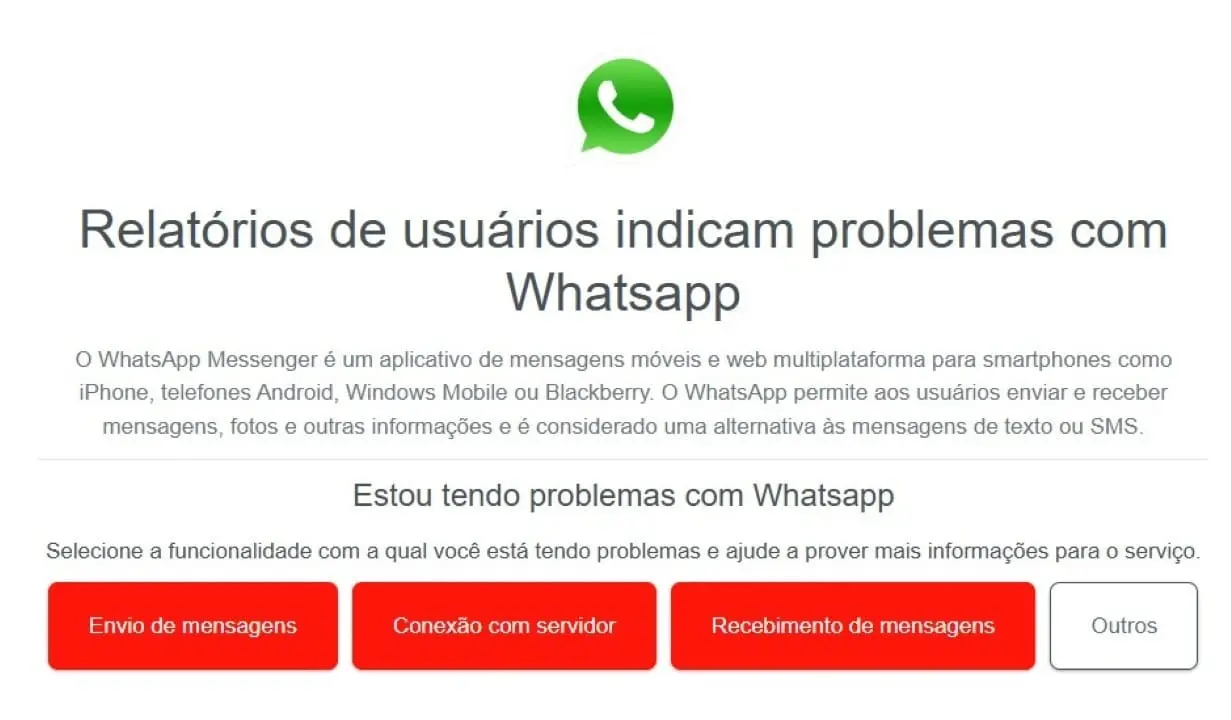
- Server connection issues account for 12% of reported cases.
- Mobile version also experiences sync delays.
- Companies report losses in urgent internal communications.
Initial user reports reveal the scope of the issue
Since the early hours, professionals like Wesley, who relies on the app for audio exchanges in virtual meetings, faced complete blocks. He described the situation as “impossible to work today,” noting that media simply wouldn’t send. Letícia Lima, another affected user, noticed the issue from 9 a.m. onward, with audios and photos stalling on both 4G and Wi-Fi, complicating her work routine.
Josué Comerlato and Old Milani, both in corporate settings, confirmed similar issues across entire companies, where sending images and videos stopped abruptly. Emersom pointed specifically to morning audio issues, while Thiago Lucas mentioned the inability to make calls since early hours. These accounts illustrate how the instability wasn’t limited to individuals but broadly impacted groups and organizations.
The pattern of complaints suggests a centralized server issue, as it affected users across different carriers and devices. Evilásio J. Lima reported account suspensions since the previous day, requiring constant reviews, which worsened the chaos. Ayrton Amaral highlighted the Windows version offline since 4 p.m. the previous day, suggesting the issue may stem from recent updates.
No mesmo tema: WhatsApp records global instability on November 4, 2025 and affects millions of users in Brazil
Real-time monitoring highlights complaint spikes
Tracking platforms captured a sudden surge in notifications. At 9:57 a.m., complaints peaked at 466, a significant jump from the usual. The 24-hour graph shows that while normal volumes hover around dozens per hour, the incident pushed reports to alarming levels.
Of the total notifications, 78% focused on message sending, with 12% related to server connections and 9% to receiving messages. This imbalance underscores that the core issue lies in data transmission, particularly multimedia. Users in São Paulo, Rio de Janeiro, and Fortaleza were the most vocal, but reports emerged nationwide.
- Sending plain text worked in 80% of cases but failed in long threads.
- Audios up to 30 seconds stalled in 90% of reported attempts.
- Short videos took over five minutes to upload, if completed.
- High-resolution photos rarely progressed beyond the initial loading stage.
- Groups with over 50 members saw duplicated or lost messages.
The comparison with typical hours reveals the peak occurred during high morning demand, coinciding with the start of workdays. This amplified the disruption, turning a critical tool into a source of collective frustration.
Saiba mais: WhatsApp down: users report app crashes and access issues across Brazil this Wednesday
Web version under scrutiny for recurring issues
WhatsApp Web, launched to streamline desktop use, has a history of vulnerabilities. On Wednesday, the instability manifested as blank screens or generic error messages, mimicking network failures even on robust connections. Users reported that scanning the initial QR code worked, but subsequent syncing stalled.
This version relies on a bridge with the mobile app, which may explain bug propagation. Recent updates aimed at improving encryption seem to have introduced browser incompatibilities, like Chrome and Edge. Professionals switching to desktop during the day felt the impact most, with workflows halted in shared spreadsheet chats.
Many tried basic fixes like clearing cache or restarting browsers, but effects were temporary. The issue persisted until noon, forcing migrations to alternative apps or emergency emails. In corporate settings, this meant delays in approvals and feedback, highlighting over-reliance on the platform.
Media complaints expose technical limitations
Audio sending emerged as the Achilles’ heel of the instability. Users like Letícia described recordings starting but stalling on upload, draining battery without progress. Videos and photos showed endless loading bars, even for lightweight files under 5MB.
This failure impacts not just casual chats but commercial negotiations where visual attachments are critical. In a country where the app handles 90% of digital exchanges, such disruptions ripple through productive chains. Reports indicate automatic compression failed, unnecessarily spiking data traffic.
- Long audios over 1 minute rarely completed sending.
- iPhone HEIC photos caused frequent web crashes.
- 720p videos required manual reconnection after 20% progress.
- Stickers and GIFs loaded but failed to attach in quick replies.
- PDF documents sent intact, serving as a temporary workaround.
Technicians suggest regional data center overloads contribute, especially with post-pandemic usage spikes. The lack of prior alerts from Meta amplified the surprise, leaving users reliant on makeshift forums for tip exchanges.
Veja Também

Verão intenso na Europa Ocidental supera marcas de calor e provoca incêndios

Capivara ataca psicóloga Fabiana Lenz em lagoa de Florianópolis durante acampamento

Vídeo viral exibe cachorro aterrorizado sendo arrastado por força misteriosa em casa
Mais sobre o assunto: WhatsApp verzeichnet am 4. November 2025 weltweite Instabilität und betrifft Millionen von Nutzern in Brasilien
Incident history reinforces seasonal patterns
WhatsApp outages aren’t new, but Wednesday’s event highlighted recurrences. In July, a similar peak stalled sends for hours, affecting millions. September has seen a 20% annual rise in complaints, tied to expansions like larger group calls.
These episodes often align with global update rollouts, tested first in emerging markets like Brazil. Monitoring data shows 70% of instabilities resolve within four hours, but yearly downtime exceeds 50 hours for active users.
With over 2 billion active accounts globally, the platform prioritizes scalability, but local node failures expose weaknesses. In Brazil, where the app replaces SMS in 95% of cases, these events trigger record searches for “WhatsApp down.”
Practical solutions mitigate disruptions
While normalization unfolds, users adopt strategies to bypass the chaos. Restarting the mobile app syncs the Web in 60% of cases, clearing temporary buffers. Toggling airplane mode for 30 seconds forces reconnection, resolving 40% of server complaints.
In professional scenarios, exporting chats to email preserves history during outages. Tools like Telegram serve as backups, with quick contact migration via QR. Using beta versions captures early fixes, though with minor risks.
- Check for updates on Google Play or App Store before relaunching.
- Disable data-saving mode to prioritize multimedia sends.
- Use lightweight VPNs to reroute traffic, avoiding regional blocks.
- Clear browser cache every 24 hours of use.
- Monitor status on dedicated sites for early alerts.
These tactics, drawn from past experiences, restore partial functionality but don’t replace full stability. The service’s reliance fuels demands for redundancy in digital ecosystems.
Feature expansion strains infrastructure
New tools like automatic message translation raise expectations but stress servers. Recently implemented, this feature processes billions of daily interactions, demanding more bandwidth. In Brazil, where multilingual chats are common internationally, adoption hit 30% in a week.
Saiba mais: WhatsApp registra instabilidade global em 4 de novembro de 2025 e afeta milhões de usuários no Brasil
However, such integrations can clash with network optimizations, causing multimedia bottlenecks. Meta invests in local data centers to mitigate, but morning peaks still overload shared routes with other services.
Users note that features like high-quality voice calls, launched in August, consume 25% more data, worsening failures on unstable connections. This technical evolution, while innovative, requires fine balancing to avoid disruptions like today’s.
Daily reliance drives alternative searches
With WhatsApp anchoring 80% of communications in the country, outages like this spur temporary migrations. Rival apps see 15% influxes during peak hours, with Signal and Telegram gaining traction for similar encryption. Yet, contact inertia keeps most users loyal.
Companies, aware of the risk, diversify to hybrid platforms, integrating Slack for corporate use. Individuals resort to costly, limited SMS as a fallback. This dynamic reveals the fragility of digital monopolies in connected nations.
Wednesday’s instability underscores the need for resilience, with users educated on regular backups. While Meta remains silent, the community fills the void with crowdsourced solutions, sustaining flow despite setbacks.