Moon phase today Friday 10/03: Observers see a waxing crescent Moon on October 3, 2025 with progressive brightness
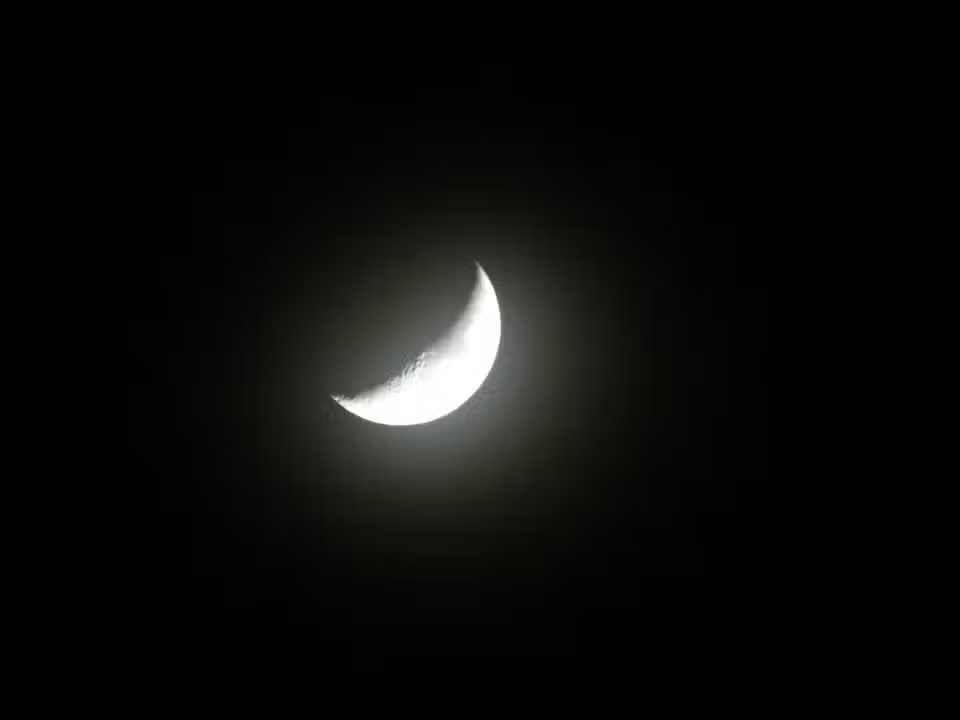
The crescent moon dominates the sky this Friday, October 3, 2025, across Brazil. The Earth’s natural satellite shows about 80% of its surface illuminated by the Sun. This phase follows the New Moon and precedes the Full Moon expected on the 7th.
Visibility increases gradually as the Moon moves away from alignment with the Sun. Observers in the southern hemisphere notice the illuminated part facing left. The phenomenon results from the relative position of the Sun, Earth, and Moon.
The complete lunar cycle lasts an average of 29.5 days and influences natural phenomena like tides.
Visibility and observation
The crescent moon appears on the eastern horizon shortly after sunset. Clear skies enhance visibility of craters and mountains on the illuminated edge.
Choose locations away from urban lights for better viewing. Simple binoculars enhance details on the lunar surface.
Formation of the crescent phase
The Sun progressively illuminates the lunar disk as the satellite orbits Earth. This transition follows the New Moon, when alignment makes the celestial body invisible.
The Moon’s synchronous rotation keeps the same face toward Earth. Partial illumination creates the characteristic crescent shape.
The phase lasts about seven days in the total lunar cycle. Astronomical observations confirm the daily increase in brightness.
Influence on tides
The Moon’s gravity causes spring tides during the crescent phase. This action, combined with the Sun, raises ocean levels in certain regions.



- Tides show greater amplitude on exposed coasts.
- Marine species adjust behaviors to light variations.
- Fishermen monitor cycles for nighttime activities.
The phenomenon occurs globally, with local variations due to coastal geography.
Animal behavior related
Nocturnal animals respond to the increasing lunar light intensity. Corals and mollusks synchronize reproductive cycles with the phases.
Sea turtles emerge on beaches under specific lighting conditions. Migratory birds alter flight patterns during brighter nights.
Scientific studies record these adjustments in diverse ecosystems.
October lunar calendar
The Full Moon occurs on the 7th at 00:48, marking peak illumination. The transition to waning begins on October 13.
- New Moon occurs on October 21.
- New crescent returns on October 29.
- The cycle restarts with an average duration of 29.5 days.
Astronomers predict optimal visibility in areas without light pollution.
The crescent phase facilitates telescopic observations of surface relief. The satellite reaches an average distance of 381,000 kilometers from Earth on this date.
Veja Tambem em Ciência

Avi Loeb sugere que cometa escuro 1998 KY26 pode ser sonda soviética Phobos 1

Avi Loeb explica explosão de meteoro que abalou Massachusetts com energia de 2% da bomba de Hiroshima
Imagens de satélite registram destruição após explosão do foguete New Glenn
Lua cheia de junho de 2026 ocorre na segunda-feira com o Strawberry Moon
Projeto Svarog e outros testes mostram potencial e limites das velas solares no espaço

Ondas de choque de estrelas moribundas esculpem berçários estelares em forma de roda de carroça cósmica
Estudo de Imperial College aponta velas solares para borda do Sistema Solar em 10 ou 20 anos
Venera 13 pousou em Vênus em 1982 e enviou primeiras fotos coloridas da superfície
Astrofotógrafo registra Nebulosa Cabeça de Cavalo em 115 horas com telescópio de quintal
Telescópio James Webb faz primeira medição direta de buraco negro supermassivo antigo
Meteorito de 4,5 bilhões de anos revela evidências de fontes termais antigas em Marte