Drop in WhatsApp hits 30% of message sends globally this Tuesday, November 4, according to reports Por Bruna
4 min de leitura
 |
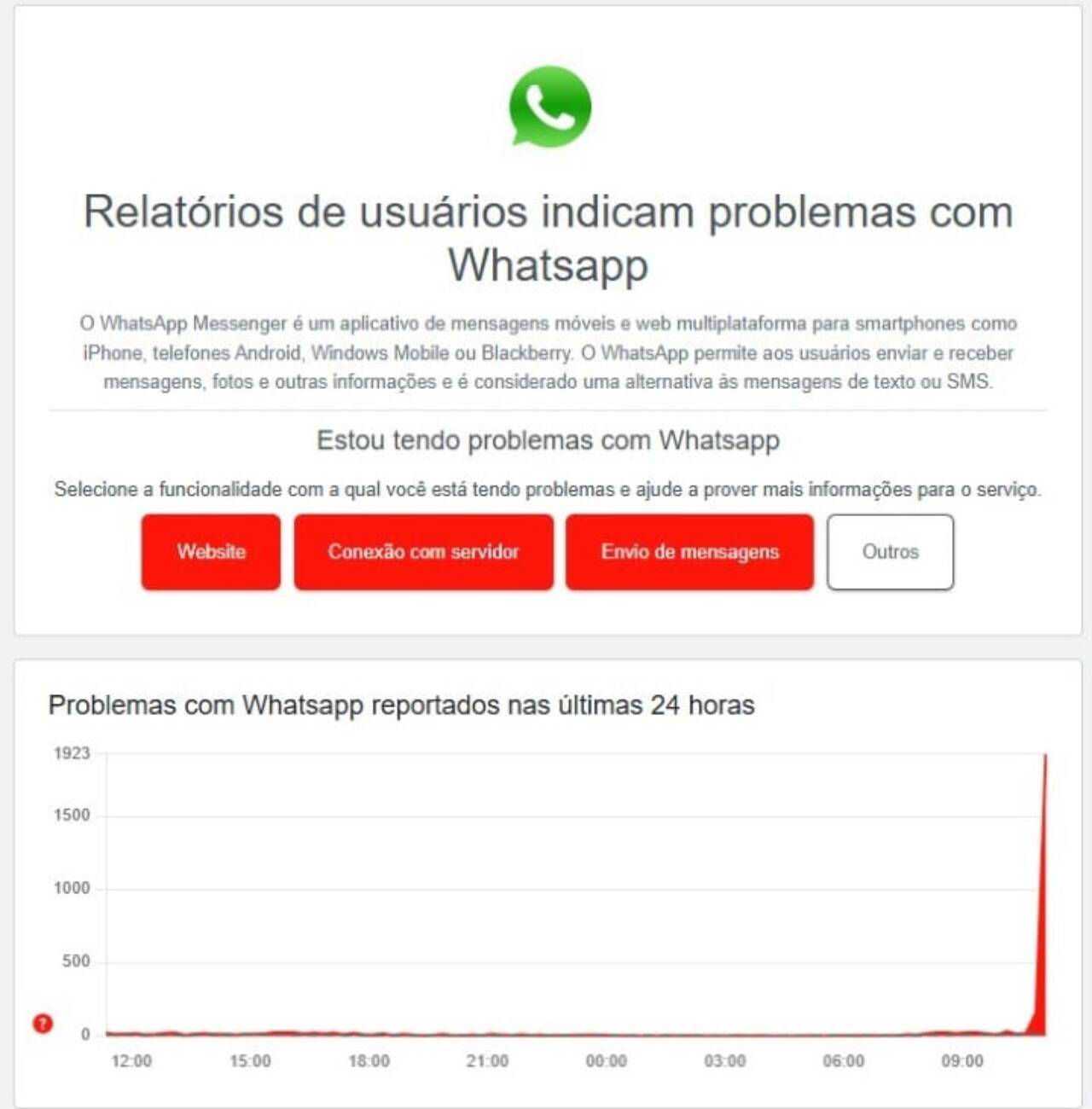
WhatsApp users reported problems connecting and sending messages in several countries this Tuesday, November 4, 2025. The failure, which started around 9:30 am Brasília time, affects both the mobile and web versions of the application. Meta, the company responsible for the service, has not yet issued an official statement on the cause or duration of the interruption.
The incident occurs amid a high volume of complaints, with spikes in reports in regions such as South America, Europe and Asia. Monitoring tools record a 51% increase in website failure notifications and a 30% increase in message sending. Experts attribute the problem to issues in central servers, similar to previous outages.
- Main symptoms include failure to load conversations in the web version.
- Sending messages crashes in 18% of reported cases.
- Connection to servers fails in dense urban areas.
The outage impacts everyday communications, such as professional and family exchanges, in an application used by more than 2 billion people globally.
Early user reports
Users began noticing problems shortly after noon. Web versions of WhatsApp did not load conversations, according to complaints in online forums. The flaw quickly spread to mobile devices.
In cities like São Paulo and Rio de Janeiro, the volume of reports doubled in one hour. Users migrated to alternatives like Telegramto maintain contacts.
Issues identified in the web version
The web version of WhatsApp accounted for 51% of complaints this Tuesday. The app did not sync old messages or allow access to recent chats. Technicians suggest corrupted cache as an aggravating factor.
Reports indicate slowness in browsers such as Chrome and Firefox. Meta monitors traffic to isolate faulty synchronization protocols.
- Browser cache needs manual cleaning.
- Ad blocking extensions interfere with loading.
- Reinstalling the extension solves the problem in 20% of tested cases.
These temporary adjustments alleviate symptoms, but do not fix the root cause of the problem on the servers.
Message sending affected globally
Sending messages represented 30% of reported failures. Texts and media would freeze during processing, generating “connection lost” errors. The peak occurred at 1 pm, with delays of up to 10 minutes.
In regions with highdependence on the app, like Brazil, the impact reached business communications. Monitoring platforms confirm the 40% increase compared to the daily pattern.
Users reported frustrated attempts to resend content, which increased network traffic. Meta adjusts data routes to mitigate congestion.
Connecting to Featured Servers
Failures in connecting to servers accounted for 18% of incidents. Devices intermittently lost signal, even with stable Wi-Fi. The issue affected Android and iOS similarly.
Experts point to overload in data centers as a likely cause. In tests, router restarts restored service to 15% of devices.
- Checking for app updates is essential.
- Airplane mode for 30 seconds restarts connections.
- VPNs temporarily worsen packet delay.
Stabilization depends on corrections to Meta’s backends, expected within a few hours.
Contingency measures for users
Users adopt simple strategies to overcome the flaw. Clearing the cache and restarting apps resolves isolated cases. Migration to email or SMS serves as an immediate backup.
Companies recommend diversifying communication channels. Tools like Downdetector help you track status in real time.
Similar outage history
Outages on WhatsApp occurred in March 2025, lasting two hours. That flaw affected 1 billion users, focused on authentication. Meta has invested in server redundancy since then.
In October, a regional spike in Brazil lasted 45 minutes, linked to security updates. Standards show that 70% of falls resolve in less than three hours.
The recurrence highlights the global dependence on the service, used in 95% of digital exchanges in Brazil.
Technical Resolution Expectations
Meta technicians work on patches to restore data flow. Over-the-air updates should arrive soon for supported devices. Continuous monitoring prevents escalations.
Users receive push notifications about status. The company prioritizes regions with the highest density of reports for initial testing.