NASA reveals exotic Phippsaksla rock outside Jezero crater, originating from asteroids


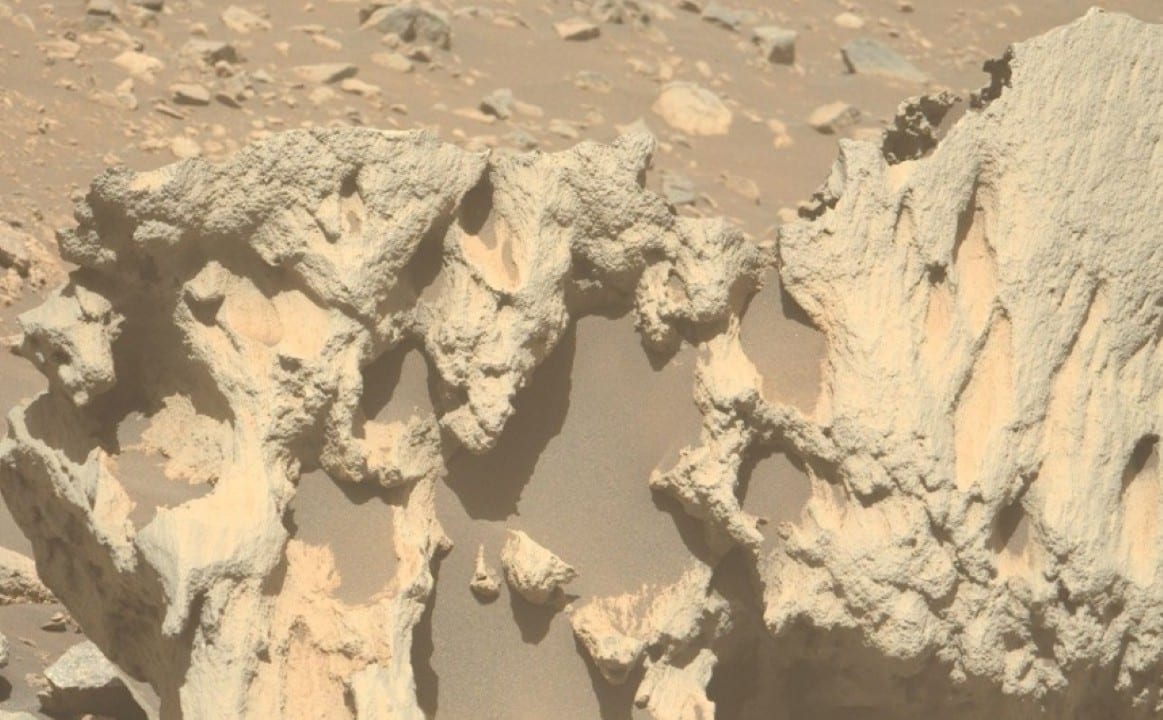
NASA’s Perseverance rover identified an unusual rock on the soil of Mars, measuring about 80 centimeters in diameter. The formation, named Phippsaksla, has a high composition of iron and nickel, which suggests its origin as a ferronickel meteorite from asteroids. The find occurred in September 2025, outside the Jezero crater, a site explored by the mission since its landing in 2021.
Team scientists confirmed the preliminary data using the SuperCam instrument, which analyzed the rock surface. This detection potentially marks the first meteorite of its kind found by Perseverance in the region. NASA released the images and analysis on November 13, 2025, after delays caused by operational disruptions.
Jezero Crater, with its history as an ancient lake, serves as the mission’s main focus for searching for signs of past habitability. However, recent exploration has extended into adjacent areas such as the Vernodden site, where the rock stands out for its sculpted shape and elevation above the flat, fragmented terrain.
- Photographs captured on September 2 and 19, 2025;
- Initial analysis via SuperCam carried out the week before the announcement;
- Exact dimensions: 80 cm wide, with cavernous texture observed in close-up.
Distinctive features of the formation
Phippsaksla Rock rises above neighboring rocks, which generally remain low and flat due to Martian erosion. Its surface displays sculpted contours, whichrasta with the fragmented environment around.
This elevation suggests resistance to erosion, common in metallic meteorites in Mars’ thin atmosphere.
Instruments involved in detection
The SuperCam, mounted on the rover’s mast, fired lasers to vaporize tiny samples of the rock. The technique revealed iron and nickel spectra at high levels.
Other sensors, such as Mastcam-Z, recorded high-resolution images to document the cavernous texture.
This data was transmitted to Earth for immediate processing by the team in Pasadena, California. The combination of tools allows for precise remote analysis, without direct contact with the ground.
Exploration beyond Jezero Crater
Perseverance began operations in Jezero Crater in February 2021, collecting samples of sedimentary and igneous rocks. The extension to external areas aims to map ancient impacts and geological variations.
In these outlying regions, the terrain reveals older bedrocks, marked by craters from past meteorites. The presence of Phippsaksla reinforces the hypothesis thatthat such events distributed metallic fragments across the surface.
The mission has already identified 33 stored samples, including rocks with evidence of interaction with ancient water. This diversity supports studies on the planetary evolution of Mars.
Comparisons with previous findings
Previous rovers such as Opportunity and Spirit detected iron meteorites in 2005, including formations up to one meter in diameter. Curiosity found specimens such as Lebanon in 2014 and Cacao in 2023, both in Gale Crater.
These cases show similar patterns of preservation, with rocks lying on flat surfaces due to low chemical erosion on Mars.
The previous absence of ferronick meteorites at Jezero intrigued scientists, given its similar age to Gale and the count of smaller impacts in the basin, delta and crater rim.
Preservation in a Martian environment
Metallic meteorites resist degradation better in Mars’ thin atmosphere, which offers little protection against radiation but limits oxidation. This explains elevated positions in terrain without visible impact craters.
In some scenarios, the original craters erode over millions of years, leaving only the fragment exposed. Perseverance now operates on ancient, impact-scarred bedrocks where such preservations become more likely.
Continued analysis of Phippsaksla could refine models of meteorite distribution on the planet.
Implications for future missions
Confirmation as a meteorite would add Perseverance to the list of rovers that have studied cosmic visitors to Mars. This inclusion would expand the catalog of fragments analyzed remotely.
Projects like Mars Sample Return, in partnership with ESA, plan to collect and return samples to Earth for detailed laboratory examinations. By July 2025, 33 tubes have been filled with rocks, soil and atmosphere.
These returns would allow magnetic and structural checks impossible with onboard instruments, advancing understanding of asteroid formations.