
Satellites capture unprecedented magnetic pulsation and reveal complex rhythm at the center of the Earth

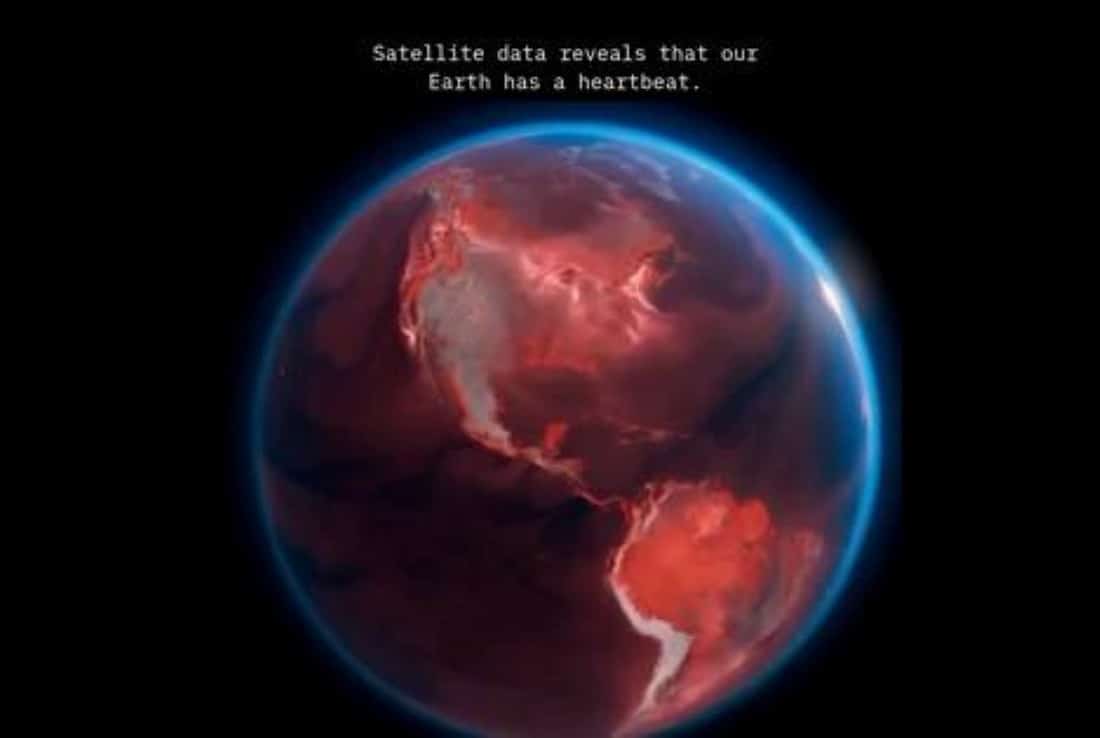
A new analysis of data collected by space observation satellites suggests that Terra manifests rhythmic patterns in its interior and surface, comparable to a living organism. Pesquisadores of geophysics and space science have monitored fluctuations in the magnetic field and atmospheric phenomena that indicate internal activity much more dynamic than previously thought. The planet demonstrates mysterious cycles that influence everything from the biosphere to GPS navigation.
This detailed monitoring is carried out by constellations of satellites with geomagnetic sensors, which can map the intensity and direction of the Earth’s magnetic field at different points on the globe. The precision of these measurements allows scientists to ‘see’ what is happening thousands of kilometers below the surface, in the liquid outer core where the field is generated.
The magnetic field acts as a vital protective shield, deflecting charged solar particles that would otherwise damage life and technology.
- Measurements reveal magnetic waves that move through the core every seven years.
- This movement occurs westward, at an estimated speed of 1,500 km per year.
- Such periodic patterns help to understand the dynamics of the geodynamo, the engine that generates the magnetic field.
Atlântico Sul Anomaly: Shield weakening
The weakening of the magnetic field in the region known as Anomalia of Atlântico Sul (AAS) is one of the focuses of greatest attention. Nesta area, which extends from América from Sul to África, the protective shield is weaker, allowing easier penetration of space radiation.
Although the phenomenon does not represent an immediate risk to life on the surface, increased exposure to high-energy particles directly affects satellites and electronic equipment that fly over the region, requiring special shielding and, sometimes, the temporary deactivation of critical components. The continued expansion of the AAS indicates profound and ongoing changes in the planet’s internal dynamics.
Seismic Oscillation and the 26-Second Pulse Puzzle
In parallel to magnetic fluctuations, seismology detects a phenomenon known for more than six decades: the ‘Terra pulse’. Sismógrafos around the world register a subtle, almost imperceptible tremor, which repeats with impressive regularity every 26 seconds.
The exact origin of this low-frequency oscillation, whose epicenter is often located in Golfo of Guiné, on the west coast of África, remains a mystery to science. Algumas hypotheses suggest that pressure from ocean waves against continental shelves in the region may be the cause, but the complexity and constancy of the pulse continue to challenge current geophysical models.
Biosphere fluorescence and the solar current
A third set of observations, focused on the surface, reveals that the biosphere also reacts to spatial influences in a rhythmic manner. Sensores satellites measure sunlight-induced fluorescence, an infrared glow emitted by vegetation during photosynthesis.
The intensity of this fluorescence is a crucial indicator of plant vitality and biosphere productivity, being strongest in the summer months and weakest in periods of drought. This process is seen by some researchers as a direct response to solar energy injected into the atmosphere, with vegetation acting as a global sensor to the Sol’s electromagnetic currents. Tais data is crucial for monitoring the health of forests and agricultural crops in a climate change scenario.
The importance of continuous monitoring
The global effort to monitor these manifestations – be they the magnetic waves of the core, the seismic pulse of the ocean or the light response of vegetation – is essential. The combination of data from several satellite missions and ground observatories allows the construction of more accurate geomagnetic maps, which are essential for navigation, communication and critical infrastructure planning. Understanding the interconnectivity of these phenomena reinforces the vision of a geologically and biologically interconnected and pulsating planet. The most recent studies seek to integrate these measurements to refine the capacity



