
Scientists record record brightness on comet 3I/ATLAS with tail elongated by millions of kilometers

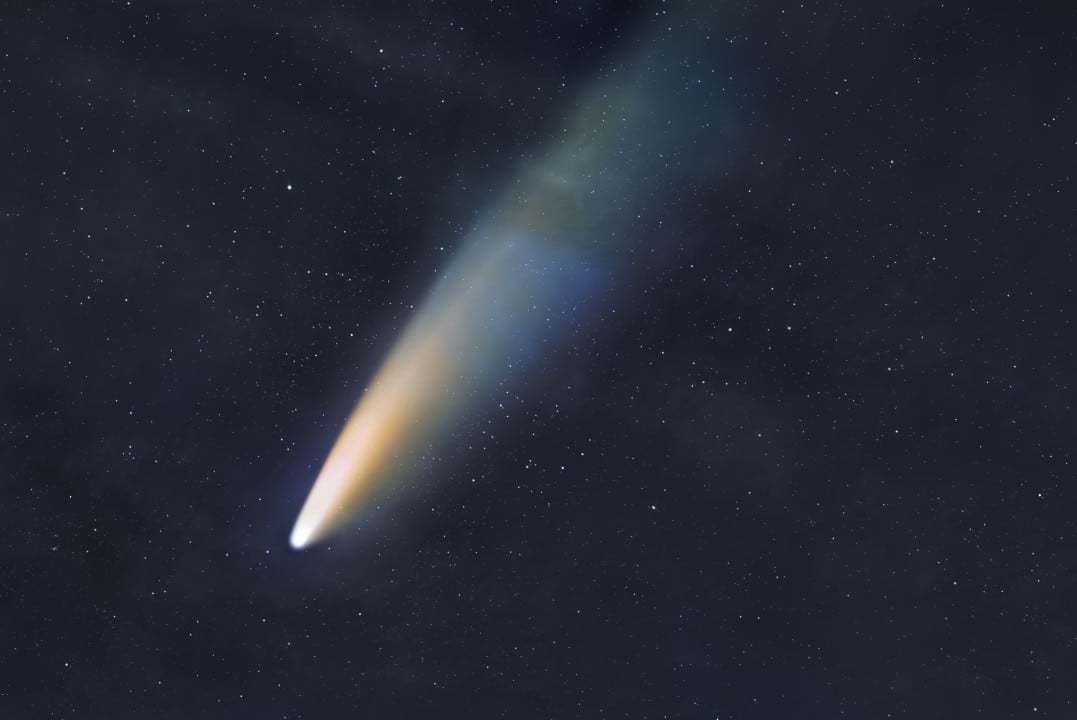
Recent images captured by robotic telescopes reveal that the interstellar comet 3I/ATLAS has developed an ionic tail that is longer and brighter than any previous record. The object, detected in July 2025 by the ATLAS system in Chile, presents this structure extended over millions of kilometers as it crosses the inner Sistema Solar. Astrônomos from around the world monitor the phenomenon, which occurs due to the interaction between solar radiation and gases released by the comet’s nucleus. Essa activity reinforces the scientific importance of the visitor, the third of external origin confirmed in the history of space observations.
The comet follows a hyperbolic orbit, indicating that it does not belong to the gravity of Sol and will head towards interstellar space after its passage. Observações Preliminaries point to a composition rich in metals such as nickel and iron, as well as carbon dioxide in high proportions. Esses data was obtained by instruments such as the Telescópio Espacial James Webb and the Hubble, which captured gaseous emissions during the approach to perihelion in October.
Initial detection details
The detection of 3I/ATLAS occurred on July 1, 2025, using the ATLAS telescope at Río Hurtado, at Chile. Inicialmente classified as a possible asteroid, subsequent observations confirmed its cometary nature by the presence of a diffuse coma and tail-shaped elongation. Essa rapid identification enabled continued tracking, with pre-discovery data backdated to June 2025.
Astronomers have noted cometary activity at distances of up to 6.4 astronomical units from Sol, suggesting early outgassing. The object travels at speeds above 57 km/s, crossing the Terra orbit with a low inclination in relation to the ecliptic.
Chemical composition revealed
Spectroscopic observations identified glowing nickel vapor around the nucleus, indicating a structure rich in ferrous metals. Essa characteristic differs from typical solar comets, which prioritize ice and organic dust.
The Telescópio James Webb detected carbon dioxide at levels eight times higher than water, exceeding expected variations by six times. Essa ratio suggests formation in cold, distant environments from another star, possibly as thick as Via Láctea.
Data from Observatório Neil Gehrels Swift confirmed hydroxyl gas, a marker of sublimated water. Essas emissions occur without abrupt bursts, maintaining stable brightness until August 2025.

Ionic tail formation
The ionic tail arises from the ionization of gases such as carbon monoxide by solar ultraviolet radiation. Charged Partículas are pushed by the solar wind, forming an elongated band opposite Sol, visible at angular lengths of 0.7 degrees.
Images from November 10, obtained by Projeto Telescópio Virtual on Itália, show an extension of three million kilometers after perihelion. Essa structure grew with accelerated sublimation of ice, driven by warming to 1.4 astronomical units.
Color and brightness changes
The hue of 3I/ATLAS varied to reddish tones in July, attributed to evolutionary dust in the coma. In August, observations of Gemini South recorded an antisolar tail of 30 arc seconds, equivalent to 56 thousand kilometers.
Brightness increased seven and a half times during solar approach, with no rapid post-perihelion loss. Essa luminosity allows for detailed terrestrial studies, contrasting with previous visitors such as 2I/Borisov.
Trajectory and orbital landmarks
The comet passed within 28 million kilometers of Marte on October 3, 2025, allowing images from orbiting probes. In December, it will reach the minimum point at Terra, at 270 million kilometers, without risk of collision.
The Europa Clipper probe crossed the ion tail between October 30 and November 6, collecting interstellar particles. ESA’s Hera mission recorded similar data through November 1, improving solar wind models.
- Speed relative to Sol: 58 km/s at initial detection.
- Distance to perihelion: 210 million kilometers on October 30th.
- Next approach to Júpiter: March 2026, before interstellar exit.
Space probe observations
The MeerKAT network detected hydroxyl absorption on October 24, confirming water release. Telescópio Espacial Hubble captured a dusty tail in July, elongating three seconds of arc.
In November, ESA’s JUICE mission analyzed the object between 2 and 25 November using spectroscopy instruments. Essas collections reveal volatile compounds such as carbonyl sulfide, absent in local comets.
ESA’s Trace Gas Orbiter determined the trajectory with ten times greater accuracy, based on Martian data. Essa planetary integration marks the first official determination of another planet’s cometary orbit.
Contributions to astrophysics
3I/ATLAS provides data on remote stellar systems, estimated to be 7 billion years old. Sua hyperbolicity confirms ejection during outer planetary formation.
Polarimetric studies show atypical light reflection, suggesting an irregular surface. Esses insights prepare future missions, like Comet Interceptor in 2029.



