
Saturn’s rings disappear from Earth’s view in November 2025, NASA explains about planetary alignment

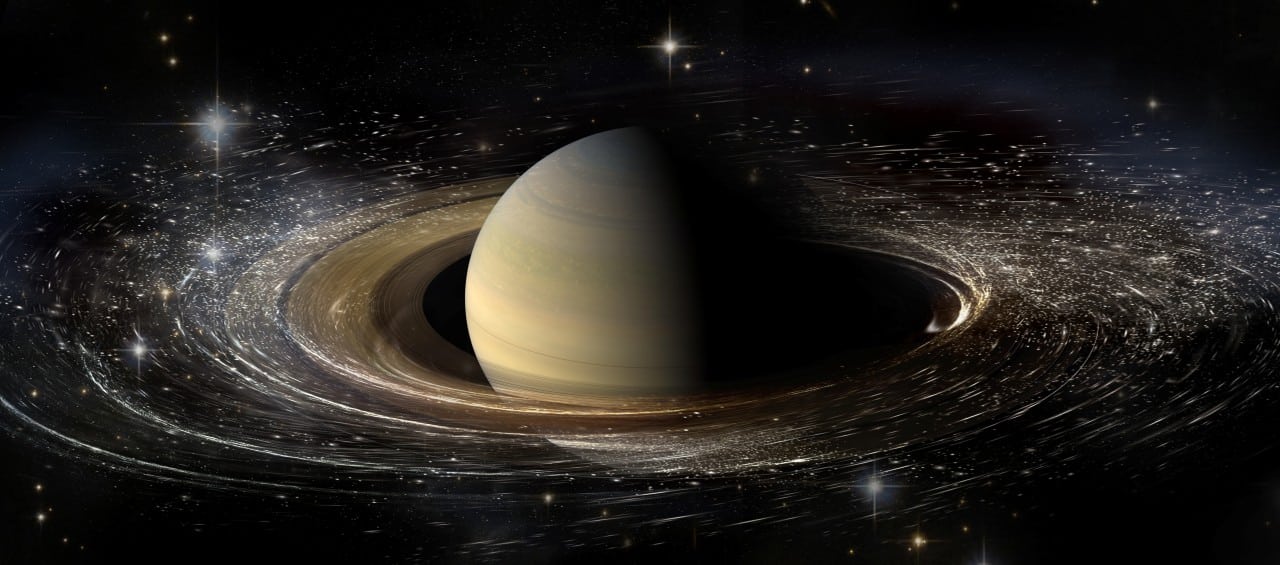
Nasa reported that the rings of Saturno became invisible from the perspective of Terra on Sunday, November 23, 2025. The phenomenon occurred due to the orbital alignment between the planet and Terra, known as ring plane crossing. Esse event, predicted by the space agency, does not alter the physical structure of the rings, which remain intact around the gas giant.
Astronomers observed Saturno in the southeastern sky after sunset, but noticed the absence of the iconic rings. The 26.7 degree tilt in Saturno’s orbit relative to Sol causes periodic variations in visibility.
The complete crossover of plans will not be repeated until 2038, according to calculations by Nasa based on data from the Cassini mission.
Composition of rings and their formation
The rings of Saturno consist of seven main structures formed by ice particles, rocks and dust.
These materials come from comets, asteroids or fragments of moons destroyed by the planet’s gravity. Partículas range from grains of sand to mountain-sized blocks, with an average thickness of 10 meters.
Observation of the phenomenon in detail
Astronomers recommend powerful telescopes to capture the event, although visibility is minimal.
The planet appears in the southeastern sky between sunset and 3:30 a.m., Brasília time.
- Peak invisibility occurs about an hour after the rise of Saturno on the previous Saturday.
- Rings gradually reappear over the next few weeks, widening for observers.
- Clear weather conditions favor detection in tropical regions of the Southern Hemisphere.
Orbital cycle and predictions of Nasa
The orbit of Saturno, lasting almost 30 Earth years, tilts the equator and rings relative to Sol. Esse movement creates equinox events every 15 years, when the sun’s rays fall directly on the plane of the rings.
During these periods, shadows cast by the rings form narrow bands on the planet, compressing vertical structures.
Nasa used data from the Cassini probe, which orbited Saturno from 2004 to 2017, to model these occurrences. The agency estimates that the next full alignment will occur in 2038-2039, allowing for new observations of moons and disturbances.

Recent origin of the rings
Studies indicate that the rings of Saturno are relatively young, estimated to be up to 400 million years old.
Evidence from Cassini reveals that they formed recently on a cosmic scale, possibly from a disintegrated moon. Micrometeoroides of the Kuiper belt continuously impact particles, accelerating erosion.
Long-term erosion processes
Particles from the rings fall into the atmosphere of Saturno by gravitational and magnetic influence.
This phenomenon, called ring rain, removes material equivalent to an Olympic-size swimming pool every 30 minutes.
- Rate of loss accelerates dissolution, with complete disappearance predicted in 100 to 300 million years.
- Ring C, the thinnest, could disappear in a few million years due to low density.
- Influence of Júpiter alters trajectories, contributing to the dispersion of debris.
Discoveries during alignments
Events like November’s make it easier to detect moons hidden by rings under normal conditions. Entre 1655 and 1980, 13 satellites were identified during similar crosses.
Nasa plans to use James Webb to capture infrared images, revealing chemical compositions. The space telescope recorded Saturno in 2023, highlighting disturbances in the rings.
Unique structures in the rings
Transient helices and rays appear as linear disturbances, extending thousands of kilometers. Essas formations arise from gravitational interactions with moons such as Prometeu and Pandora.
The Divisão Cassini, gap between rings A and B, measures 4,800 kilometers wide and reflects low density.




