

Star S301 breaks speed record near Milky Way central black hole

Astronomers operating the Very Large Telescope Interferometer in Cerro Paranal, located in Chile’s Atacama Desert, have identified star S301 as the fastest and closest star ever tracked around Sagittarius A*, the supermassive black hole at the center of the Milky Way. Reaching velocities of approximately 25,000 kilometers per second, the newly analyzed star provides the precise orbital conditions required to calculate the direct rotation of the black hole.
The discovery, led by the GRAVITY+ collaboration and the European Southern Observatory, was published on August 19, 2026, in the journal Nature, with Karim Abd El Dayem, a researcher at the Paris Observatory, serving as lead author. Felix Mang, a doctoral researcher at the Max Planck Institute for Extraterrestrial Physics and study co-author, explained the scale of the orbit: “What is special about this star is that it’s orbiting Sagittarius A* on a very tight orbit, taking just 8.7 years to complete it, and is approaching the black hole at a mere 12 times the distance of Earth to the Sun. That is unprecedented.”
Record velocity and extreme orbital proximity to the galactic center
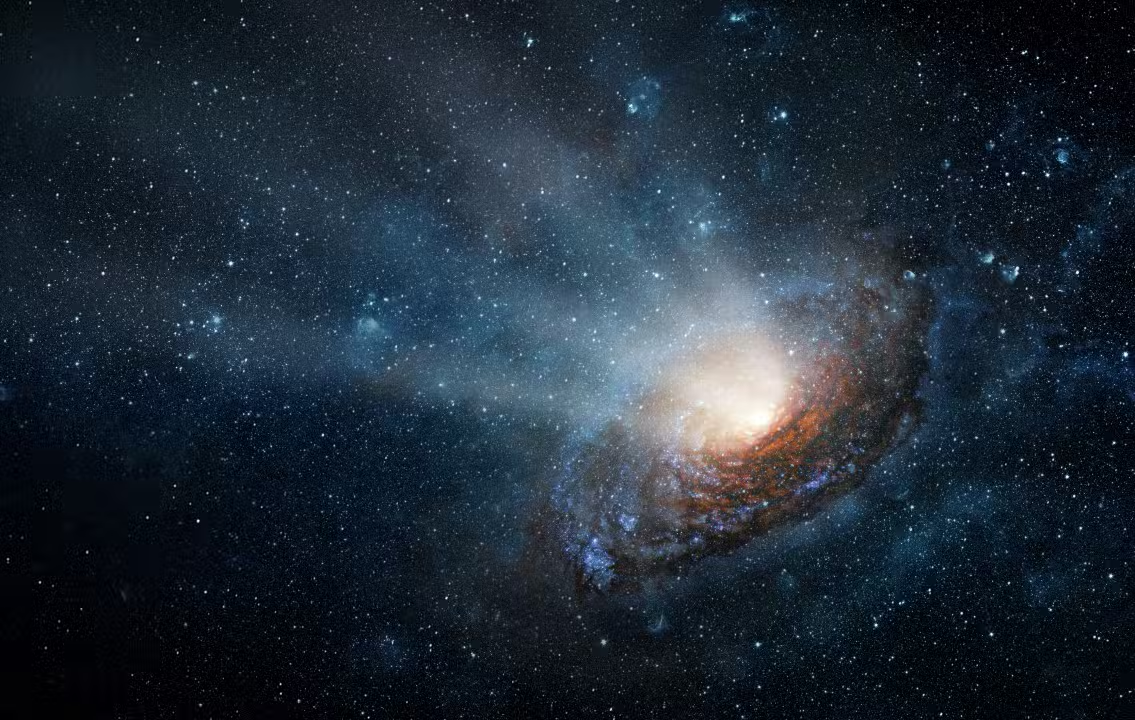
At its pericenter, which marks the point of closest approach, S301 travels at more than 8% of the speed of light while plunging into the gravitational field produced by Sagittarius A*, a black hole containing an estimated 4 million solar masses. The star reaches a clearance of about 12 astronomical units, or approximately 1.78 billion kilometers from the gravitational center, matching the scale of the physical distance between the Sun and Saturn. Because the object is about 2 billion times dimmer than Betelgeuse, detection required targeted interferometric resolution to separate its light from dense star clusters in the galactic core.
The unprecedented closeness places S301 ten times nearer to the central black hole than S2, the primary benchmark star previously tracked across a 16-year orbital period to measure gravitational redshift. Reinhard Genzel, director of the Max Planck Institute for Extraterrestrial Physics and winner of the 2020 Nobel Prize in Physics, emphasized the scientific significance of tracking the object: “Decades of carefully tracking stars orbiting our galaxy’s central black hole, Sagittarius A*, have led to this breakthrough discovery of a very promising star. Because it orbits so close to Sagittarius A*, S301 opens a new window to the fundamental properties of spacetime in this extreme black-hole environment.”
Key parameters of the S301 orbital trajectory
- Orbital period: 8.7 years, representing the shortest known orbit around Sagittarius A*.
- Maximum velocity: 25,000 kilometers per second, equivalent to roughly 15,500 miles per second.
- Pericenter distance: approximately 12 astronomical units, or 1.78 billion kilometers.
- Light speed fraction: exceeding 8% of the speed of light at closest passage.
- Recent closest approach: early 2023, following historical orbital tracking traced back to 2017.
- Next pericenter encounter: scheduled to occur in 2031.
Testing general relativity through frame dragging
Under Albert Einstein’s theory of general relativity, a massive spinning black hole drags the fabric of spacetime along with its spin, generating an effect known as Lense-Thirring precession or frame-dragging. Because S301 travels through this immediate relativistic zone, the rotation of Sagittarius A* is expected to impart a measurable tilt and shift onto the star’s path over successive orbits. Stefan Gillessen, a senior researcher at the Max Planck Institute for Extraterrestrial Physics, outlined the importance of the target: “For the first time, we would actually be able to measure very directly the spin of a massive black hole, which would be a key test of Einstein’s theory.”
Astrophysicists attribute the origin of S301 to the Hills mechanism, a gravitational process where an incoming binary star system is disrupted after passing too close to a supermassive black hole. During the encounter, tidal forces severed the bound pair, ejecting one star at hypervelocity while leaving S301 captured in its current tight, high-speed orbit.
Next observation milestones and pending measurements
Researchers detected S301 using the upgraded GRAVITY+ instrument on the Very Large Telescope Interferometer and have tracked its path using archival data covering observations since 2017. To calculate the spin of Sagittarius A*, teams need to monitor S301 across at least two complete orbital periods, an effort that will combine continued observations from GRAVITY+ with the future Extremely Large Telescope and its MICADO instrument over the next decade.
The exact numerical value of the spin of Sagittarius A* remains unconfirmed. Astronomers cannot calculate the final rotational rate until S301 completes more orbital arcs and passes its next pericenter in 2031.


