
New comet discovered by astronomers promises rare brightness and will be visible to the naked eye in the coming months

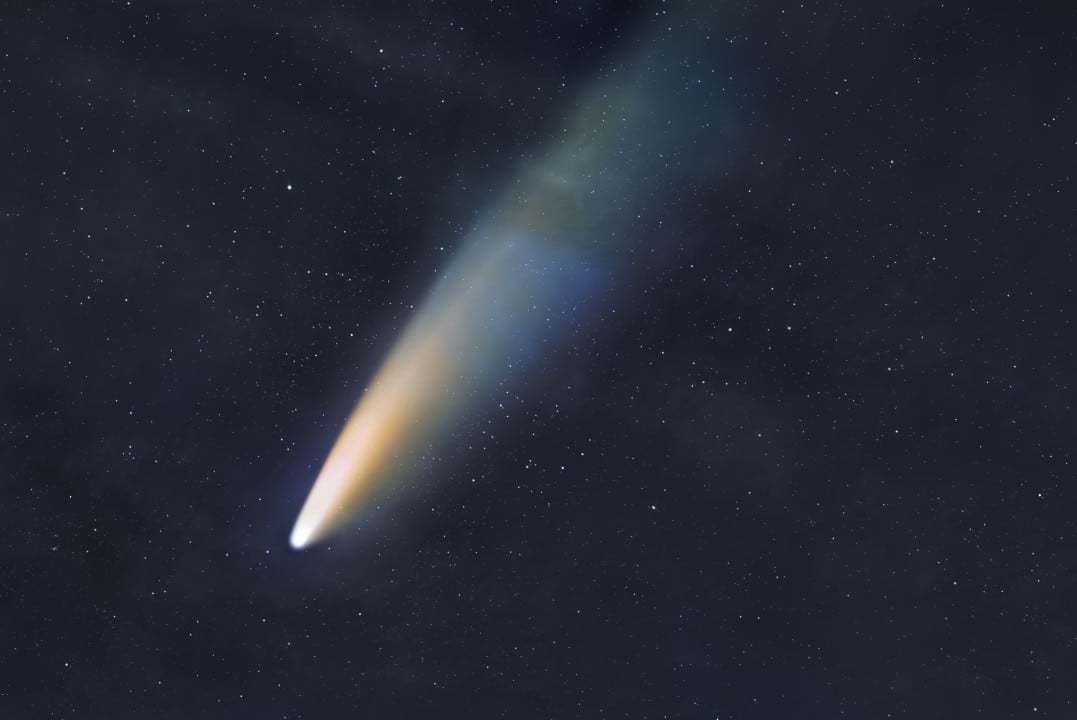
A new comet, provisionally cataloged as C/2024 P3, has been identified by an international network of observatories and is on a trajectory that will make it a celestial spectacle in the coming months. The object, composed of ice, rock and dust, is currently approaching the interior of Sistema Solar, and projections indicate that its brightness may increase to the point that it can be observed with the naked eye.
The star’s passage through perihelion, its closest point to Sol, is what will determine the maximum intensity of its luminosity. During this period, solar heat will cause the volatile materials on its surface to sublime, creating a vast tail and glowing coma that will make it stand out in the night sky. The expectation is that the phenomenon will reach its peak visibility between the end of this year and the beginning of next.
The best observation conditions will be concentrated at Hemisfério Sul, which will benefit the public in different regions of the country. Astrônomos amateurs and professionals are already monitoring the object, adjusting its orbit calculations to more accurately predict the ideal dates and locations to follow its passage.
The discovery and trajectory of the new visitor
Comet C/2024 P3 was initially detected by automated sky scanning systems designed to identify objects close to Terra. Após the first alerts, observatories in different parts of the world confirmed the discovery and began the process of characterizing its orbit.
Preliminary data reveals that the celestial body has an extremely long and elliptical orbit, suggesting that it originates from Nuvem of Oort, a vast region in the confines of Sistema Solar. Isso means this could be your first or one of your rare visits to Terra’s neighborhood in thousands of years.
Currently, the object is still in distant regions, but its speed increases as it is attracted by the gravity of Sol. Continuous monitoring is essential to refine predictions and understand your behavior.
Official confirmation and definitive naming of the comet will be carried out by international astronomical bodies after collecting more observational data, a standard procedure for new celestial discoveries.
Characteristics and composition of the celestial body
Initial spectrographic studies indicate that the nucleus of C/2024 P3 has an estimated diameter of between 1 and 3 kilometers, a considerable size for a long-period comet. Sua composition is typical of these Sistema Solar “fossils”, including frozen water, carbon dioxide, methane and other organic compounds mixed with dust and rock fragments. As it approaches Sol, surface heating releases these gases, forming the coma, a bright, diffuse atmosphere around the core. The pressure of solar radiation and solar winds pushes this material away, creating two distinct tails: one of dust, more curved and yellowish, and another of ions, straight and with a bluish hue. The presence of compounds such as diatomic carbon can give the coma a greenish color, a visually impressive detail that can be captured by astrophotographers.
How and when to observe the phenomenon
To get the best observation experience, it will be crucial to look for locations with low light pollution, such as rural areas or areas away from large urban centers. The ideal period for viewing will be during the hours before dawn or just after sunset, when the sky is darkest and the comet will be positioned above the horizon. Using astronomy apps for your cell phone can help you locate the object accurately, indicating its position in relation to known constellations.
The comet’s visibility will gradually evolve. Inicialmente, it will be a target only for telescopes and powerful binoculars. Conforme approaches its peak brightness, predicted for the final months of the year, it may become a diffuse point visible to the naked eye. The observation “window” at its maximum brightness is expected to last a few weeks, allowing many people the opportunity to witness the cosmic event.
Brightness predictions and possible surprises
Current projections suggest the comet could reach an apparent magnitude between +3 and +4, which would make it easily visible without equipment in dark skies. Contudo, it is important to note that comets are notoriously unpredictable celestial bodies.
A comet’s brightness directly depends on the rate at which its ice sublimates, and this activity can vary drastically. Existem historical cases of comets that exceeded expectations and became extremely bright, as well as others that fragmented or simply did not release as much material as expected, resulting in a discreet appearance.
Interaction with solar heat and gravity can even cause the nucleus to fragment. Embora This could shorten its lifespan, a fragmentation event could temporarily increase the comet’s brightness, creating an even more dynamic spectacle in the sky.
Recommended equipment for observation
Although there is the possibility of viewing with the naked eye, the use of binoculars is highly recommended. A simple pair of binoculars, such as the 7×50 or 10×50 models, will be enough to reveal the comet’s coma and possibly the beginning of its tail.
For more dedicated observers, small and medium aperture telescopes will offer a much more detailed view, allowing the structure of the coma and the different tails to be distinguished. Astrophotography with long exposure cameras will also be able to record spectacular images of the celestial visitor.
The scientific importance of the event
The passage of C/2024 P3 represents a valuable opportunity for the scientific community. Because they are primitive objects, practically unchanged since the formation of Sistema Solar 4.6 billion years ago, they function as time capsules.
Analyzing the light reflected and emitted by the comet allows scientists to determine its detailed chemical composition. Esses data provides crucial clues about the conditions and materials present in the nebula that gave rise to Sol and the planets.
Guidelines for the general public
The recommendation for those who want to follow the phenomenon is to stay informed through science communication channels and astronomy clubs, which will provide updates on the trajectory and brightness of C/2024 P3. Planejar a night of observation away from the city lights will be the key to enjoying this rare astronomical event.



