
Interstellar comet 3I/Atlas confirms hyperbolic trajectory and reaches speed of 57 km/s in 2025

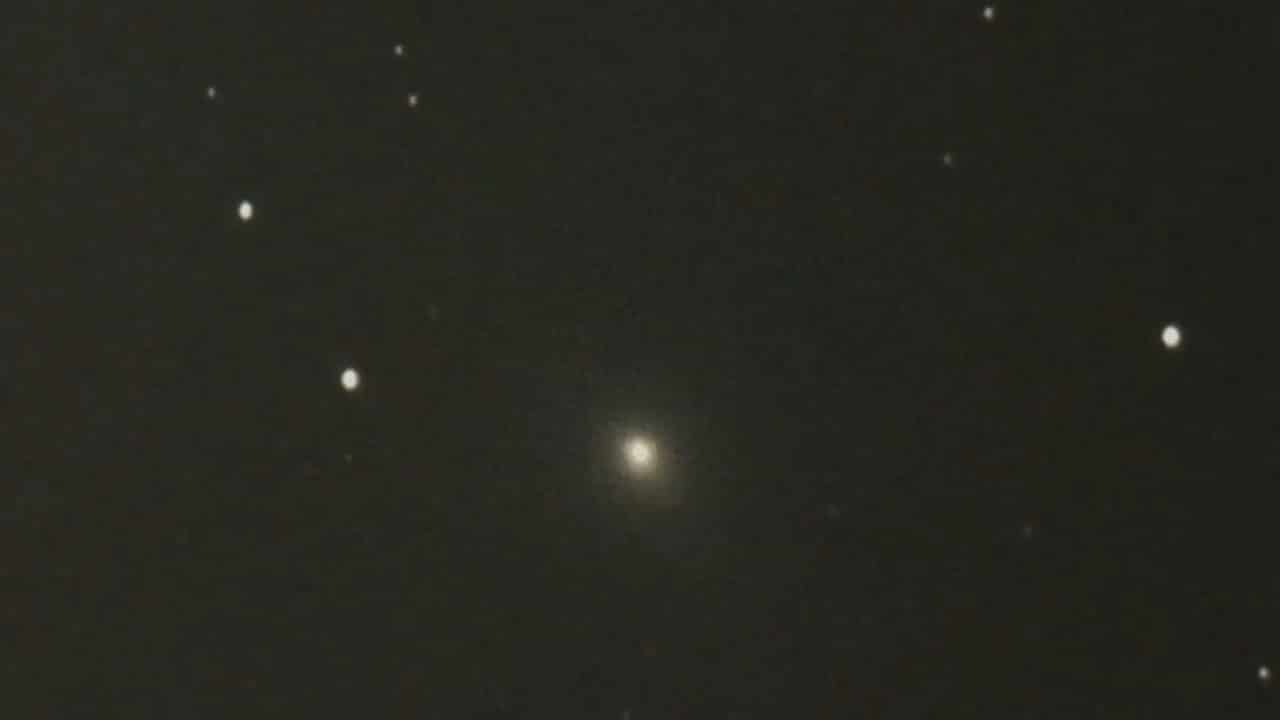
A new visitor from another star system is crossing our cosmic neighborhood in 2025. The interstellar comet, cataloged as 3I/Atlas, has been confirmed by astronomers and is moving at an impressive speed of 57 kilometers per second. Observations indicate that the object follows a hyperbolic trajectory, meaning it will not be captured by Sol’s gravity and will only make a single pass through our Sistema Solar before returning to deep space.
The recent detection positions 3I/Atlas as the third confirmed interstellar object to be observed, following in the footsteps of ‘Oumuamua in 2017 and Borisov in 2019. The field of influence of Sol extends over a vast area, but is not sufficient to trap 3I/Atlas in a permanent orbit.
The speed of the 3I/Atlas considerably surpasses that of its predecessors, which recorded marks of 26 km/s (‘Oumuamua) and 33 km/s (Borisov). Essa feature reinforces its extrasolar origin and offers scientists a rare opportunity to study material forged around another star, providing valuable data on the formation of other planetary systems.
Origin and ejection of interstellar objects
Celestial bodies like 3I/Atlas orbited their home stars for millions or billions of years before being expelled into space. The ejection of these objects often occurs due to complex gravitational interactions within their native systems, such as the influence of giant planets or the close passage of other stars. Stellar Explosões, like supernovae, are also mechanisms capable of launching comets and asteroids on intergalactic journeys, transforming them into messengers from distant worlds that carry the chemical composition of their region of birth.
These cosmic travelers travel through the void of space for long periods until, by chance, they cross a planetary system like ours. The astronomers’ job is to identify their unique trajectories, which do not conform to the orbital patterns of objects belonging to Sistema Solar, to confirm their extrasolar nature. Modern Telescópios are essential for tracking these movements and analyzing the light reflected by them, which allows us to decipher their composition and better understand the conditions from which they came, expanding knowledge about the diversity of planetary systems in the galaxy.
Hyperbolic trajectory in detail
A hyperbolic trajectory describes an open path, indicating that the object’s speed is greater than the local escape velocity at all points on its journey. Comet 3I/Atlas enters Sistema Solar, has its route slightly curved by the gravity of Sol and continues its path without forming a closed orbit.
The solar gravitational force changes the comet’s direction, but cannot reduce its speed enough for capture. Continuous observations throughout 2025 allow us to accurately map its outward path into deep space.
Orbital calculations predict the point of maximum approach to Sol, known as perihelion, with the main interaction lasting a few weeks. Modelos computational simulates the effect of the gravitational slingshot to refine predictions about its future path.
Comparison with comets in the solar system
Comets that originate in our own Sistema Solar, such as those from Cinturão of Kuiper or Nuvem of
In contrast, interstellar objects like 3I/Atlas maintain a high velocity inherited from their galactic environment, a fundamental difference that highlights their external origin. Spectroscopy is used to analyze its composition and identify element ratios that may be unique.
Acceleration observed in previous cases
The first confirmed interstellar visitor, ‘Oumuamua, exhibited intriguing behavior in 2017 by demonstrating unexpected non-gravitational acceleration during its passage through Sol. Após extensive analyses, one of the most accepted explanations for this phenomenon was the release of gases, a process known as degassing, possibly from molecular hydrogen trapped inside the object. Solar heat would have heated the rocky body, causing the gas to be expelled and acting as a natural propellant, subtly altering its trajectory in a way that gravity alone could not explain. Although other hypotheses have been raised, the lack of concrete evidence for more exotic theories has kept the natural explanation as the most likely among the scientific community.
Effects of gravitational interaction
The passage of 3I/Atlas through Sistema Solar bends its trajectory at an angle that can be accurately calculated by astronomers.
Observatories around the world monitor the object to refine orbital data in real time, ensuring the accuracy of predictions.
The comet’s kinetic energy prevails over the Sol’s gravitational pull, allowing it to continue its journey.
After leaving the solar influence, the object will maintain its perpetual movement through interstellar space, possibly for another million years.
Chemical composition analysis
Preliminary studies of the light reflected by 3I/Atlas seek to identify common chemical elements, but in proportions different from those found in objects from our Sistema Solar. Essa spectral analysis is essential to confirm its classification as an interstellar body.
Telescopes equipped with spectrographs capture the light spectrums to compare them with local materials and data from previous visitors. The results obtained so far reinforce the absence of a direct link with the formation of our Sol.
Observations continue into 2025
The global astronomical community will continue to monitor 3I/Atlas throughout its passage into 2025, taking the opportunity to gather as much information as possible about this rare messenger from another star system.
[[_0]



