
NASA detects anomalous structure in interstellar comet 3I/ATLAS and sparks debate about its origin

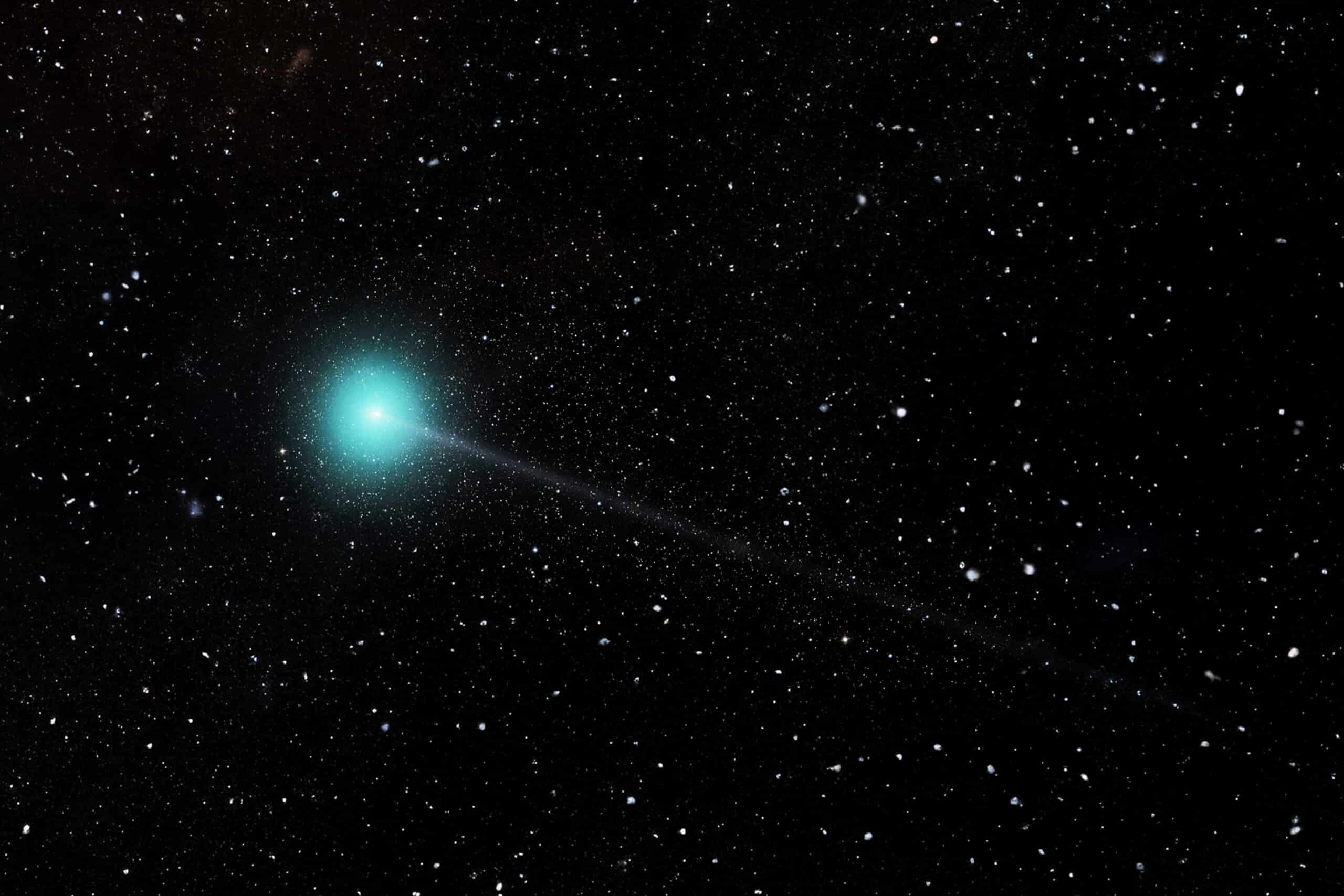
The North American space agency announced on November 5, 2025 the detection of an unusual formation in the interstellar comet 3I/ATLAS, a discovery that sparked intense debate in the global scientific community about the true origin and composition of the object. The structure, which challenges traditional cometary models, was identified during an intensive monitoring campaign of the celestial body.
The object was initially located in July 2025 by the astronomical survey system ATLAS (Asteroid Terrestrial-impact Last Alert System), at Havaí. Desde the beginning, its trajectory was classified as highly hyperbolic, a clear indicator that the comet did not originate in our Sistema Solar, but rather in the deep space between the stars.
Classified as the third confirmed interstellar visitor to enter our system, after the enigmatic ‘Oumuamua in 2017 and 2I/Borisov in 2019, 3I/ATLAS offers a rare and valuable opportunity for astronomers to directly analyze materials from another star system, providing clues about the formation of planets in other parts of the galaxy.
Discovery and unusual trajectory of the visitor
Confirmation of 3I/ATLAS as an interstellar object was quickly established by observatories around the world. Sua speed, estimated at more than 56,000 kilometers per second relative to Sol, is excessive for any object gravitationally bound to our system, including those from distant Nuvem of Oort. Essa’s speed ensures that after its passage, it will escape the pull of Sol and continue its journey through interstellar space. Cálculos orbiters predict that the comet will make its closest approach to Terra in 2026, passing to a safe distance of approximately 27 million kilometers, an event that will allow even more detailed observations by ground-based and space telescopes.
The anomaly that intrigues scientists
The main mystery surrounding 3I/ATLAS is the observation of a tail that, at certain times, appears to point in the direction of Sol. Essa characteristic, known as the “antitail”, is formed by larger dust particles that are less affected by solar radiation pressure and tend to remain in the comet’s orbital plane.
However, the structure observed in 3I/ATLAS is more pronounced and persistent than expected, suggesting complex dynamics and possibly a different dust composition than that found in our Sistema Solar comets. Essa anomaly raises new questions about the environment in which the comet was formed.
Radio emissions detected from the object
Radio analyzes of the comet confirmed the presence of hydroxyl radicals (OH), a byproduct of the breakdown of water molecules by Sol. The detection, carried out at frequencies of 1665 and 1667 MHz, is a classic signature of cometary activity, but the intensity and pattern of emissions present variations that add a new layer of complexity to the study of the object.
The scientific debate about composition
Preliminary data from Telescópio Espacial James Webb indicate a composition that includes silicates and carbon compounds, common elements in comets.
However, isotopic analysis of some of these elements reveals proportions that differ from the patterns found in Sistema Solar bodies, reinforcing the hypothesis of their extrasolar origin.
Researchers are now focusing on determining whether 3I/ATLAS formed in a carbon- or oxygen-rich stellar environment, information that could reveal characteristics of its home star system.
Global observation campaign underway
A vast collaborative observation campaign was mobilized to study 3I/ATLAS, uniting the efforts of multiple space and ground-based observatories. Telescópio Espacial Hubble and the SOHO and STEREO-A probes, specialized in monitoring Sol, are tracking the comet’s activity as it approaches its minimum distance from our star. Continuous data collection will allow a three-dimensional analysis of its core, coma and tail dynamics, providing an unprecedented portrait of its physical properties and behavior under solar influence.
Agência Espacial Europeia (ESA) also plays a key role, using its resources to compare 3I/ATLAS data with that of previous interstellar visitors. Este global effort is essential to build a cohesive model of their origin, evolution and to better understand the diversity of small bodies traveling through interstellar space. [[_0] [[_0]
Interstellar origin or a rare case of our system?
The prevailing theory holds that 3I/ATLAS is a genuine interstellar traveler, ejected from its original planetary system millions of years ago.
Its speed and trajectory are the most robust evidence supporting this conclusion, being consistent with an object that is not gravitationally bound to Sol.
An alternative hypothesis, although considered less likely by most experts, suggests that it could be an object from the outermost region of Nuvem of Oort.
In this scenario, it would have been perturbed by a nearby star in the distant past, launching it into its current unusual orbit. Análises additional spectroscopic examinations will be crucial to definitively rule out this possibility.
Next steps and what to expect
The comet will reach its perihelion, the closest point to Sol, at the beginning of 2026.
Scientists will be watching for possible fragmentation events or bursts of activity, which could expose fresh material from inside the core. Tais events would provide a direct and pure sample of a building block of another planetary system.



