
Solar flare X1.9 alters observations of interstellar comet 3I/ATLAS as it approaches Earth


Administração Nacional Oceânica and The event occurred in the active region of Sol, generating a coronal mass ejection that could interfere with observation instruments. Cientistas monitor the impact on the object, discovered in July 2025 by the ATLAS system on Chile.
This temporal coincidence arises in the midst of a phase of high solar activity, with the solar wind reaching speeds above 650 km/s. The affected region will rotate to face Terra next week, enhancing magnetic disturbances. Astrônomos adjust protocols to capture data from 3I/ATLAS, whose hyperbolic trajectory confirms origin outside of Sistema Solar.
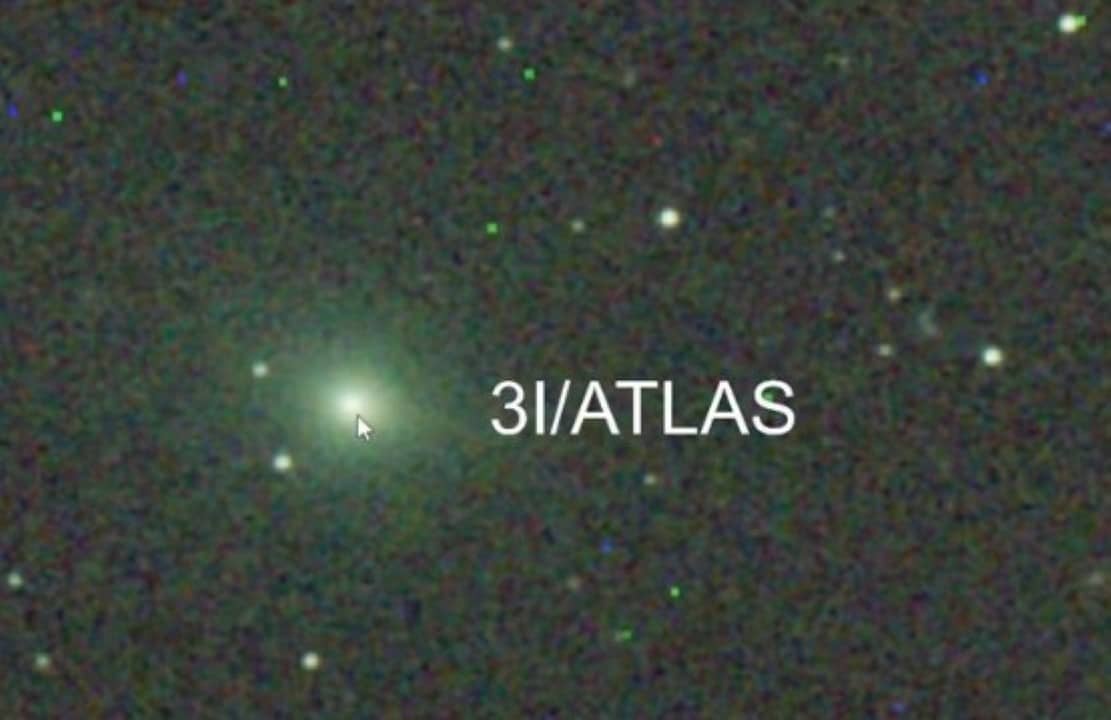
The comet, the third confirmed interstellar after 1I/ʻOumuamua and 2I/Borisov, has a reddish coma and tails detected by telescopes such as Hubble and Webb. Sua minimum distance to Terra will be 1.8 astronomical units, or approximately 270 million kilometers, without risk of collision.
- Solar wind speed: greater than 650 km/s, with electron peaks at 8,300 pfu.
- Magnetic component Bz: drop to -6 nT, signaling instability.
- Eruption magnitude: X1.9, with propagation of darkening in the solar corona.
- Critical date: December 19, 2025, point of closest approach.
Solar flare details
The solar detonation released energy equivalent to billions of atomic bombs, propagating a shock front across the surface of Sol. Essa wave destabilized a nearby filament, leading to a secondary explosion on the opposite side of the star. Observatórios and NASA’s Solar Dynamics Observatory captured the process in real time.
Regions of plasma have been evacuated, with dimming visible in X-ray images. The resulting coronal mass ejection travels at speeds that can reach Terra in two to three days, although directed partially out of direct line of sight.
Anomalous characteristics of 3I/ATLAS
The comet exhibits inexplicable acceleration in its trajectory, with rotational pulses detected by spectrometers. Jatos of non-radial gas emerges from its coma, which has grown from 13 thousand km in June to 18 thousand km in July 2025. Essa activity persists despite the 1.4 AU distance to perihelion on October 29.
Chemical composition includes reddish micrometric dust, similar to D-type asteroids, but with irradiated tholin emissions. Telescópios terrestrials in Chile and Havaí confirmed diffuse coma in July, with a tail length of 3 arc seconds.
The lack of outbursts through August suggests stability, but the recent solar flare could amplify emissions. Observações from TESS indicates activity since May 2025, at 6.4 AU from Sol.
Researchers from Instituto to Astrofísica to Canarias reported evolving reddish color, pointing to changes on the surface. Essa peculiarity reinforces the value of 3I/ATLAS for studies of exoplanetary systems.
Influence of the solar wind on observations
The accelerated solar wind, now above 650 km/s, affects the comet’s ionic tail, deflecting particles to form an antitail. Elétrons in geosynchronous orbit recorded peaks of 8,300 pfu, complicating readings from space telescopes.
The negative Bz component at -6 nT indicates opposing magnetic fields, enhancing reconnections that alter the interaction with the interstellar plasma. ESA’s Equipes adjust satellites such as Juice and Europa Clipper to capture signatures of the 3I/ATLAS tail between October 30th and November 6th.
This dynamic can mask data about the organic composition of the core, which preserves elements of its original star system. Sondas like Mars Express, close to Marte in October, registered a proximity of 29 million km without serious interference.
Scientific preparations for the passage
Astronomers mobilize global networks, including the Vera C. Rubin Observatory, to track movement through the constellations Virgem and Leão in December. Luminosity will fall below magnitude 12, requiring medium-sized telescopes.
NASA integrates data from missions such as Parker Solar Probe and SOHO to model flare impacts on the heliospheric environment. Previsões indicate that 3I/ATLAS will maintain nuclear integrity despite intense jets.
Anomalies detected on the comet
Hyperbolic trajectory exceeds expected speeds, with subtle deviations suggesting external gravitational influence. Radio Emissões captured by MeerKAT in África of Sul show OH absorption lines with periodic patterns, defying standard cometic models.
The nucleus, estimated to be 3.5 miles in diameter, resists thermal stress, unlike comets like C/2025 K1 that have fragmented. Imagens recent Gemini South reveal broad coma without post-perihelion fragmentation.
This resilience raises questions about ice crusts as carbon dioxide protecting water ice. Observações of Webb measure surface temperature to validate hypotheses.
Space telescope observations
Hubble captured images in July 446 million km from Terra, showing a broad tail pointing east. Webb analyzes spectra to identify preserved organics, while TESS detected early activity in May.
Probes like Hera and Europa Clipper dove into the ion tail in November, recording magnetic draping. Dados reach Terra in February 2026 due to thermal limitations.
These multiagency contributions construct a unique chemical profile, comparable to Borisov but with greater dust.
Event trajectory and chronology
3I/ATLAS entered Sistema Solar with a speed of 137 thousand km/h, detected on July 1, 2025. Pré-observations date back to June 14, confirming hyperbolicity.
Perihelion on October 29 at 210 million km from Sol; approach to Marte on October 3 at 29 million km. Passagem by Júpiter in 2026 will change final route to interstellar space.
The December 1st flare coincides with solar rotation, increasing risks to communications at radio frequencies at Ásia and Austrália.
Implications for planetary defense
ESA’s IAWN enables protocols for precise monitoring, integrating data from ATLAS and Rubin. Exercícios simulate tracking of interstellar objects, improving alerts.
The absence of a direct threat allows a focus on science, but the flare reinforces the need for shielding satellites. Comunidades of planetary defense debate whether anomalies justify categorization beyond natural.



