
Space discovery: PUNCH and NASA probes capture 3I/ATLAS shining near Mars in 2025

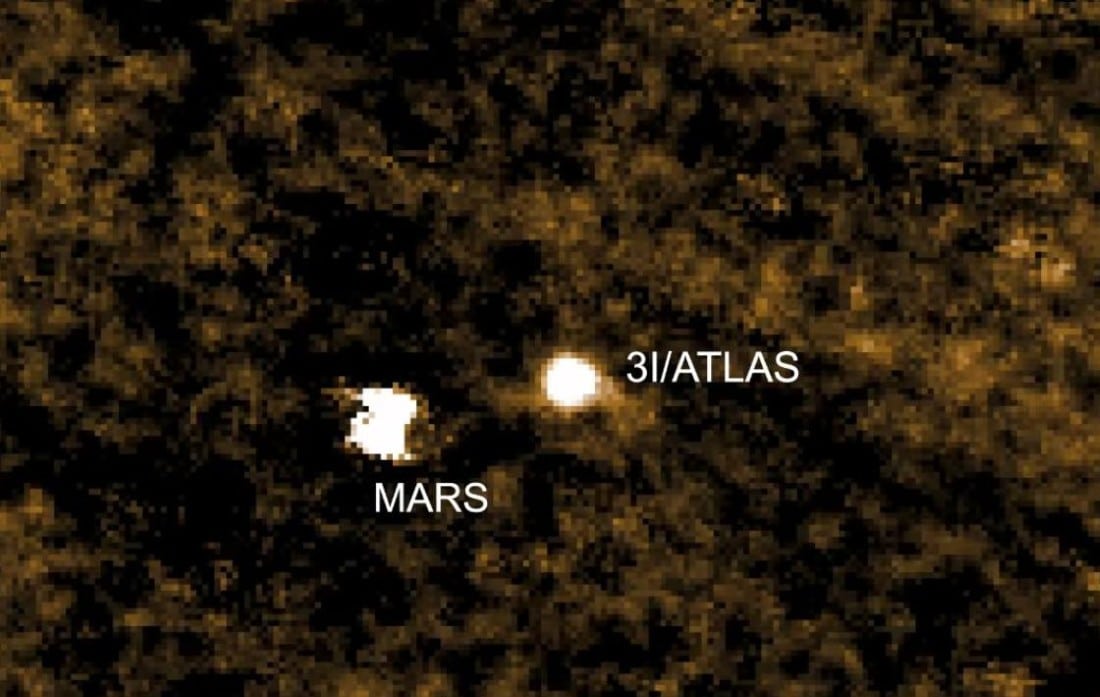
NASA’s PUNCH mission, dedicated to studying the solar corona, obtained significant images of the interstellar comet 3I/ATLAS during its close passage to Marte in September and October 2025. Cientistas were surprised by the intensity of the object’s brightness, even in close proximity to the red planet, highlighting unusual features for a visitor from outside
The detection of 3I/ATLAS occurred on July 1, 2025, using the ATLAS telescope, located at Chile. Comet Este was officially recognized as the third interstellar object to enter Sistema Solar, following in the footsteps of 1I/’Oumuamua and 2I/Borisov.

A vast network of NASA and ESA probes joined efforts to monitor the phenomenon. Instrumentos as well as Mars Reconnaissance Orbiter (MRO) and MAVEN, both in orbit around Marte, provided crucial and detailed data during the approach.
Initial observations from the PUNCH mission
The PUNCH mission, which launched in 2025 with the main objective of investigating the solar corona and solar wind, played a fundamental role in this record. PUNCH equipment captured the comet between September 28 and October 10, 2025, offering a unique perspective.
The combined PUNCH images revealed 3I/ATLAS as a well-defined central white dot, while Marte appeared as a bright spot moving across the field of view. The mission’s ability to observe regions close to Sol allowed it to track the comet in positions that would be challenging for ground-based telescopes.
Comet 3I/ATLAS and its identification
Comet 3I/ATLAS represents an important milestone for planetary science. Sua interstellar origin offers a rare opportunity to study material from other stellar systems, providing clues about the formation and evolution of planets and comets beyond our own.
Data collection by multiple probes
Several other space missions contributed to the comet 3I/ATLAS observation campaign. The Lucy probe, for example, managed to glimpse the object at a distance of approximately 240 million miles, while the Psyche probe recorded continuous observations over a period of eight hours.
Ultraviolet images, obtained by some of these instruments, were essential for mapping the presence of hydrogen atoms in the comet’s coma, the cloud of gas and dust that surrounds it. Esses data is vital to understanding the activity and composition of the object.
Martian trajectory and proximity
Comet 3I/ATLAS made its closest approach to Marte on October 3, 2025, passing about 18.6 million miles from the planet. Mars Reconnaissance Orbiter (MRO), using its HiRISE camera, captured a black-and-white image that showed the comet’s diffuse coma and dusty tail.
The proximity allowed probes orbiting Marte to make precise measurements of the comet’s trajectory. Agência Espacial Europeia (ESA)’s ExoMars The Perseverance rover, which operates on the Martian surface, also recorded 3I/ATLAS on October 4, albeit as a faint speck against the starry sky. Esses combined data provides valuable information about the object’s interaction with the Martian environment.
Composition and structure analysis
Preliminary analyzes indicate that the core of 3I/ATLAS has an estimated diameter of about 1 kilometer, as revealed by images from Telescópio Espacial Hubble on July 21, 2025. The coma, the cloud of gas and dust surrounding the core, exhibited unusual cyan hues, suggesting the presence of atypical volatiles in its composition.
Telescópio Espacial James Webb (JWST) used its NIRSpec instrument to obtain near-infrared spectra, allowing identification of possible chemical differences compared to comets that originate from our own Sistema Solar. Esses Chemical traces could offer crucial clues about the comet’s origins in another star system. Além Furthermore, the absence of a prominent ionic tail, despite the observed activity, indicates relatively low ion production. Observações from the MAVEN mission mapped the presence of hydrogen and hydroxyl in the coma during the perihelion approach period.
Contributions from solar and global missions
Space missions focused on solar observation, such as STEREO and SOHO, also followed 3I/ATLAS, tracking it from September 11 to October 26, 2025. SOHO recorded a faint central brightening of the comet between October 15 and 16, while STEREO captured a series of stacked images that detailed the object’s movement through space.
Other probes, including Parker Solar Probe and SPHEREx, contributed additional data on the comet’s dust and emissions. Essas missions were able to capture the three-dimensional structure of the tail, complementing observations from ground-based telescopes and helping with modeling the dust ejection. The comet’s perihelion occurred on December 12, 2025, at a distance of 1.36 astronomical units from Sol, without presenting any risk of collision. The global observation campaign, coordinated by the UN’s International Asteroid Warning Network (IAWN), involved instruments such as the JWST and the Very Large Telescope (VLT) over a period of two months.
Scientific implications and future of interstellar objects
Detailed observation of objects like 3I/ATLAS offers scientists the opportunity to make direct comparisons with comets originating in our own Sistema Solar, as well as with other interstellar objects already studied, such as 1I/’Oumuamua and 2I/Borisov. The persistent luminosity of 3I/ATLAS, even under challenging conditions, suggests the possibility of a more reflective surface or an exceptionally efficient dust ejection mechanism.
The data collected during this observation campaign will be fundamental to future studies, allowing researchers to model the evolution of comets in distant star systems and improve our understanding of the diversity of celestial bodies in the universe. Additional Missões, such as Europa Clipper, also contributed peripheral observations, enriching the catalog of trajectories of interstellar objects. Astrônomos predict that 3I/ATLAS will leave Sistema Solar after its perihelion, leaving a legacy of information for long-term analysis.



