
Mitsunori Tsumura reveals unprecedented image of interstellar comet 3I/ATLAS with straight tail and symmetrical coma

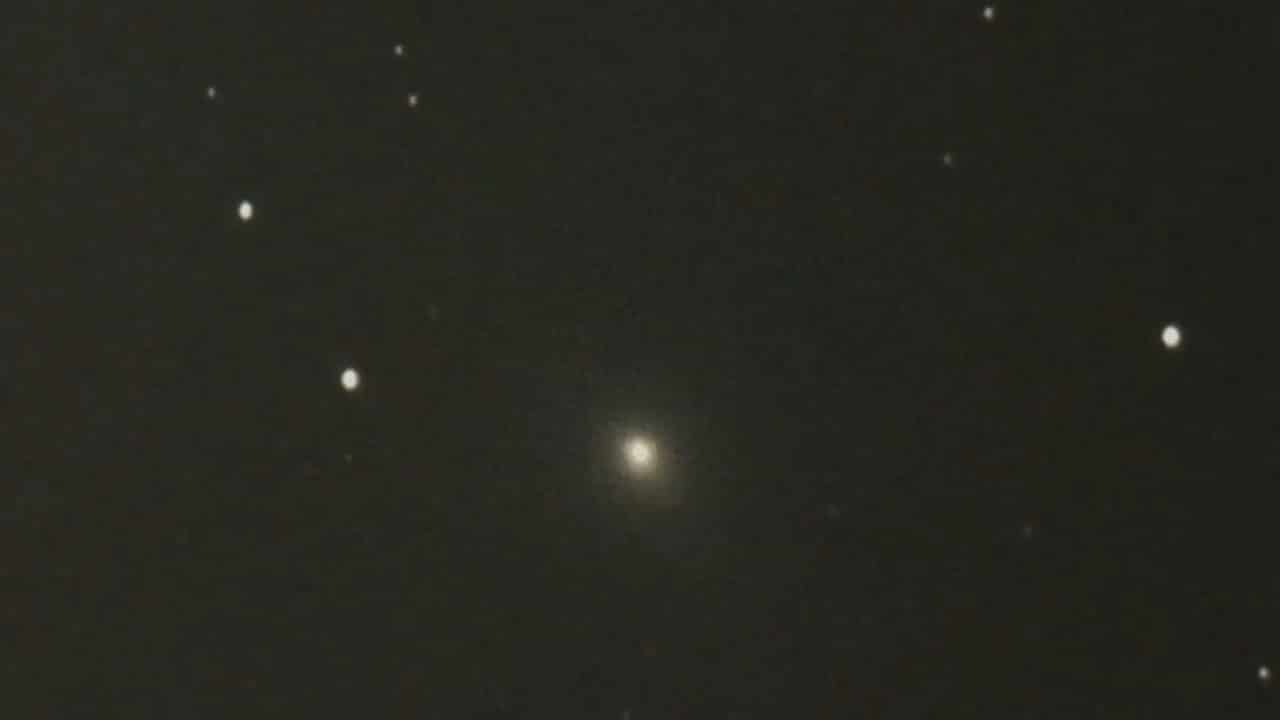
Japanese astronomer Mitsunori Tsumura has released an unprecedented image of the interstellar comet 3I/ATLAS, captured on November 22, 2025, using a 0.5-meter telescope. The recently published observation highlights features that are distinct from typical comets, such as an ionic tail and fine, collimated dust, and a coma with remarkably symmetrical luminosity. Especialistas examine the material to understand any differences in the composition of the object, whose origin is external to Sistema Solar, offering a rare opportunity to study matter from other stellar systems.
This capture comes amid a series of intensified global monitoring that followed the comet’s discovery by the ATLAS system in July 2025. 3I/ATLAS’s unusual trajectory and visual properties have generated great interest in the international scientific community, challenging established models of cometary formation and evolution.
The visual characteristics recorded by Tsumura point to atypical behavior, which manifests itself in several aspects of its structure:
Straight tail defies dispersal expectations
The tail of comet 3I/ATLAS remains remarkably narrow throughout its entire length, contrasting with the dispersion usually caused by the action of the solar wind. Esta characteristic suggests that the materials that compose it are resistant to external pressure, which differs significantly from the behavior of comets originating in our system.
The observed collimation indicates a robust structure, similar to initial observations of other interstellar objects such as 2I/Borisov, but with an even more pronounced linearity. Esta peculiarity raises important questions about the nature of the material and the sublimation processes that occur on this celestial body.
Absence of curvature in the cometary structure
There is no curvature in the comet’s tail, despite its hyperbolic trajectory through interplanetary space. The solar wind typically imposes arcs on the tails of solar comets due to relative speed and interaction with ejected particles, a common phenomenon in astronomy.
The complete straightness predominant in this object challenges conventional models of interaction between comets and the interplanetary environment, suggesting a peculiar resistance to external forces. NASA data, in turn, indicate non-gravitational accelerations that regulate the comet’s orbit, influencing its path.
The precision of these accelerations is remarkable, approaching the radius of Hill to Júpiter, at a distance of 53.5 million kilometers. The predicted distance for 2026, 53.445 million kilometers, reinforces the most recent orbital analyses, indicating surprising predictability for an object of its nature.
Symmetrical luminosity in the central coma
The 3I/ATLAS coma has a uniform and almost spherical luminosity, without the anisotropic jets that are common in irregularly shaped cometary nuclei. Chaotic sublimation in natural comets often generates asymmetries in the coma, but the uniformity observed in this object suggests stable and controlled emission processes.
Observations of Telescópio Espacial Hubble estimate the core’s diameter at up to 5.6 kilometers, although data from August 2025 suggests it could be less than 440 meters. Imagens from missions like PUNCH confirm a brief elongation of the tail, aligning with atypical patterns detected in September.
The discrepancy in the luminosity decay suggests a controlled emission, even if analyzes point to ancient interstellar ice, formed under very different conditions in another stellar system. Esta consistency in the emission of material from the coma is one of the central puzzles that 3I/ATLAS presents to scientists.
Intriguing parallel secondary filament
A faint, linear structure is visible, running parallel to the main tail, with minimal angular separation. Diferente of the usual division between ionic and dust tails that separate as they move away from the nucleus, this filament maintains a reduced proximity, which is unusual behavior.
This characteristic suggests the existence of multiple flows of material that do not diverge in their patterns, a behavior that intrigues astronomers and indicates complexity in the ejection dynamics. Ground-based telescopes record a greater extent than would be expected for natural objects in Sistema Solar, adding more mystery.
Compact core without dust diffusion
The nucleus of 3I/ATLAS appears as a stellar condensation, without the diffusion of dust that is typical of comets in our system. In common cometary structures, the nuclei emit diffuse halos with clusters and streaks, but in this case, the central concentration is high and there are no luminous nodes. Essa’s absence of diffuse texture reinforces the uniformity of the tail, a feature observed in multiple spectral bands since its passage through perihelion, 1.4 astronomical units from Sol, in October 2025. The proximity to Marte has allowed data from missions such as understanding its unique trajectory and deepening the study of its unusual composition.
Hyperbolic trajectory and continuous monitoring
Comet 3I/ATLAS follows a hyperbolic path, indicating that its origin is outside of Sistema Solar, coming from the direction of the constellation of Sagitário, opposite the solar apex. Observations carried out by Telescópio Gemini Sul and Nordic Optical Telescope confirm the comet’s activity since May 2025, when it was 6.4 astronomical units from Sol. The reddish composition of the coma is evolving, suggesting a changeable surface, with nickel and iron emissions detected in the August analyses. Missões like MAVEN record ultraviolet hydrogen, but with no visible match predicted, broadening the debate about the volatility of interstellar objects and their interaction with the interplanetary medium.




