
Image of cosmic butterfly NGC 6302 marks anniversary of Gemini South telescope with data on dying stars

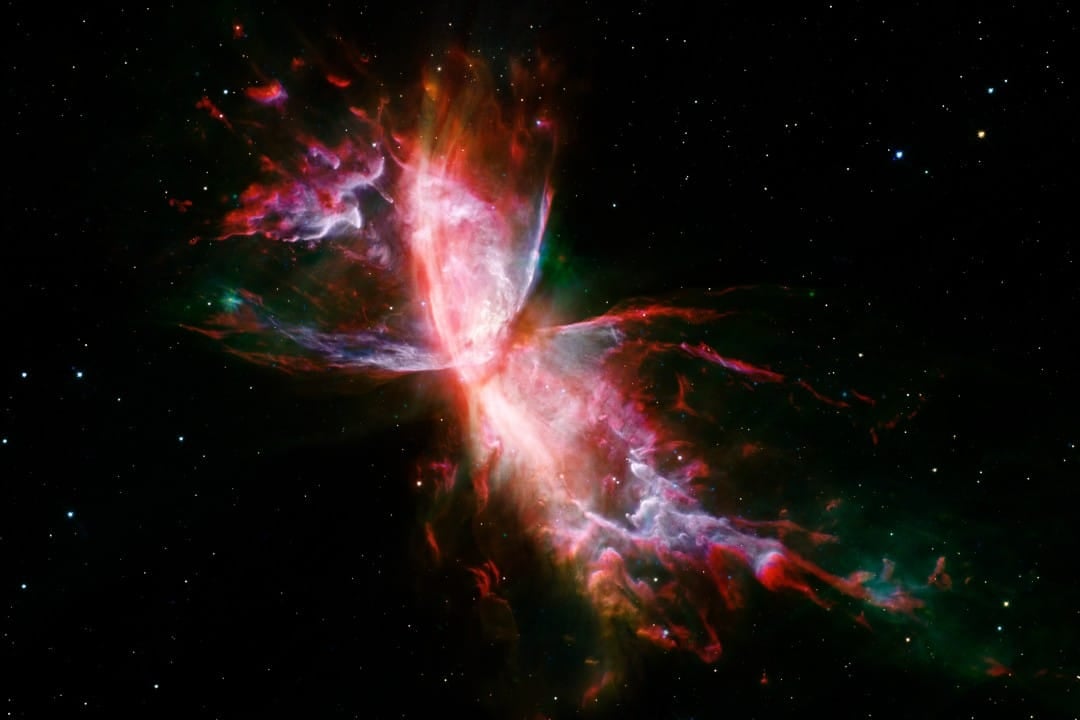
The NoirLab laboratory has released a detailed image of the planetary nebula NGC 6302, known as Borboleta Cósmica, to mark 25 years of the Gemini Sul telescope, in the Atacama desert, at Chile. The capture took place last month, with the instrument pointed at the constellation of Escorpião, around 3,000 light-years from Terra. Essa gaseous structure represents the final stage of a star of similar mass to Sol, which ejected its outer layers approximately 2,000 years ago.
The choice of the image came from Chilean students involved in the Observatório Internacional Gemini project, which has operated the telescope since its first observation in December 2000. NoirLab, linked to the Fundação Nacional of Ciência of the Estados Unidos, highlighted the photo as a way of illustrating advances in observations of planetary nebulae. The nebula displays symmetrical wings of ionized gas, heated by radiation from the central star.
NGC 6302 measures a diameter equivalent to 10 thousand times that of Sol and continues to expand. Pesquisas recent studies indicate that its formation involves bipolar jets of material, creating the butterfly appearance.
Here are key elements of the capture:
- Estimated distance: Entre 2,500 and 3,800 light years.
- Central star temperature: Acima of 250 thousand degrees Celsius.
- Observed gases: Hidrogênio in red and oxygen in blue.
Origin of the gaseous structure
Planetary nebulae arise when low- to medium-mass stars exhaust their nuclear fuel and expand their outer envelopes. In the case of NGC 6302, the process began millennia ago, with equatorial ejections forming a ring of dust that still surrounds the nucleus.
Previous observations, such as those from the Hubble telescope in 2009, identified the central star as a white dwarf with two-thirds the solar mass, compacted into a volume similar to that of Terra. The ultraviolet radiation from this star ionizes the surrounding gas, generating the visible glow on the structure’s wings.
The Gemini Sul, with its 8.1-meter mirror, captured fine details thanks to adaptive optics, which correct atmospheric distortions in real time.
Contributions to modern astronomy
Observatório Gemini, made up of twins in Hemisfério Norte and Sul, has provided global coverage of the night sky since 2000.
This image reinforces the telescope’s role in studies of stellar evolution, providing spectra that reveal precise chemical compositions. In 25 years, the instrument has contributed to discoveries about exoplanets and supernovae, integrating data with satellites such as James Webb.
Local students participated in target selection, promoting inclusion in astronomical research at Chile.
Continued operation depends on international collaborations, with recent upgrades improving infrared sensitivity.
Technical details of the capture
The photograph uses filters to separate emissions of chemical elements, with red lines indicating ionized hydrogen and blue lines representing oxygen. The central star, hidden by dense dust, reaches extreme temperatures that heat the wings to 20 thousand degrees Celsius.
The imaging process involved integrating multiple exposures to reduce noise, resulting in a resolution that highlights interconnected gas bubbles. Comparações with data from Atacama Large Millimeter Array shows dusty structures at the center, essential for understanding the formation of cosmic dust.
Researchers note that the expansion of the nebula occurs at speeds of hundreds of kilometers per second.
Stellar formation and evolution
Stars like NGC 6302 follow a predictable cycle: after the red giant phase, they lose mass via stellar winds, forming planetary nebulae in around 20 thousand years. Esse stage enriches the interstellar medium with heavy elements, building blocks for new stars and planets.
The cosmic butterfly exemplifies asymmetric ejections, possibly influenced by an undetected binary companion. Estudos indicate that 80% of planetary nebulae have similar bipolar shapes.
Data from Gemini Sul feeds computer models that simulate these dynamics, predicting the fate of Sol in 5 billion years.
The nebula remains visible to amateur telescopes on clear nights in the Southern Hemisphere.
Advances in Infrared Observations
The Gemini Sul integrates instruments such as the GPI, which detects exoplanets, but for NGC 6302 it prioritized the spectroscopic mode. Essa technique measures speeds of expanding gas, confirming polar jets at 950 km/s.
Collaborations with James Webb, launched in 2021, complement visions: while the orbital one penetrates deep dust, the terrestrial one offers broad context. In 2025, joint ventures produced three-dimensional maps of nebulae.
NSF funding guarantees upgrades, such as new detectors for medium wavelengths.
Implications for cosmic dust studies
Dust grains in NGC 6302, measuring micrometers in size, grow by collisions and condensation, forming the basis for planetary systems. Observações recent measurements have measured sizes of one millionth of a meter, suggesting rapid maturation.
These organic and mineral materials mirror those of early Terra, linking nebulae to the origins of life. Análises chemistry reveals an abundance of carbon and silicon.
The dust cycle recycles galactic elements, sustaining continuous star formation.
Legacy of 25 years of Gemini
Since 2000, the telescope has processed petabytes of data, generating thousands of publications. Celebrações in 2025 include public exhibits at Chile, highlighting local impacts on science.
The instrument monitors variations in objects like NGC 6302, tracking annual changes in expansion.
Future missions, such as Extremely Large Telescope, will inherit techniques from Gemini.



