
Indian scientists find spiral galaxy identical to the Milky Way from 12 billion years ago

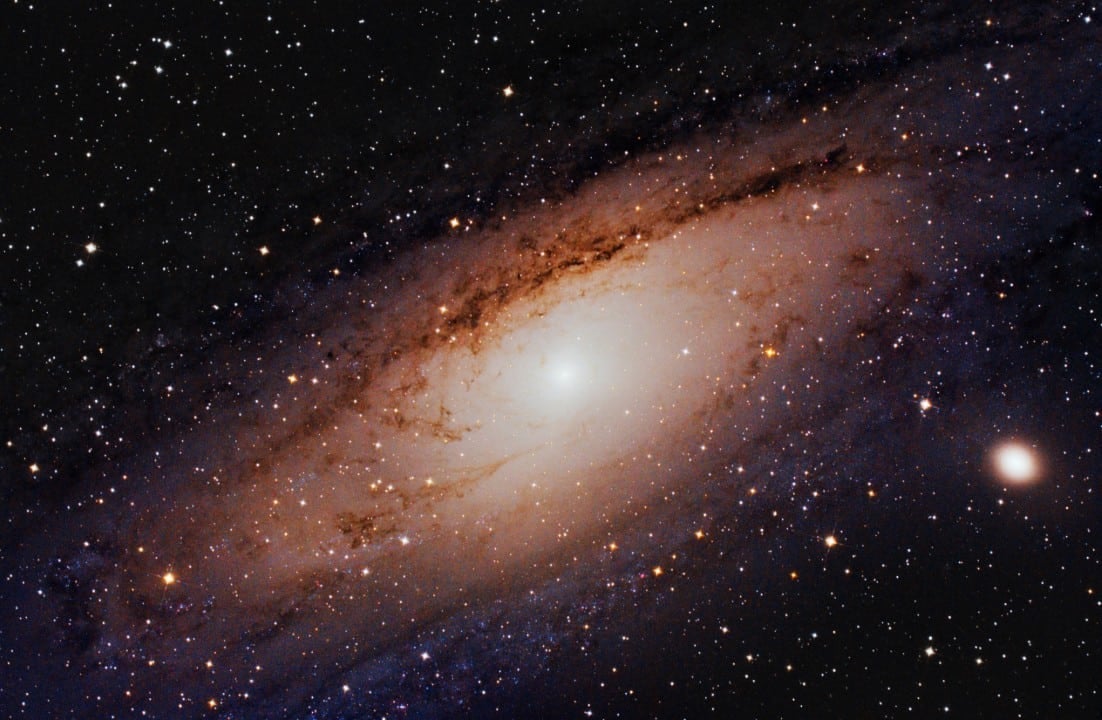
Indian scientists have identified, with data from Telescópio Espacial James Webb, a spiral galaxy fully formed when the universe was just 1.5 billion years old. Batizada from The discovery, published in the journal Astronomy and Astrophysics in November 2025, questions current models of galaxy formation in the early universe.
The galaxy was located by doctoral student Rashi Jain, from National Centre for Radio Astrophysics (NCRA-TIFR), in Pune, during JWST image analysis. Seu advisor, Professor Yogesh Wadadekar, confirmed the large structure with two well-defined spiral arms and star clusters along them.
Characteristics of the galaxy Alaknanda
Alaknanda has a diameter estimated at 30 thousand light years and a mass equivalent to 10 billion suns.
The star formation rate is 20 or 30 times higher than the current rate of Via Láctea.
The object displays the classic “beads-on-a-string” pattern, with clusters of young stars aligned in the spiral arms.
Context of the early universe
Traditional models indicate that galaxies from the period known as the cosmic dawn were small, irregular and chaotic.
The presence of such an organized spiral structure just 1.5 billion years after Big Bang represents a significant exception.
Previous observations of James Webb already indicated galaxies that were more complex than expected, but Alaknanda stands out due to its degree of maturity.
Detection process
Rashi Jain analyzed details of around 70,000 objects captured by JWST until identifying the only large spiral.
The galaxy appears magnified by gravitational lensing created by the cluster Abell 2744, facilitating the observation of a distant and faint structure.
Amplification occurs by an approximate factor of two, according to data from NASA, ESA and CSA.

Structural details observed
The galaxy features a bright central disk with symmetrical arms that wrap around a luminous bulge.
The arms contain regions of intense star formation, visible as bright spots along the spiral structure.
The configuration reproduces characteristics of nearby spiral galaxies observed today.
Implications for cosmology
The discovery reinforces recent evidence that the early universe was more structured than previously believed.
Sophisticated structures like rotating disks and spiral arms arose earlier in cosmic history.
Researchers plan new observations with JWST and the Alma observatory at Chile to investigate the rapid formation of the arms.
Indian team work
The study was conducted entirely by scientists from NCRA-TIFR, in Pune.
The identification occurred during a systematic analysis of deep fields obtained by the CEERS program on James Webb.
Publication in Astronomy and Astrophysics followed international peer review.
The galaxy Alaknanda demonstrates that processes of assembling large rotating disks occurred on short time scales in the young universe. The structure maintains a high rate of star formation and advanced spatial organization for its time. Futuras spectroscopic observations should reveal the object’s chemical composition and internal dynamics.



