
James Webb discovers spiral Alaknanda galaxy formed 12 billion years ago and shakes cosmology

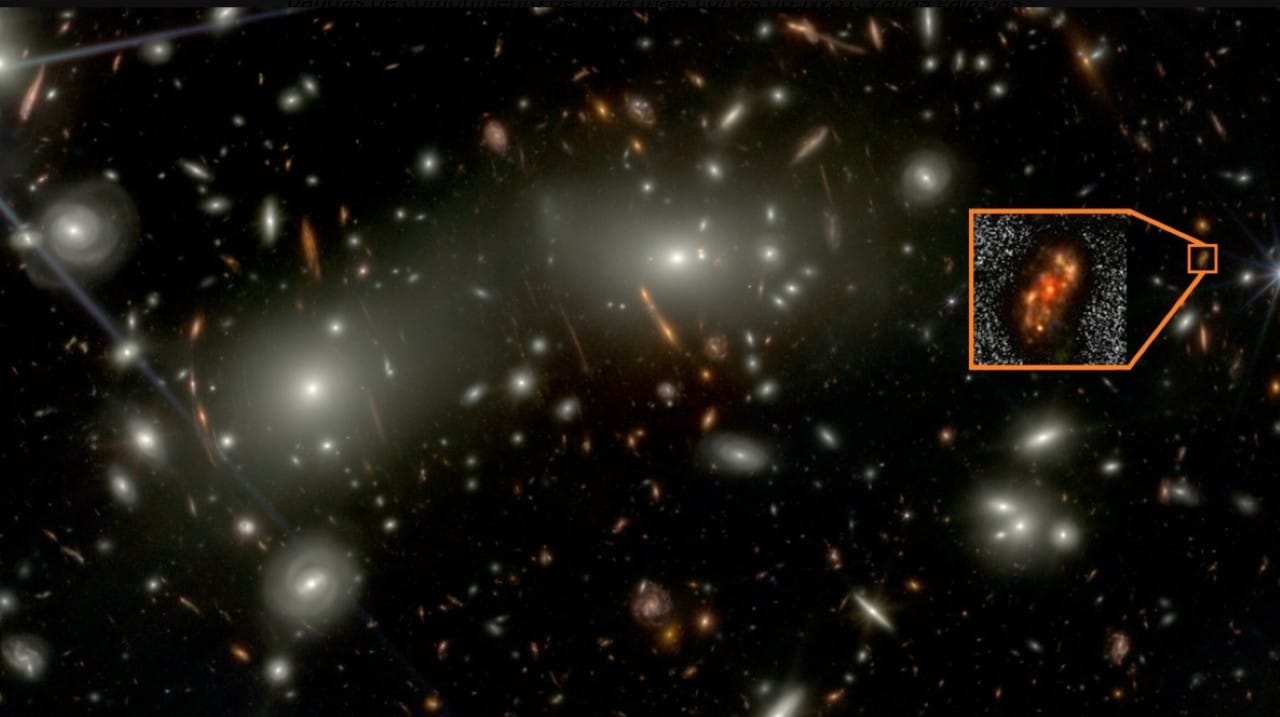
Espacial James Webb Telescope identified a fully formed spiral galaxy when Universo was just 1.5 billion years old. Batizada of Alaknanda, the structure is around 12 billion years old and has well-defined symmetrical arms. The discovery, led by Indian astronomers, was published in the magazine Astronomy and Astrophysics.
The galaxy has a diameter of approximately 30 thousand light years and is home to around 10 billion stars. The finding contradicts models that predicted chaotic and irregular structures in the primordial Universo.
- Structure similar to the current Via Láctea
- Bright core and two sharp spiral arms
- Formation occurred in a few hundred million years
Characteristics of the galaxy Alaknanda
Researchers from Centro Nacional of Radioastrofísica of Índia analyzed images captured by JWST. The galaxy Alaknanda stands out for its unusual symmetry for the cosmic era in which it existed.
The diameter corresponds to one third of the modern Via Láctea. The presence of spiral arms indicates organized rotation and efficient distribution of matter.
Identification process in James Webb
Rashi Jain was examining a set of 70,000 objects observed by the telescope when he identified the structure. Apenas a record showed characteristics of a classic spiral among thousands of primitive galaxies.
The Telescópio James Webb, launched in December 2021, operates in infrared and allows observing remote periods of the Universo. The images reveal details impossible to capture with previous instruments.
The analysis confirmed the distance and age through redshift. The data indicate accelerated formation of rotating disk and spiral arms.
Implications for cosmological models
The discovery suggests that galaxy formation processes occurred more quickly than calculations indicated. Complex Estruturas emerged when Universo was just 10% of its current age.
Traditional models expected small, irregular galaxies in the period known as cosmic dawn. The presence of a mature spiral indicates greater efficiency in the agglomeration of matter.
The finding reinforces evidence that the primitive Universo presented conditions favorable to rapid organization. Outras JWST observations have already shown massive galaxies at similarly remote times.
Technical details of the observation
The galaxy was detected during a systematic deep field survey. The images combine multiple filters from the telescope’s NIRCam instrument.
The spiral morphology remains visible even with the stretching caused by cosmic expansion. The luminosity of the nucleus suggests the presence of a supermassive black hole or a high rate of star formation.
Context of Indian research
The study was conducted by NCRA-TIFR staff on Pune. Yogesh Wadadekar coordinated the complementary spectroscopic analysis.
Publication took place in November 2025 in Astronomy and Astrophysics. The results underwent peer review before official release.
Advances made possible by JWST
The telescope operates from point L2, 1.5 million kilometers from Terra. The 6.5 meter segmented mirror allows for unprecedented resolution in infrared.
Observations like Alaknanda demonstrate the ability to resolve fine structures in distant objects. The instrument continues to map hundreds of thousands of early galaxies.
The discovery is part of the CEERS extragalactic survey program. Novos data will be analyzed in the coming months to identify similar cases.



