
30,000 light-year-old Alaknanda galaxy identified in primordial era shakes Big Bang theories

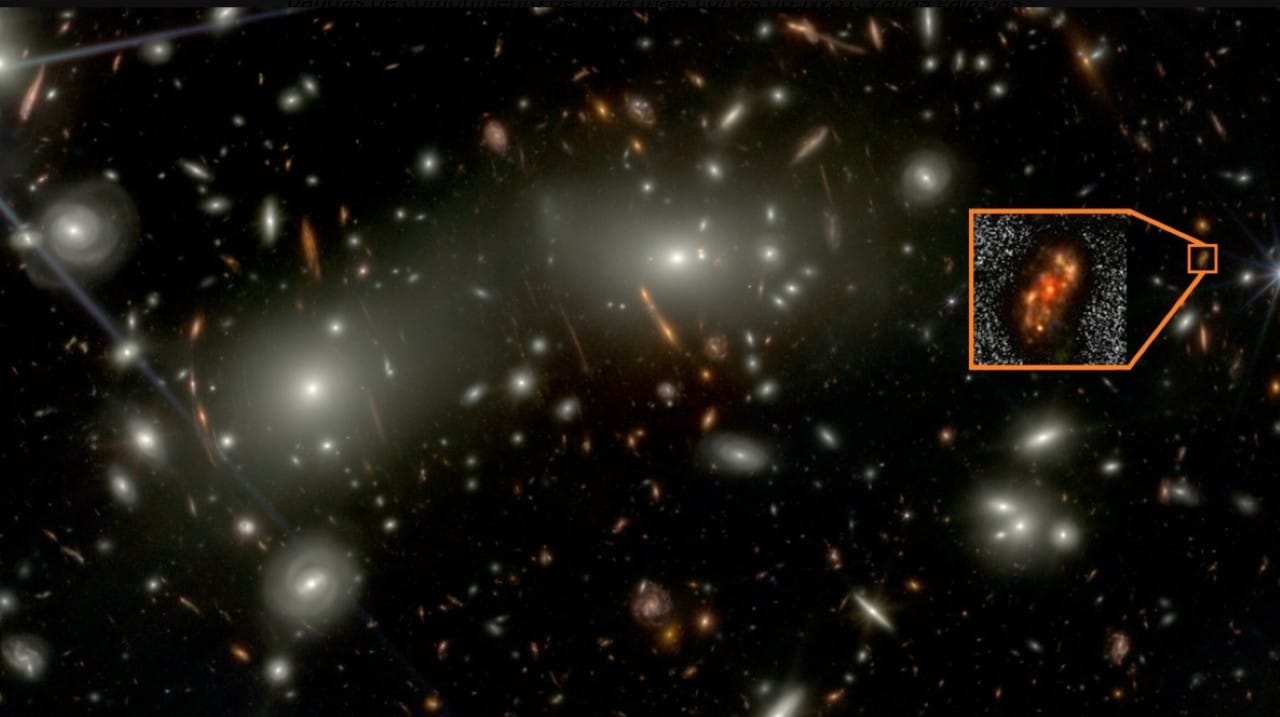
Astronomers at Centro Nacional of Radioastrofísica of Índia (NCRA-TIFR) announced the identification of a mature spiral galaxy, named Alaknanda, observed by Telescópio Espacial James Webb. The structure, formed about 12 billion years ago, reveals an unexpected organization in the early universe. The finding, published in November 2025 in the magazine Astronomy and Astrophysics, occurred during analysis of data collected by the space instrument operated by NASA, ESA and CSA.
The galaxy Alaknanda emerged when the cosmos was just 1.5 billion years old, or about 10% of its current age. Sua light, which traveled 12 billion years to reach Terra, shows symmetrical spiral arms and a bright central core. Essa configuration contrasts with expectations for small, irregular galaxies at this early epoch.
Researchers such as Rashi Jain and Yogesh Wadadekar highlight the similarity between Alaknanda and Via Láctea, despite the temporal difference. The diameter of 30 thousand light years represents a third of the size of our galaxy, and it is estimated that it houses 10 billion stars. The rapid formation of this structure requires revisions to standard cosmological models.
The discovery reinforces recent observations from James Webb about a more mature universe in the early days. Antes, telescopes like Hubble suggested chaotic scenarios shortly after Big Bang, which occurred 13.8 billion years ago. Agora, evidence points to accelerated stellar clustering processes.
Observed characteristics of Alaknanda
The galaxy has two well-defined spiral arms, visible in the infrared images of James Webb. Essa symmetry indicates early structural stability, with organized rotation of gas and dust.
Computer models estimate a star formation rate of 63 solar masses per year at the observed time. Essa speed exceeds the current speed of Via Láctea by more than 20 times, suggesting favorable conditions for rapid gravitational collapse.
The central core displays an intense glow, probably from young, massive stars. Análises spectra confirm chemical composition compatible with initial stellar populations, including dominant light elements such as hydrogen and helium.
Context of observation by James Webb
Telescópio Espacial James Webb, launched in 2021, operates in orbit around Sol in the second Lagrangian. Seus NIRCam and NIRSpec instruments captured Alaknanda at infrared wavelengths, penetrating cosmic dust.
Data was processed at the NASA operations center on Baltimore, on Estados Unidos. The Indian team analyzed a catalog of 70,000 celestial objects to isolate the galaxy, using morphological classification algorithms.
Additional observations with the Hubble were compared, revealing differences in resolution. The James Webb highlights fine details in the spiral arms, absent in older images of the predecessor.
The international partnership allowed priority access to telescope time. Propostas for follow-up include detailed spectroscopy to map rotational speeds.
Implications for cosmological models
Current theories predict that spiral disks require billions of years to stabilize after initial galactic mergers. Alaknanda, however, exhibits order on a scale of hundreds of millions of years.
- Accelerated dark matter clump may explain the stellar mass of 16 billion suns.
- Mergers with smaller galaxies likely contributed to the rapid growth.
- Spiral density waves emerged early, promoting concentrated star formation.
- Hydrodynamic simulations need to incorporate more efficient supernova feedback.
These factors suggest that the early universe allowed for non-linear evolutions. Ajustes in cosmic structure hierarchy equations are under discussion among cosmologists.
Details of star formation in the primordial era
Alaknanda accumulated half of its stars in the last 200 million years of its observed phase. Esse outbreak indicates continuous influx of hydrogenated gas from neighboring regions.
Hierarchical accretion processes brought together molecular clouds within a few stellar generations. Radiação ultraviolet radiation from massive stars ionized the surrounding hydrogen, facilitating subsequent collapses.
Comparisons with other ancient galaxies, such as JADES-GS-z14-0, show similar patterns of excessive luminosity. Ambas challenge the post-Big Bang slow formation paradigm.
Future studies with the Observatório ALMA, on the Atacama, on the Chile, aim to detect carbon monoxide emissions to quantify gas reservoirs.
Analysis team and methodology
Rashi Jain, a doctoral candidate at Pune, led the initial screening of spiral galaxy candidates. Ela applied morphological filters based on asymmetry and smoothness of luminous surfaces.
Yogesh Wadadekar coordinated dynamic modeling, simulating evolutions under Newtonian gravity. The team used TIFR supercomputers to run galactic collision scenarios.
Collaborations with ESA astronomers have validated spectral interpretations. The study integrated data from multiple James Webb campaigns, totaling 100 hours of exposure.
The name Alaknanda honors a sacred Indian river, reflecting the influx of matter that shaped the galaxy. Publicação open in the European journal facilitates peer replication.
Plans for future observations
Proposals for additional time at James Webb include mapping outlying stellar halos. Isso will help trace interactions with surrounding dark matter.
ALMA will investigate millimeter emission lines to measure dust temperatures. Resultados may clarify early chemical enrichment cycles.
Astronomers plan to expand deep-field searches of the JWST. Enlarged Catálogos can reveal more exceptions like Alaknanda, refining rarity statistics.
Integration with data from the future Roman telescope, scheduled for 2027, will allow volumetric surveys. Esses efforts aim to build a complete census of early galaxies.
Comparison with known structures
Via Láctea, 100,000 light-years in diameter, formed its spiral disk about 10 billion years ago. The smaller Alaknanda anticipates this process on a vast temporal scale.
- Difference in stellar mass: Via Láctea has 100 to 400 billion stars; Alaknanda, 10 billion.
- Current formation rate: 1-2 solar masses/year in our galaxy versus 63 in the early Alaknanda.
- Composition: Ambas rich in metals, but Alaknanda shows initial abundance gradients.
- Rotation: Velocidades similar, indicating comparable density profiles.
These similarities reinforce the universality of galactic evolutionary mechanisms.



