
NASA detects anomalous structure in interstellar comet 3I/ATLAS and fuels debate about its origin

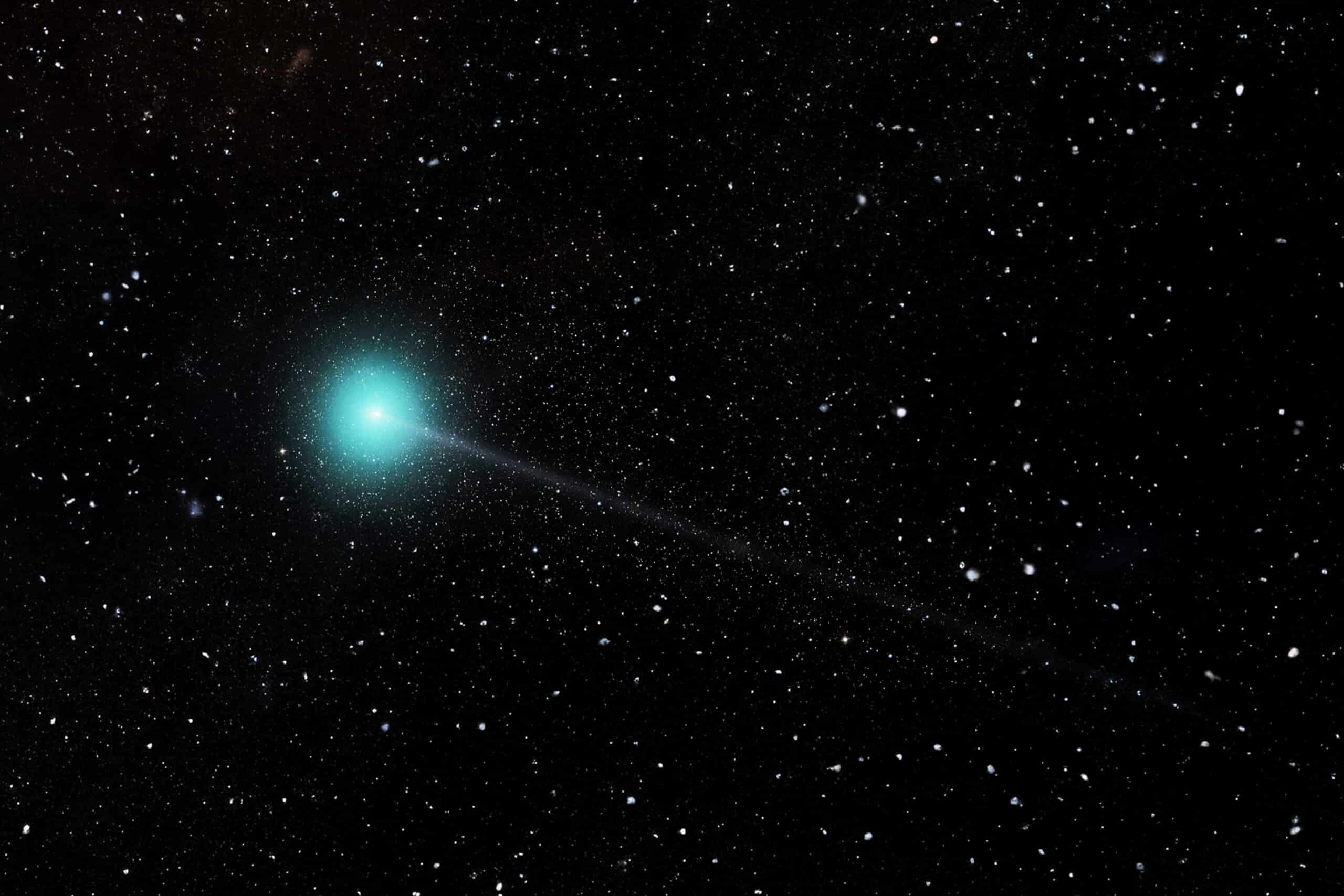
Agência Espacial Americana (NASA) detected an unusual structure in the interstellar comet 3I/ATLAS on November 5, 2025, reigniting intense debates among astronomers about its formation and the movement of celestial objects. Observado initially by the ATLAS observatory in July, this celestial body displayed a fan-shaped tail directed towards the sun, an unprecedented phenomenon for previously recorded comets. Essa unique feature challenges existing cosmological models.
This celestial body, whose fragmented tail extends for an impressive 56,000 kilometers, passed at an estimated distance of 2.7 million kilometers from Earth’s orbit, according to calculations by observatories in América of Norte. Additional observations, including those from Telescópio Espacial Hubble, were unable to clearly determine the gas emission, but identified uniform ionic emission.
Scientists have been closely monitoring this structure since October 29, the date of the comet’s perihelion, to understand the dynamics involved.
[[_0]
[[_0]
Initial discovery and hyperbolic path
The ATLAS observatory (Asteroid Terrestrial-impact
This celestial body moves at a speed of 58 kilometers per second, a rate that prevents it from being captured by solar gravity, ensuring that it continues its journey beyond our cosmic neighborhood. Sua nature is fundamentally different from that of comets that form in Nuvem from Oort, the most distant region of our solar system.
Unusual chemical composition and emissions
Spectral analysis performed by Telescópio Espacial Hubble revealed that the chemical composition of 3I/ATLAS remains unclear in several respects. While diatomic carbon is a major component, followed by water and hydroxyl ions, the most notable presence was that of nickel, an anomaly for comets that originate in our solar system.
This detection suggests that 3I/ATLAS formed in a unique interstellar environment, with distinct physicochemical conditions. In November, radio emissions at 1,665 GHz and 1,667 GHz were recorded, the first of their kind for an interstellar comet, indicating the presence of exotic volatile substances that further complicate its chemical profile.
After its perihelion, the comet lost about 13% of its volatile mass, and its acceleration was greater than that predicted by the action of the solar wind alone. Observations of Hubble made it possible to determine the comet’s nucleus, which varies between 320 meters and 5.6 kilometers, a range that reflects the difficulty in measuring such a dynamically active celestial body.
Transformations in the observed structure
Images captured by NASA on November 3 showed 3I/ATLAS’s fan-shaped tail pointing directly toward the sun. Contudo, just two days later, on November 5, this structure had completely dissipated, being replaced by a vast tail of ions.
This rapid evolution raises crucial questions about the comet’s gas and dust emission mechanism. Teorias currents suggest that magnetic fields may interact in unusual ways with the solar wind, causing abrupt changes in the comet’s morphology.
Responses from the scientific community
Astronomers point out that modeling the behavior of 3I/ATLAS with current theories is extremely challenging. The fan structure and its rapid dissipation indicate an unusual acceleration and evolution for a comet originating from another star system.
This singularity raises fundamental questions about its origin and subsequent evolution in interstellar space. The debate unfolds in several research groups, including centers for small bodies in the solar system. Astronomer Avi Loeb, from Universidade from Harvard, reinforced that there is no physical explanation for the comet’s current behavior, further boosting the discussion.
Detailed telescope observations
Telescópio Espacial Hubble confirmed that the comet’s nucleus varies between 320 meters and 5.6 kilometers, a data corroborated by files from the TESS satellite from May 2025. Além In addition, the MAVEN orbiter, positioned above Marte, detected changes in the comet’s coma during its passage.
These observations provide crucial data for comparison with previous interstellar objects such as Oumuamua and Borisov. Joint analysis of these data enriches understanding of the multifaceted nature of these celestial bodies, revealing characteristics that defy expectations.
Potential gravitational interaction
The passage of comet 3I/ATLAS through Marte in March 2026 could generate a significant gravitational disturbance. Simulações computerized technology already predicts extreme deviations in its trajectory in relation to models of the solar system. Este event will be closely monitored to test and refine astrophysical models.
As of October, the comet had passed within 27 million kilometers of Marte, and orbiters like Mars Reconnaissance Orbiter have provided high-resolution images. Durante this approach, an unexplained acceleration was recorded for several days, adding to the list of unusual behaviors.
Implications for interstellar research
Comet 3I/ATLAS offers a unique window into other star systems, allowing direct observation of material that formed outside our cosmic bubble. Suas unusual dynamics and chemical composition challenge existing models of comet formation in early stellar systems.
This suggests a possibility of greater diversity in these processes than previously thought. Global Esforços, like the Comet Interceptor program of Agência Espacial Europeia (ESA), are accelerating data analysis to maximize scientific return. The contribution of amateur observers also proves crucial, providing valuable high-quality image data during its appearance.



