
Pulsar like heartbeat intrigues astronomers in interstellar comet 3I/Atlas heading to Earth

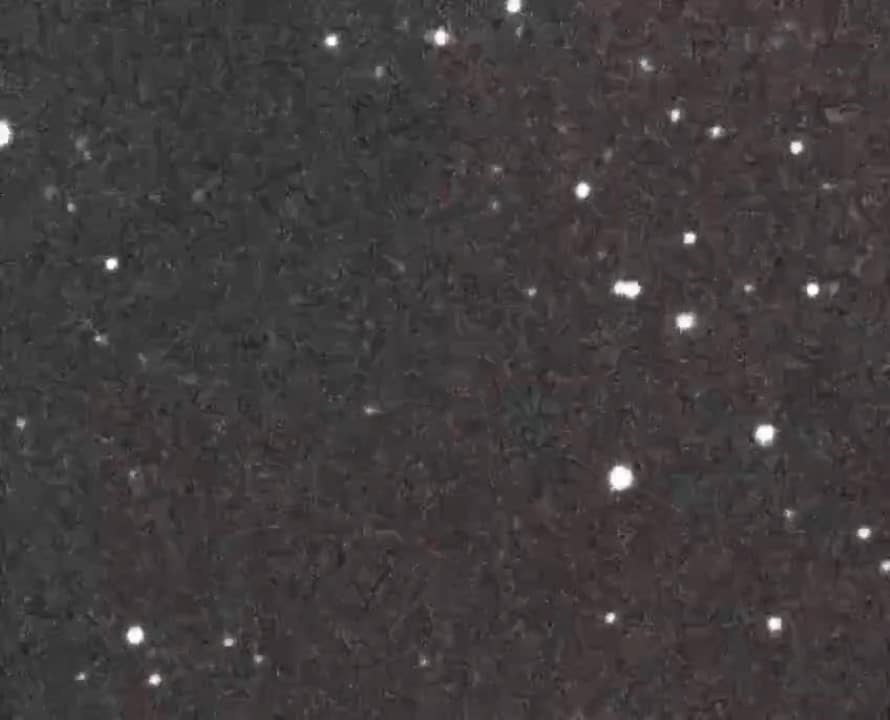
Comet 3I/Atlas, the third interstellar object confirmed by science, displays a brightness pattern that repeats every 16 hours. Esse phenomenon, detected by ground-based telescopes, occurs as the comet approaches Terra, with its closest passage scheduled for December 19, 2025. Astrônomos explain the pulse as a result of the rotation of the nucleus, which releases gases from frozen areas exposed to Sol. The American space agency confirms that there is no risk of collision, with a minimum distance of 273 million kilometers.
Discovered in July 2025 by the ATLAS system, the comet travels at speeds of up to 68 kilometers per second. Sua origin external to Sistema Solar makes it a rare opportunity for studies on the formation of other stellar systems. The light pulse, initially speculated as a signal of artificial origin, is attributed to natural processes by most experts.
Origin and discovery of the cosmic visitor
Astronomers identified 3I/Atlas on July 1, 2025, through observations at Chile. The object, with a diameter estimated at a few kilometers, follows a hyperbolic trajectory that differentiates it from local comets.
Its speed indicates independence from solar gravity, confirming interstellar status. Estudos initials point to an age greater than 7 billion years, prior to the formation of Sistema Solar.
- Discovery: July 1, 2025, by ATLAS on Hemisfério Sul.
- Maximum speed: 68 km/s at perihelion, on October 29, 2025.
- Distance to Sol at perihelion: 1.36 astronomical units.
The comet crossed perihelion between the orbits of Terra and Marte, intensifying global observations. Telescópios and Gemini captured images that reveal their ice- and dust-rich composition.

Mechanism of the observed light pulse
The core of 3I/Atlas rotates every 16.16 hours, exposing frozen surfaces to Sol. Esse rapid heating sublimates gases, generating jets that increase Terra’s visible brightness.
Similar processes occur in other comets, but the regularity here draws attention. Observações of November 2025 recorded the cycle accurately, using data from multiple observatories.
The release of carbon dioxide and water forms the ionic tail, which expanded to 3 million kilometers after perihelion. Astrônomos monitor variations to map internal structure.
In recent analyses, the pattern remains stable, despite the increasing distance from Sol. Isso allows accurate predictions for land passage.
Hypotheses about rhythmic behavior
An astrophysicist from Harvard proposes that the pulse may involve mechanisms beyond ordinary natural ones. Ele compares the phenomenon to a “celestial electrocardiogram”, suggesting internal cycles for orbit corrections.
However, the scientific community prioritizes explanations based on ice sublimation. Estudos published in December 2025 rule out technological origins due to lack of additional evidence.
The debate gained traction after images from November showed unusual alignments in the tail. Pesquisadores test computer models to simulate the jets.
The proximity to Júpiter in March 2026 could alter the pulse due to gravitational influences. Equipes prepare telescopes to capture changes in real time.
Trajectory and impact on Earth observation
The 3I/Atlas route takes it beyond the Júpiter orbit after December. On December 19, it will reach 1.8 astronomical units from Terra, visible with amateur telescopes at Hemisfério Norte.
Observers note that the tail initially points against the Sol, a rare “anti-tail”. Essa configuration evolves as the comet moves away, facilitating detailed photos.
- Current position: Direção in the constellation of Virgem, 2.1 AU from Terra.
- Approach to Júpiter: Março of 2026, without risk of collision.
- Sistema Solar output: Início of 2026, in addition to monitoring capacity.
NASA reinforces that the object does not affect planetary infrastructure. Amadores can track you via apps like Stellarium until January.
Composition and preliminary data collected
Spectra indicate the presence of water, carbon monoxide and organic dust in 3I/Atlas. Esses elements suggest formation in a distant protoplanetary disk.
Analysis of images from probes close to Marte detected hydrogen emissions. The comet releases about 10^28 molecules per second during peaks of activity.
Research focuses on “ice volcanoes” on the surface, which drive periodic jets. Dados of November 2025 confirm irregular rotation in the core.
The study reveals clues about interstellar chemistry, comparable to missions like Rosetta. Equipes international companies share data in open repositories.
Recent observations and scientific alerts
Telescopes at Havaí recorded the pulse on December 2, 2025, confirming the 16-hour cycle. Anomalias in the tail have generated debates about potential fragmentation.
The space agency monitors to rule out disintegration, common in active comets. Até now, the core remains intact, with a stable brightness.
Scientists predict visibility will decrease after January 2026. Observatórios prepare files for long-term analysis.
The phenomenon reinforces the importance of networks like ATLAS for early detections. Colaborações global companies accelerate publications in specialized journals.
Preparations for the passage of December
Teams at Estados Unidos adjust instruments to capture the comet in high resolution. The distance of 273 million kilometers allows for detailed spectrum studies.
European astronomers plan night sessions in December, focusing on color variations. Isso helps map ice sheets.
- Key equipment: Telescópio Hubble and James Webb for infrared imaging.
- Optimal time: Madrugada on December 19, visible in mid-latitudes.
- Target audience: Estações professionals and equipped amateurs.
The passage marks the end of the active observation phase, with data feeding models of comet evolution.
Scientific legacy of 3I/Atlas
The comet contributes to understanding interstellar migrations in Via Láctea. Sua composition differs from local objects, indicating galactic diversity.
Future studies will compare with Oumuamua and Borisov, the interstellar predecessors. Isso advances theories about planet formation.
Data collected in 2025 fills gaps in astronomical catalogs. Publicações initials appear in December, with conferences in 2026.
The event highlights advances in remote sensing, benefiting searches for exoplanets. Pesquisadores see potential for future missions.



