
Santander and Bradesco apps go offline simultaneously and affect Pix transactions, balance and login


Customers of Santander and Bradesco on Complaints focus on errors such as “data could not be loaded”, according to reports on monitoring platforms.
The failure affects millions of account holders in several regions, coinciding with the fifth working day of the month, when many receive salaries. Bancos confirmed the instabilities and informed that technical teams are working to resolve the case. Até At the moment, there is no exact forecast for the total normalization of services.
Initial user reports
Users began reporting problems early on, with recurring error messages in the Santander app. Em Aracaju, a customer mentioned failure when trying to log in at 10:35 am.
At Rio Grande of Sul, another account holder at Bradesco indicated it was impossible to transfer amounts via Esses incidents quickly spread throughout São Paulo and other capitals.
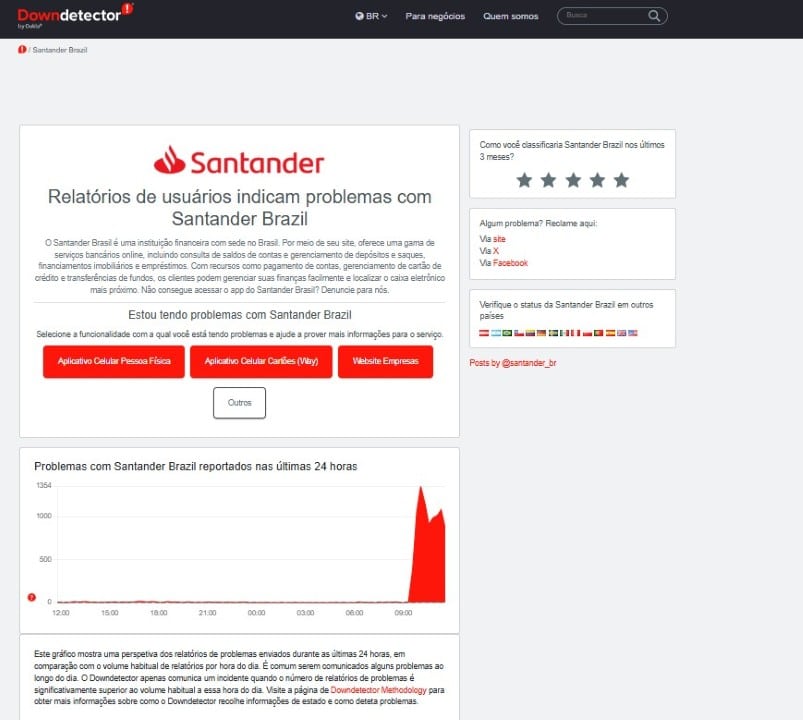
Downdetector had registered more than 1,200 notifications for Santander as of noon.
Failure evolution throughout the day
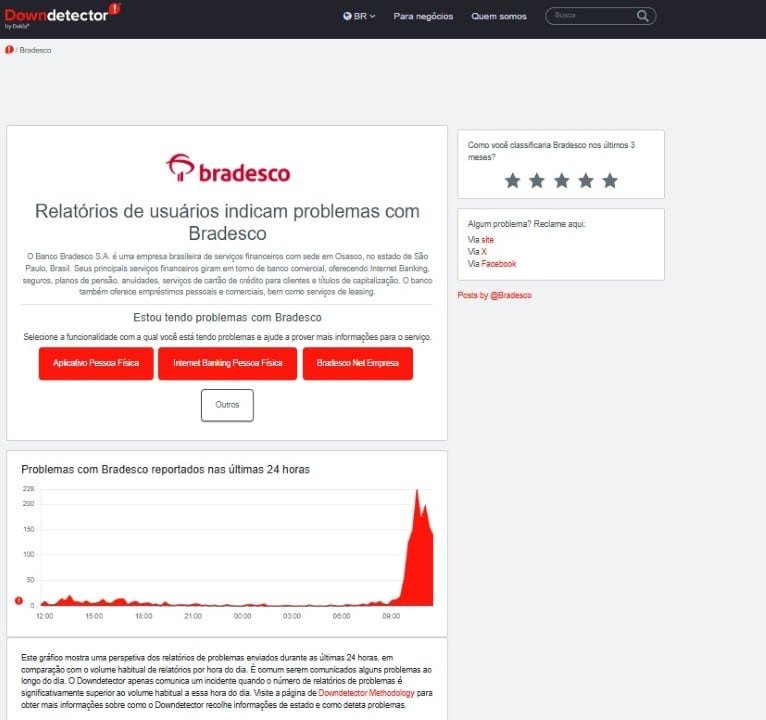
Instability in Bradesco appeared at 9:09 am, with a peak of 209 complaints at 10:39 am. Clientes reported blocks in balance inquiries and payments.
For Santander, reports started at 9:13 am, reaching 1,254 entries at 9:58 am. Next, Bradesco’s digital bank, also had 190 notifications at 10:04 am.
These numbers exceed the usual volume by 50%, according to monitoring data. Concurrency suggests possible overload on shared infrastructure.
Most common types of errors
- Message “Unable to load data” appears in 70% of cases on Santander.
- Failures in Pix represent 60% of complaints in Bradesco.
- Problems with credit cards affect 20% of impacted users.
- Balance inquiries fail in 15% of reports combined.
These errors prevent essential operations such as online deposits and withdrawals. Bancos guide subsequent attempts to work around the problem.
Official responses from banks
Santander identified the failure in digital channels and activated teams for quick correction. The institution recommends access via internet banking or physical branches.
In Bradesco, the intermittency was confirmed as momentary, with regularization in progress. Clientes can call the center 4002-0022 for immediate support.
Ambos os bancos pedem paciência e evitam detalhes sobre causas, focando em resolução. Atualizações occur via official social networks.
Impact on everyday transactions
Account holders waste time queuing at branches due to the impossibility of remote payments. A user of João Pessoa reported waiting for more than an hour to withdraw.
Partner companies face delays in receipts via Pix, affecting cash flows. The volume of unfulfilled transactions exceeds thousands this morning.
Regions such as Nordeste and Sudeste concentrate 65% of complaints, with a higher density of users.
Recent history of instability
In recent months, Santander has recorded similar crashes in September and October 2025. Cada episode lasted between 1 and 3 hours, with partial fixes.
Bradesco experienced interruptions in November, coinciding with high traffic days like Black Friday. Esses patterns indicate vulnerabilities at peak usage.
In 2024, global outages affected Microsoft systems, impacting Brazilian banks. Medidas of contingency have evolved, but failures persist.
Guidelines to get around the problem
Customers must check their internet connection before attempting to log in again. Limpeza of in-app cache can resolve local errors in 30% of cases.
Using ATMs or branches avoids interruptions in financial emergencies. Para Pix, alternatives like other banks facilitate immediate transfers.
Banks provide 24-hour customer service channels to record incidents. Continuous Monitoramento from Downdetector helps you track real-time status.
Preventive measures adopted
Institutions invest in server updates to reduce recurrences. Testes of load simulates high volumes of daily accesses.
Partnerships with cloud providers strengthen resilience against overloads. Relatórios internals analyze causes for future improvements.
Regulators like Banco Central monitor these events to ensure stability in the national financial system.



