
G3 Geomagnetic Storm Warning on December 9 Threatens Global Power Grids, Communications

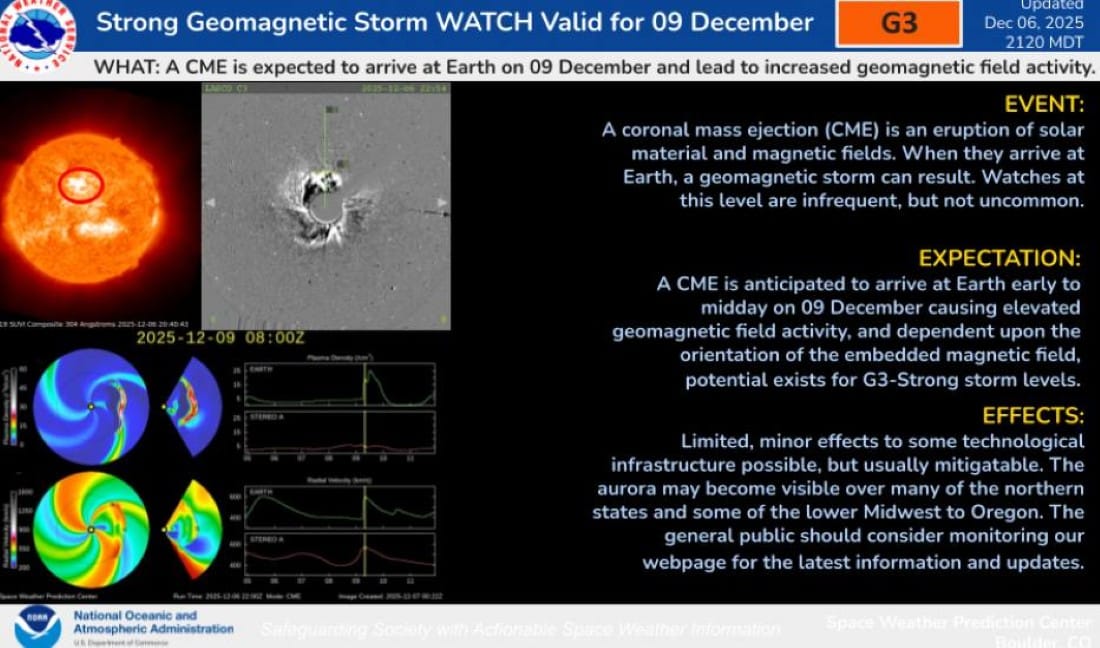
NOAA’s Centro of December. The impact on Terra should occur between dawn and noon UTC on the 9th, and could generate moderate to strong disturbances in the planetary magnetic field.
This solar region, geoeffectively positioned near the center of the solar disk, produced the flare that released charged particles towards the planet. Especialistas have been monitoring the event since Saturday, with models such as WSA-ENLIL indicating the precise arrival of the solar plasma. G3 intensity, on NOAA’s scale of 1 to 5, suggests visible effects such as auroras at mid-latitudes, but also operational risks for terrestrial infrastructure.
Continuous monitoring reveals that the flare began at 20:29 UTC and ended at 20:49 UTC, with type II radio emission at 1,143 km/s confirming the acceleration of the CME. Agências space coordinates responses to mitigate potential impacts.
Origin of solar flare
Active region 4299 has emerged as a hotbed of solar instability in recent days, with increasing activity observed since December 1st. Essa area, classified as beta-gamma, concentrates complex magnetic fields that favor energetic explosions. The M8.1 flare represents the recent peak, surpassing previous C-class events in the same region.
Coronagraphic models, such as those from the SOHO satellite, captured the expansion of the CME as an asymmetric halo, covering the entire solar limb. Essa configuration indicates a direct trajectory to Terra, with an estimated speed of around 1,000 km/s. Pesquisadores highlight that flares of this magnitude occur during the maximum of solar cycle 25, updated to peaks in 2025.
Proton emission above 10 MeV remained at background levels until late December 6, but smaller increases were detected around 23:30 UTC. Esses data reinforces the need for real-time surveillance.
Potential impacts on infrastructure
Electrical grids face the main risk from geomagnetic inductions that can overload transformers on long transmission lines. In past G3 events, such as May 2024, outages occurred in parts of América and Norte, affecting up to 10 million users per hour. Operadores prepare selective shutdowns to protect equipment.
Satellite navigation systems, such as GPS, record errors of up to 10 meters in accuracy during storm surges. Aviões on polar routes adjust altitudes to avoid high radiation, with airlines monitoring particle streams. Civil aviation coordinates with the FAA for minimum deviations.
- Satellites in low orbit can experience increased atmospheric drag, altering trajectories by up to 1 km per day.
- High-frequency radio stations experience ionospheric blackouts for 30 to 60 minutes in affected regions.
- Oil pipelines and railways detect induced currents, requiring preventive inspections of conductors.
These measures are based on protocols established by NOAA since 2015, with annual testing in multi-agency exercises.
Detailed prediction of CME arrival
The WSA-ENLIL model, initialized at 22:00 UTC on December 6, projects the initial impact at 00:00 UTC on December 9, peaking at 12:00 UTC. The Earth’s magnetosphere should register fluctuations in the Kp index between 6 and 7, confirming the G3 level. Condições Minor G1s are expected on December 8th and 10th as holdovers.
Current solar wind speeds, around 400 km/s, accelerate with the arrival of the CME to 600-700 km/s. The Bz component of the interplanetary field, if oriented to the south, intensifies the magnetic reconnection, prolonging the storming for 12 to 24 hours. Observatórios as the ACE on L1 provide alerts 30 to 60 minutes in advance.
Factors such as the density of the CME, estimated at 10 particles per cm³, influence the severity. In simulations, similar scenarios generated auroras visible up to 40 degrees north latitude.
The full halo trajectory ensures full solar corona envelope, maximizing the Earth-directed fraction by 80-90%.
Effects on communications and technology
Interference in HF signals affects maritime and emergency communications, with attenuation of 20-50 dB in bands 3-30 MHz. Operadores radio amateurs report failures in transatlantic contacts during historic G3 storms. Redes Terrestrial 5G maintains resilience, but GEO satellite links face delays of 100 ms.
Differential GPS, used in precision agriculture, records deviations that impact harvests in areas of 5-10 hectares. Bancos and stock exchanges activate backups for transactions, avoiding losses estimated at US$ 1 billion per hour in extreme events, according to Lloyd’s 2013 updated report.
- Power grid equipment has incorporated DC current blockers since 2020, reducing failures by 70%.
- Optical imaging satellites adjust orbits to avoid exposure to high-energy particles.
- ESA storming warning systems protect missions like Artemis II, scheduled for 2026.
These advances mitigate risks, but G3 events still require global coordination.
Northern lights observation
Auroras extend to mid-latitudes, visible from Nova York to Madri under clear skies. Pink and green Intensidade arises from electron collisions with oxygen and nitrogen in the ionosphere at 100-300 km altitude. Fotógrafos position themselves on magnetic poles for long captures of 10-30 seconds.
In 2024, a similar G3 allowed southern glimpses of Inglaterra, with reports from 50,000 observers. Aplicativos and Aurora Alerts predict peaks with 80% accuracy. Ideal Condições include Kp above 6 after local sunset.
Regions such as Alasca and Escandinávia record continuous brightness for hours, with a spectrum dominated by 557.7 nm. Amadores use DSLR cameras with ISO 1600 to document the phenomenon.
Mitigation and monitoring measures
Space agencies have been expanding sensor networks since 2020, with 20 satellites dedicated to real-time forecasts. Protocolos include automatic shutdowns in high voltage substations, tested in annual simulations. União Internacional of Telecomunicações updates standards for radiation in 2025.
Satellite companies like SpaceX implement magnetic shields on Starlink, reducing failures by 40% during storms. Governos invests US$500 million annually in resilience, according to Casa Branca’s 2022 plan. Treinamentos for grid operators includes weekly G3 scenarios.
Collaboration between NOAA, ESA and JAXA ensures data sharing every 5 minutes. Esses efforts minimize global downtime to less than 1% in critical infrastructures.




