
7.6 earthquake hits Aomori coast in Japan and triggers tsunami warning with waves up to 3 meters


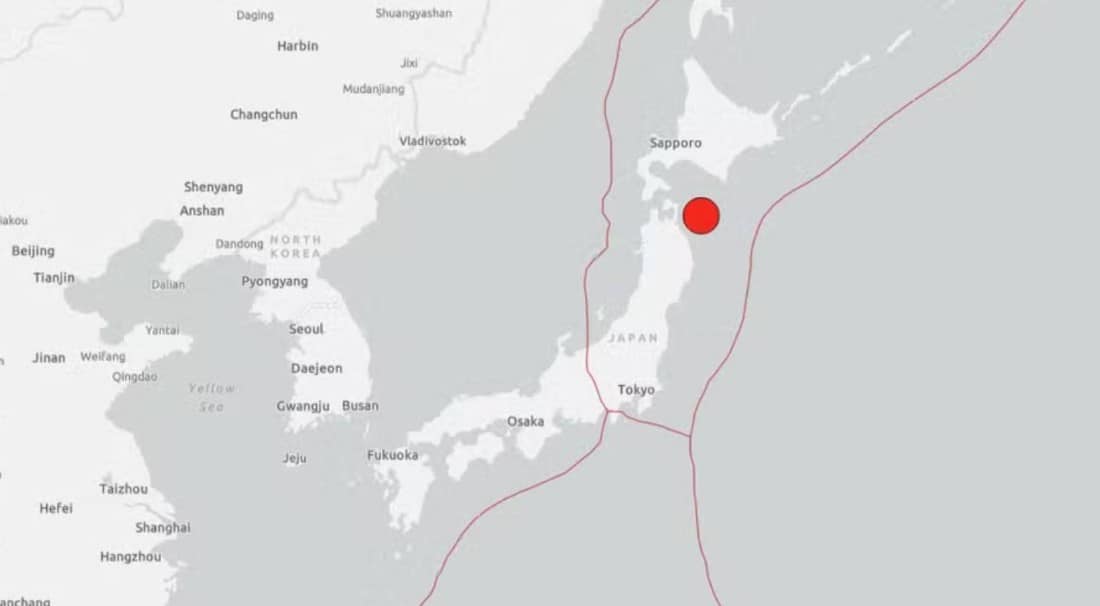
An earthquake of magnitude 7.6 hit the east coast of the province of Aomori, in the north of Japão, at 4:15 pm local time this Monday (8). The epicenter occurred about 80 kilometers from the coast, at a depth of 50 kilometers, according to data from Agência Meteorológica of Japão (JMA). Autoridades issued tsunami warnings for coastal areas, with orders to immediately evacuate to high ground or safe shelters.
The tremor was felt across much of the country, including Tóquio, where it registered intensity 2 on the Japanese seismic scale. The JMA predicted waves of up to three meters in regions such as Hokkaido, Aomori and Iwate. Moradores from coastal areas received instructions to move quickly, avoiding lowlands and beaches.
Prime Minister Sanae Takaichi reinforced the guidelines in an official statement. Ela highlighted the need for collaboration between federal and local governments to mitigate harm. Até At this time, there are no confirmed reports of casualties or significant destruction, but infrastructure inspections remain ongoing.
Evacuation measures in action
Emergency teams activated response protocols less than 30 minutes after the initial tremor. Cerca of 23 thousand people in the affected prefectures were advised to leave their homes. Barcos of fishing hurriedly left for the high seas in ports such as Urakawa, in Hokkaido.
The JMA recorded a tsunami of 40 centimeters in cities such as Mutsu and Ogawara, in Aomori, just before midnight local. Autoridades locations set up coordination centers to monitor aftershocks and distribute basic supplies to evacuees.
Rescue vehicles prioritized elevated routes, with sirens echoing in coastal neighborhoods. Escolas and companies suspended activities, directing employees to designated shelters.
Epicenter details and intensities
The main earthquake occurred offshore, east of Misawa, a port city in the province of Aomori. Magnitude 7.6 on the Richter scale corresponded to intensity 6 on the Japanese Shindo scale at Hachinohe, indicating strong perceptible shaking. Réplicas of magnitudes between 4.5 and 5.8 followed the main event in the subsequent hours.
The depth of 50 kilometers helped to dissipate part of the energy, reducing direct impacts on structures. However, the tremor spread through Honshu and parts of Hokkaido, affecting more than 10 million residents indirectly. Sensores from JMA detected variations in sea level in real time, confirming the tsunami risk.
Official instructions for the population
Prime Minister Sanae Takaichi used official channels to disseminate clear messages. Ela emphasized that no one should return to risk areas until the alert has been formally canceled. Chief Cabinet Secretary Minoru Kihara followed up with calls to avoid vehicles on escape routes.
- Evacuate to terrain above 20 meters in altitude or reinforced buildings.
- Keep a distance of at least 200 meters from the coast.
- Monitor updates via radio or JMA apps.
- Prepare kits with water, food and medicine for 72 hours.
These guidelines aim to minimize unnecessary exposures during the critical period.
Coordinated government response
The federal government established a crisis committee shortly after the quake, integrating defense and meteorology agencies. Inspeções at nuclear power plants, such as Higashidori and Onagawa, did not detect initial anomalies. East Japan Railway interrupted lines in the northeast for track and station assessments.
City halls in Miyagi and Fukushima received secondary alerts for variations of one meter in sea level. Equipes engineering team evaluated bridges and highways, prioritizing access to shelters. Colaboração with self-defense forces ensured distribution of generators in remote areas.
The focus remains on preventing secondary losses, with 24-hour monitoring of seismic activities. Autoridades locals reported quick adherence to orders, with heavy traffic on elevated roads.
Seismic history of the region
Japan is located in the Círculo of Fogo of the Pacífico, a zone of high tectonic activity responsible for 20% of global earthquakes above magnitude 6. The province of In 2011, the 9.1 Tohoku earthquake generated the worst recent tsunami, with more than 15,000 deaths.
Prior preparation included annual evacuation drills at schools in Aomori. Redes early warning systems, installed after 2011, issued warnings within 10 seconds of detection. Esses systems have reduced fatalities in moderate events, such as a 6.8 earthquake in 2023 in the same area.
The country invests billions of yen annually in anti-choke barriers and anti-seismic buildings. Geological Estudos indicates that local faults accumulate stress every 30-50 years, justifying constant vigilance.
Replica and risk monitoring
Aftershocks continue to occur, with more than 20 events above 4.0 in the last few hours. The JMA estimates a 70% probability for additional tremors above 5.0 in the next 24 hours. Estações offshore monitoring systems track deformations on the ocean floor, predicting possible secondary waves.
- Probability of strong aftershocks: 70% in the next few hours.
- Areas of greatest risk: Costa east of Honshu.
- Expected duration of the alert: Até confirmation of stabilized seas.
Experts recommend staying in shelters for at least 48 hours. Satélites and ocean buoys provide real-time data, adjusting wave height predictions.
Nuclear infrastructure under scrutiny
Plants in the northeast region underwent immediate checks without leaks being detected. Tohoku Electric Power confirmed integrity in Higashidori reactors. Protocolos post-Fukushima include automatic shutdowns on tremors above 5.5.
Nuclear authorities have raised alert levels for visual inspections of fuel tanks. Nenhum increase in radiation was reported at outlying stations. Esses procedures avoid repetitions of past incidents, prioritizing containment.
The event reinforces the resilience of the Japanese system, designed for multiple annual earthquakes.
Community Preparedness in the Spotlight
Coastal communities in Iwate have undertaken recent tsunami training. Escolas evacuated students in less than five minutes, following mapped routes. Voluntários locations distributed door-to-door alerts in isolated neighborhoods.
- Annual training reaches 80% of the coastal population.
- Alert apps save lives with push notifications.
- Support networks include shelters with capacity for 50,000 people.
These initiatives demonstrate the effectiveness of resilience programs implemented in recent years.



