
Astronomers detect largest rotating structure in the Universe with 14 galaxies aligned


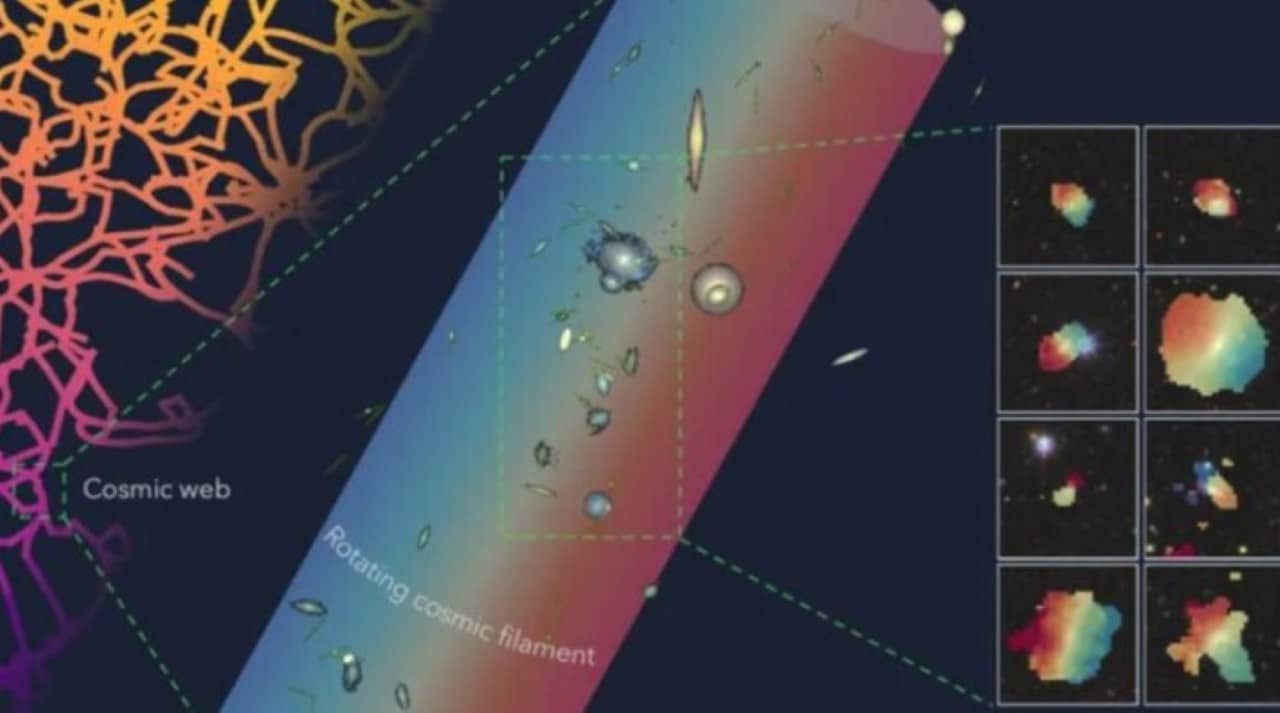
Oxford announced the detection of a giant rotating cosmic filament, considered one of the largest rotating structures ever observed. Localizado About 140 million light-years from Terra, the filament contains an aligned chain of 14 hydrogen-rich galaxies, embedded in a larger structure that spans tens of millions of light-years.
The discovery occurred during observations with the MeerKAT telescope, on África of Sul, as part of the MIGHTEE project. The researchers identified that the filament exhibits coherent rotation, with a speed estimated at 110 km/s, and the internal galaxies mostly rotate in the same direction as the structure.
- The central substructure measures 5.5 million light years long and 117 thousand light years wide.
- The larger filament spans about 50 million light years and includes hundreds of galaxies.
- Supplementary data came from instruments such as DESI and Sloan Digital Sky Survey.
Discovery details
Astronomers initially noticed an unusual alignment of galaxies shining at the same distance. Análises revealed that they form a thin line, like beads on a string.
The rotation was confirmed by the movement of neutral hydrogen in galaxies. On opposite sides of the central axis, the gas moves in opposite directions, indicating collective rotation of the entire structure.
Dimensions and characteristics
The filament stands out for its size and combination of movements. The chain of 14 galaxies occupies a thin section within a broader formation.
These structures are part of the cosmic web, which connects clusters of galaxies and directs the flow of matter in the Universo.
The observed rotation supports theories that predict gravitational torque on the primordial Universo, transferring angular momentum to forming filaments.
Observations made
MeerKAT detected radio emissions from motion-sensitive atomic hydrogen. Isso allowed us to map the internal dynamics.
Combinations with optical data confirmed distances and alignments. Most galaxies rotate in line with the filament, exceeding expectations of random distributions.
Implications for galaxy formation
Filaments act as conduits that feed galaxies with gas and angular momentum. Essa detection suggests stronger and longer-lasting influence of these structures on galactic rotation.
The finding challenges current models of cosmic evolution. Ele provides clues about how the spin of galaxies originates on vast scales.
Researchers’ statements
Lyla Jung, co-author of Universidade of
Madalina Tudorache, another co-author, described the filament as a fossil record of cosmic flows, helping to understand the growth and rotation of galaxies.
Future perspectives
Advances in telescopes will make it possible to detect more rotating filaments. Projetos like Observatório Vera C. Rubin will contribute to deeper mappings.
These observations will refine models of the cosmic web and dark matter distribution.



