
Hubble and Juice capture new images of the interstellar comet 3I/ATLAS in an active outgassing phase

Telescópio Espacial Hubble captured new images of the interstellar comet 3I/ATLAS on November 30, 2025, when the object was 286 million kilometers from Terra. The observation took place using wide-field camera 3, revealing a blue glow in the coma, the gaseous envelope around the nucleus.
This detection is part of coordinated efforts by agencies such as NASA and ESA to monitor the third confirmed interstellar visitor at Sistema Solar, discovered on July 1, 2025 by the ATLAS telescope at Chile.
The comet’s increased activity, driven by its recent proximity to Sol on October 30, allows detailed analysis of its composition before its closest pass to Terra on December 19.
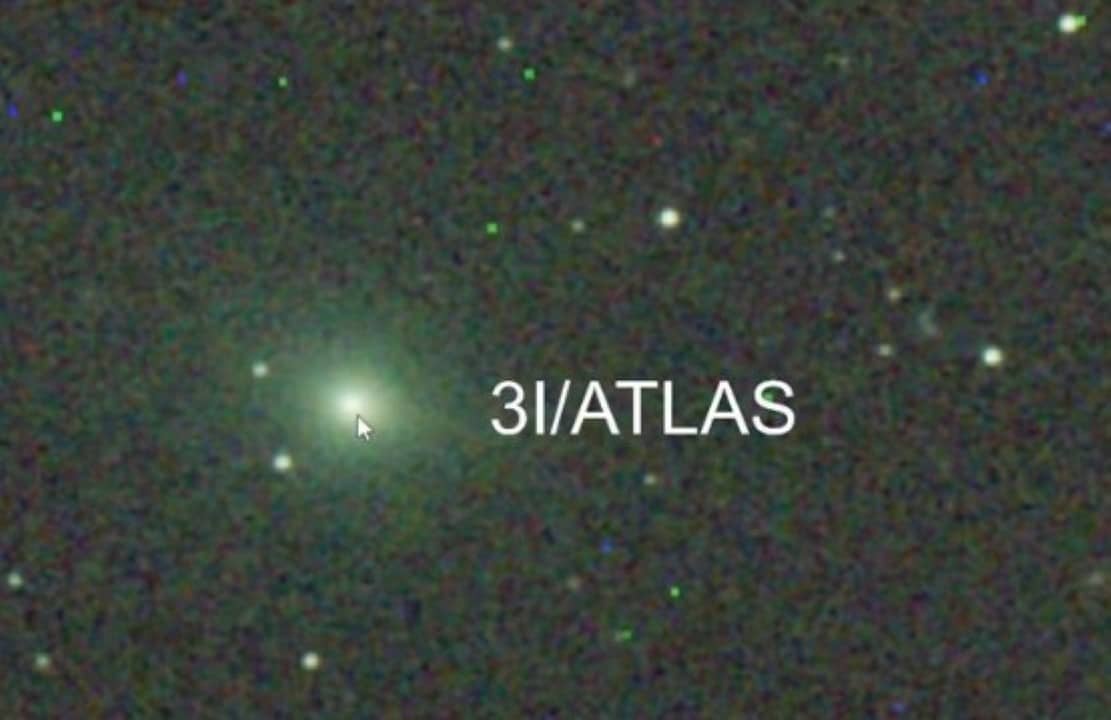
- Blue glow indicates release of gases such as carbon dioxide and methane.
- Background stars appear as dashes due to hyperbolic motion tracking.
- Estimated core diameter ranges from 440 meters to 5.6 kilometers.
Observations from probe Juice
The Juice probe, from Agência Espacial Europeia, made captures on November 2, 2025, 66 million kilometers away.
The navigation camera recorded the coma and signs of two tails: one made of gas and the other made of dust, despite not being optimized for scientific purposes.
Five scientific instruments collected data on movement and chemical composition, with transmission scheduled for February 2026.
Additional quest contributions
Missions such as NASA’s PUNCH and STEREO recorded the comet incidentally between September and October 2025.
These observations complement those of Hubble, showing tail elongations and ultraviolet emissions.
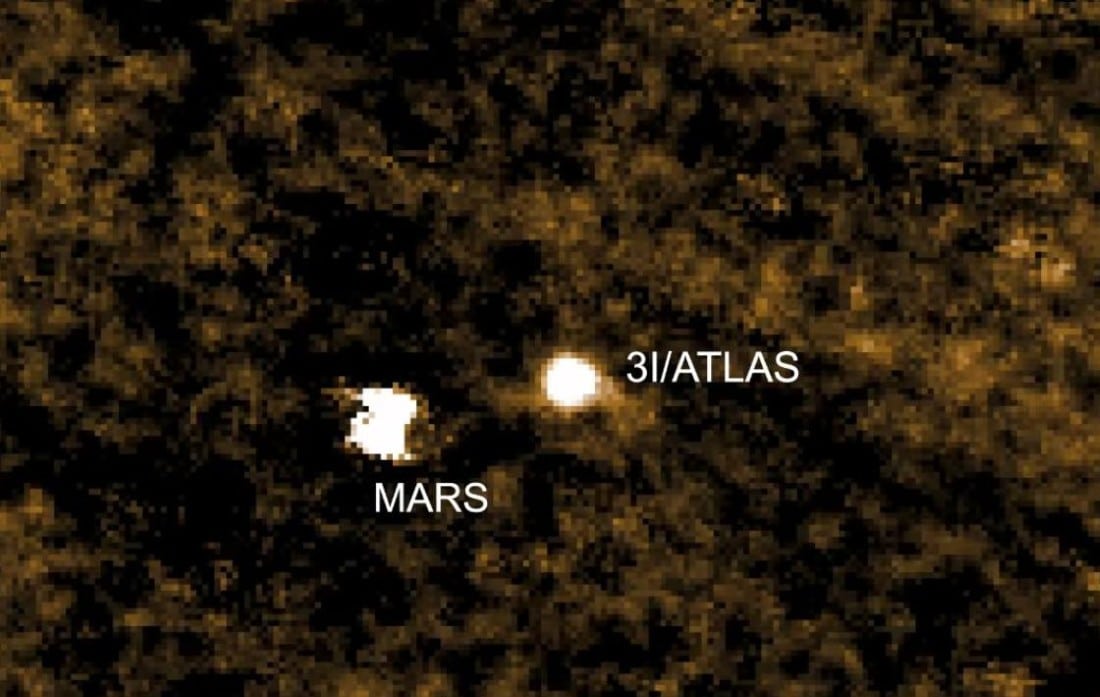
The object passed within 29 million kilometers of Marte on October 3, allowing views from local orbiters.
Preliminary data indicates mass loss rates of up to 60 kilograms of dust per second.
Chemical composition revealed
ALMA spectral analyzes on Chile detected high levels of hydrogen cyanide and methanol on 3I/ATLAS.
These compounds, in concentrations above the average for solar comets, suggest origins in distant star systems.
The red glow of the coma points to carbon-rich dust, similar to primitive chondrites.
Current trajectory and visibility
The comet follows a hyperbolic orbit at 30 kilometers per second, leaving Sistema Solar after perihelion.
On December 19, 2025, it will reach 269 million kilometers from Terra, without risk of collision.
Visible at Virgem and Leão, with magnitude 11.5 on December 6, for amateur telescopes.
Ground observations continue until January 2026, when it will reach opposition.
Surface volcanic activity
Images from Telescópio Joan Oró, at Montsec, Espanha, captured cryovolcano eruptions between November 22 and 27, 2025.
Spiral jets of gas and dust indicate sublimation of dry ice at multiple points on the surface.
The resolution allowed us to identify simultaneous active structures, unprecedented in previous interstellar objects.
These events confirm parallels with icy bodies in the outer Sistema Solar, as in Encélado.
Debates about the nature of the object
Studies submitted to EGUsphere question the classification as a traditional comet, proposing a processed rocky origin.
Hubble data from November 30 shows deviations in brightness and acceleration not explained by simple sublimation.
VLT spectra detect pure nickel at levels 11 times above solar, with no associated iron.
Models indicate a possible fragment of high-density interstellar crust, surviving billions of years.
Implications for future studies
The 3I/ATLAS pass provides a unique window for modeling dust ejection from planetary formations.
International collaborations expand data sets, refining trajectories and compositions.
The object will act as a cosmic time capsule, preserving chemistry from distant regions of the galaxy.
Forecasts point to increasing annual detections of interstellars with telescopes like the Vera C. Rubin.
Preparations for interceptions
ESA’s Comet Interceptor mission plans launches to study dynamically new comets.
Criteria include delta-v of 1.5 km/s and relative speeds below 70 km/s for safety.
Analysis of 125 years of historical data identifies just three viable candidates among 132 DNCs.
LSST will increase detections, increasing the chances of ideal targets, possibly interstellar.



