
NASA confirms: comet 3I/ATLAS coming from another star poses no risk to Earth

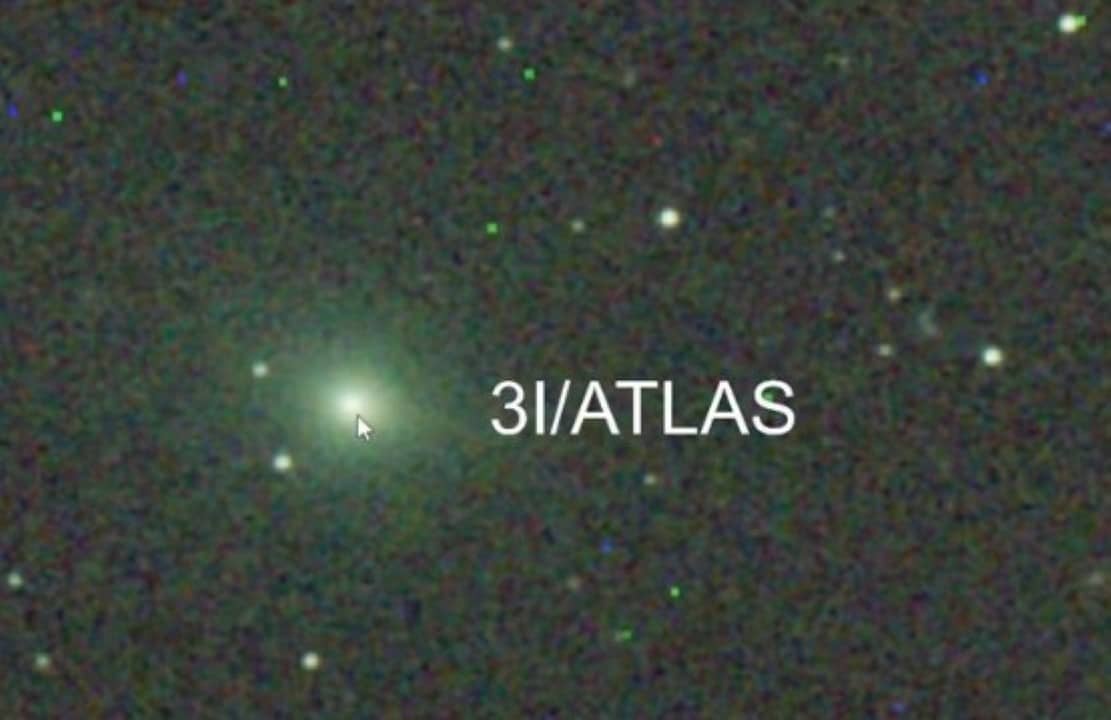
Interstellar comet 3I/ATLAS, the third confirmed visitor from outside Sistema Solar, was detected in July 2025 by the NASA-funded ATLAS network at Chile. The object moves at approximately 26 kilometers per second and has an intense glow, which generated speculation on the internet about a possible artificial origin. Especialistas from the North American space agency and Russian universities rule out risk to Terra.
The celestial body maintains a minimum distance of 240 million kilometers from the planet and passed through perihelion, the closest point to Sol, on October 30, at around 210 million kilometers. The current trajectory directs the comet towards the outer regions of Sistema Solar, close to the orbit of Júpiter.
Observations carried out by terrestrial and space telescopes confirm that 3I/ATLAS has a typical composition of icy comets, with a large amount of carbon dioxide released.

Origin in another star system
Spectroscopic studies reveal that the comet formed in an environment very different from that of Sistema Solar. The high presence of carbon dioxide indicates its origin in the cold region of another star.
Scientists estimate its age to be more than seven billion years, a value greater than the 4.5 billion years of Sistema Solar. Esses data helps understand planetary formation conditions in other corners of Via Láctea.
Different chemical composition
The James Webb space telescope identified an unusual concentration of CO2 in the comet’s gaseous envelope. The Esse pattern does not appear on objects born close to the Sol.
The tail of dust and gas expanded after perihelion, making the object more visible in the morning sky of the Sul hemisphere during November. Imagens captured by probes orbiting Marte recorded details of the structure of the coma and tail.
Trajectory and hyperbolic velocity
The comet entered Sistema Solar from the direction of the galactic plane, in the constellation of Sagitário. The speed of 26 km/s exceeds the solar escape, confirming interstellar character.
- Current speed: ~26 km/s
- Minimum distance from Terra: 1.6 astronomical units (240 million km)
- Perihelion: October 30, 2025, at 1.4 AU from Sol
- Current direction: on the run, towards interstellar space
At the end of November, the object made a slight change in course influenced by the gravity of Júpiter, behavior expected in gravitational encounters.
Detailed observations on Marte
Probes in Martian orbit have obtained the closest images ever recorded of an interstellar comet. The records show clear separation between dust tail and ion tail.
Experts from Instituto Politécnico of Perm highlight that spectral analysis reinforces the natural nature of the object. Não there is evidence of propulsion or artificial technology.
No confirmed danger
NASA maintains continuous monitoring of the trajectory of 3I/ATLAS. Modelos indicate that the object will definitely leave Sistema Solar in the coming years.
The minimum distance in relation to Terra occurred in December 2025, maintaining a safe margin of safety. Não significant approximation is predicted in future centuries.
The comet’s passage represents a rare opportunity to study primordial material from another star system without the need for interstellar missions.
Contribution to astrochemistry
The detection of specific molecules expands knowledge about chemistry in distant protoplanetary disks. The data collected will be compared with future observations of exocomets.
Russian and North American researchers are working on joint articles about the observed composition. Resultados preliminaries will be presented at astronomical congresses in 2026.
3I/ATLAS now follows a hyperbolic exit trajectory, ending a period of maximum visibility for terrestrial observers.



