
December approach reveals whether comet 3I/Atlas is a celestial body or technological object


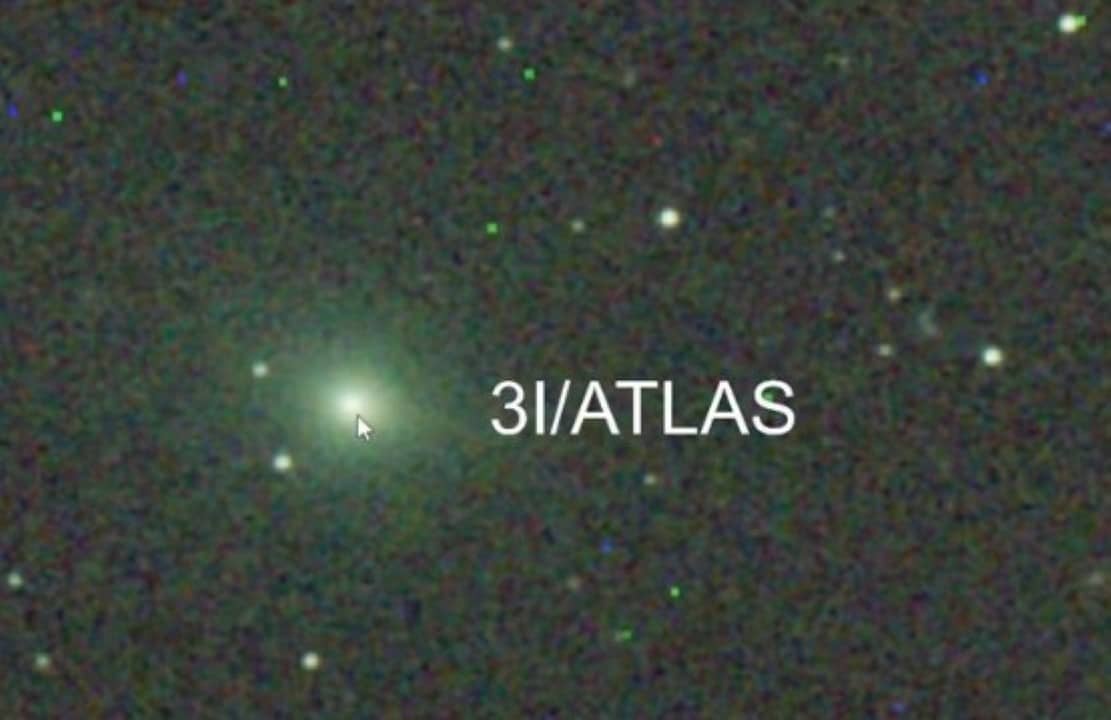
December 19th is established as the most anticipated date for the global scientific community that monitors the interstellar comet 3i Atlas. On the Neste day, the object will make its closest approach to Terra, remaining 269 million kilometers away, a crucial event for collecting new and decisive data. The expectation is that the information collected can finally determine the true nature of this passing visitor who was not born in Sistema Solar, but rather somewhere in Via Láctea.
The observation of 3i Atlas gained international focus due to its characteristics that defy the standard of traditional comets. Ele does not follow the regular orbit of celestial bodies born in the Sistema Solar region, which already makes it an intriguing object.
This comet, discovered by a telescope at Chile, has attracted the attention not only of astronomy experts, but also of scholars who raise less conventional hypotheses about its origin. The date of closest approach is seen as the window of opportunity to obtain evidence that can answer whether the object is a natural phenomenon or something more complex.
Astrophysicist Avi Loeb, from Universidade of Harvard, is among the scientists who defend the need to pay attention to the anomalies presented. Ele points out several factors that place the 3i Atlas in a separate category and suggests that the possibility of the object being of technological origin should not be ruled out.
The anomalies of an interstellar visitor
The object has demonstrated non-standard characteristics since its discovery, raising the mystery about its composition and origin. Entre The points that attract the most attention from the scientific community is the estimate of its mass, which is considerably greater than that of other interstellar objects already observed.
Initial studies estimate the mass of 3i Atlas at 33 billion tons. Esse number puts it on a higher scale of size when compared to other passing celestial bodies.
In addition to the high mass, the chemical composition also raises questions. The presence of nickel in an amount greater than that ofironis considered atypical for a comet, suggesting formation under conditions different from those known in our system.
- Mass estimated at 33 billion tons.
- Chemical composition with excess nickel.
- Trajectory with an unusual alignment.
Approximation data and technological hypothesis
The trajectory followed by the object is another highlight for researchers. The way the comet aligns and moves in space has a probability of occurring of just “one in 500”, according to calculations by Professor Avi Loeb, a specialist in interstellar objects.
This coincidence in the route reinforces the argument that the object may not be purely natural. Loeb, who has already analyzed the interstellar object Oumuamua with similar hypotheses, does not rule out that 3i Atlas could be a technological artifact, created by some distant civilization.
The scientific community is divided between the interpretation that the anomalies are just new discoveries about the diversity of comets and the view that they indicate something beyond. Data collection on December 19th will be essential to provide more evidence and deepen the spectrographic analysis of the comet.
Chemical composition and the mystery of nickel
The detection of specific chemical elements in the comet is one of the pillars in trying to understand its origin. Nickel, found in higher concentrations than expected, may be an indication that 3i Atlas was formed in a stellar or planetary environment with an abundance of this element.
Observing the comet’s tail and the way material is expelled during closest approach can offer unprecedented detail. Scientists hope to analyze reflected light and gas emission to refine density and molecular composition calculations.
It is a coordinated effort from different observatories and research groups around the globe. The objective is to cross-reference the information obtained to build a more accurate model of the structure and history of 3i Atlas.
Scientific focus on demystification
Despite the more speculative theories, most experts on celestial bodies treat 3i Atlas as a natural, albeit extraordinary, comet. Science seeks explanations within known physics and chemistry to demystify anomalies.
Any interstellar object, by definition, brings with it data from environments outside the solar influence, which already makes it unique. The complexity of the object lies precisely in its ability to challenge what is considered standard.
The observation window in December is short and the accuracy of the instruments will be put to the test. The data will help calibrate predictions and understand whether the comet is a rarity or an example of a class of cosmic objects that is still little explored. The world awaits the conclusions of the analysis.
Next steps and the search for conclusive information
Work after the approach will focus on analyzing and interpreting the volumes of data collected. Advanced Telescópios will be focused on the comet to capture the best images and measurements of its speed and trajectory.
The Avi Loeb team continues to emphasize that the 13 observed anomaly points require a thorough investigation, without ruling out any hypotheses. Transparency in the dissemination of raw data is vital for scientific debate.
- Detailed spectrographic analysis of the tail.
- Refined calculation of density and mass.
- Comparison of the real trajectory with predictive models.
If December’s data confirm suspicions that 3i Atlas is just a natural comet with extreme characteristics, it will become a fundamental object of study to understand the formation of other stellar systems. Caso Otherwise, the discussion about the possibility of technological origin will gain strength. Uncertainty is what drives research at the moment.



