
Discovery of voids behind granite in the Myquerinos pyramid indicates possible second entry

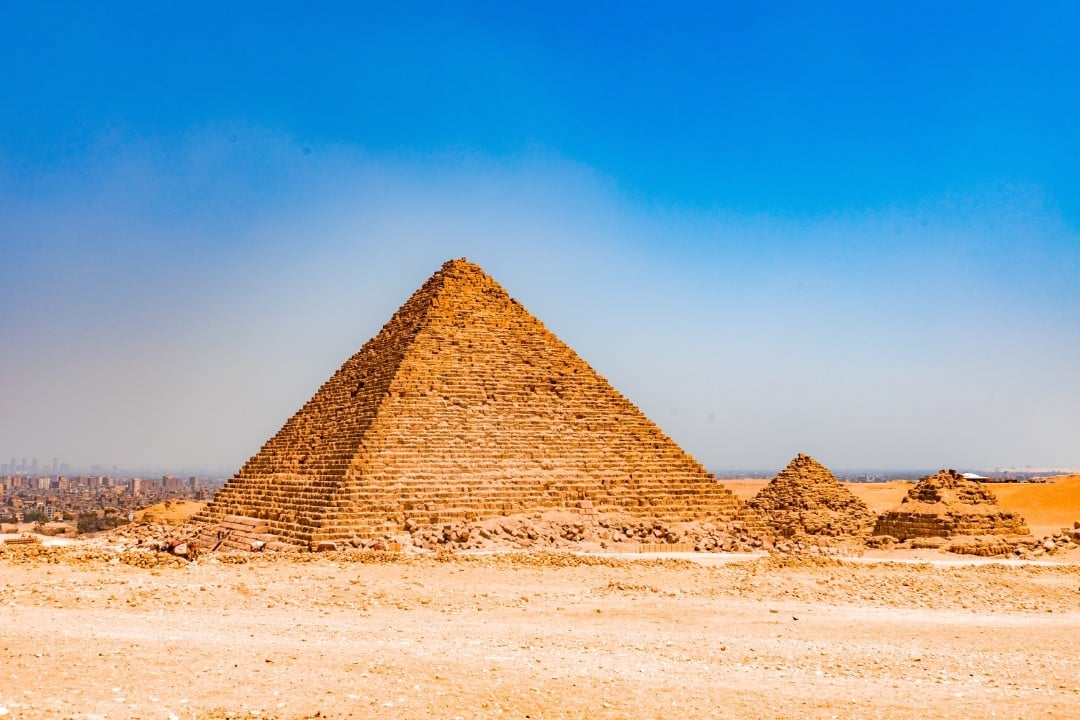
Scans carried out by an international team identified two air-filled voids behind polished granite blocks on the east face of the Miquerinos pyramid, located on the Gizé plateau, in Egito. The work was conducted by researchers from Universidade of Cairo and Universidade Técnica of
The detected structures are 1.4 meters and 1.13 meters deep in relation to the external facade. The voids have approximate dimensions of 1 meter high by 1.5 meters wide in the first case and 0.9 meters by 0.7 meters in the second. The discovery keeps the original structure of the pyramid intact.
Techniques used in detection
Researchers applied three non-destructive methods to map the interior of the building. Electrical resistivity tomography, ground-penetrating radar, and ultrasonic testing were combined to obtain accurate images.
The equipment identified clear density differences behind the polished granite blocks. Simulações numerical data complemented the data collected in the field to validate the measurements.
Features of the east face
The eastern face of the Miquerinos pyramid has granite blocks with a smooth finish in its lower portion. Essa characteristic differentiates the construction of the other pyramids on the plateau from Gizé.
The polished blocks occupy an area equivalent to that found near the main entrance, located on the north side. The aesthetic similarity fueled the theory that the region could hide secondary access.
Hypothesis presented since 2019
Researcher Stijn van den Hoven pointed out in 2019 that the smooth granite could hide a second entrance. The observation was based on comparison with the treatment given to the north entrance of the same pyramid.
The new scans provide the first physical evidence consistent with this proposal. The detected voids are vertically aligned in the central region of the east face.
Exact dimensions of voids
- First void: approximately 1 meter high by 1.5 meters wide, located 1.4 meters from the facade
- Second void: approximately 0.9 meters by 0.7 meters, positioned 1.13 meters deep
- Both have characteristics of spaces filled exclusively with air
- The position suggests possible structural continuity with the interior of the pyramid
Next steps of the research
The responsible team recommends the application of complementary scanning techniques. Métodos such as muography and infrared thermography can clarify the extent of the anomalies.
Any physical intervention remains ruled out at the moment to preserve the integrity of the monument. Additional Estudos will determine whether the voids connect to as-yet-unknown chambers.
Importance to Egyptology
The pyramid of Miquerinos is the smallest of the three large constructions of Gizé and one of the least explored internally. Novas discoveries may change the understanding of Reino Antigo construction techniques.
The results reinforce the potential of non-invasive technologies in the investigation of ancient monuments. The project has maintained collaboration between Egyptian and German institutions since the initial phase of work.
Heritage preservation
All methodologies used avoided any physical contact with the original structure. The equipment was positioned exclusively on the outside of the pyramid.
Ministério of Turismo and Antiguidades of Egito closely monitor the development of research. Autorizações for new surveys depend on the presentation of detailed technical reports.
The pyramid of Miquerinos was erected around 2,530 BC during the IV Dinastia and maintains a large part of the granite covering at its base, a feature that now gains new relevance with the voids detected behind these blocks.



