
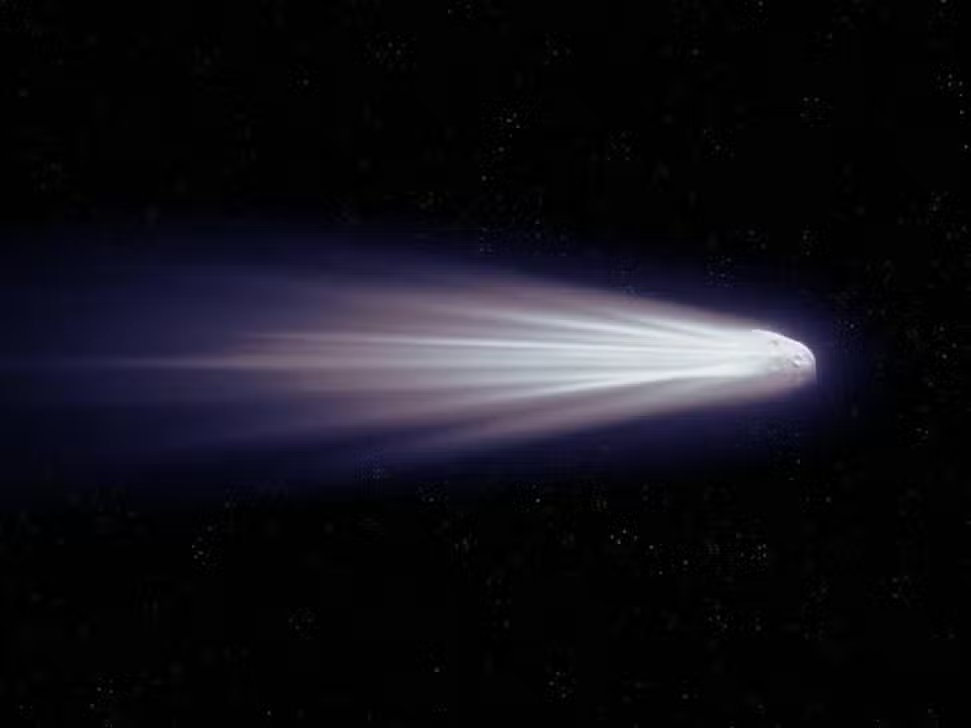
The interstellar comet 3I/ATLAS, identified in July 2025 by the ATLAS system in Chile, is showing signs of fragmentation on its journey through Sistema Solar. NASA’s Cientistas and ESA’s Agência Espacial Europeia confirm that this object, which traces its origins to a distant star system, has been releasing gases and dust particles at an increasing intensity as it approaches Sol, a direct response to increased heat exposure.
The comet’s instability is notable, occurring approximately 1.4 astronomical units from Sol, equivalent to about 210 million kilometers. The composition of 3I/ATLAS, rich in volatile ices, explains its sensitivity and accelerated reaction to high temperatures.

Imagens captured by Telescópio Espacial Hubble revealed a reddish coma, a phenomenon that suggests the presence of fine dust that has been exposed to interstellar radiation for billions of years.
Observações continuous movements through different instruments reinforce the scenario of intense activity:
- Telescopes located at Havaí and Chile record significant daily variations in the comet’s luminosity.
- Advanced spectroscopic analysis detects elevated levels of carbon dioxide.
- An international collaboration of astronomical teams coordinates data collection to predict future ejections of material.
Interstellar trajectory and origin
3I/ATLAS’ impressive speed of 58 kilometers per second is a crucial factor preventing its capture by solar gravity. The Essa feature, meticulously measured through complex orbital simulations, serves as an unambiguous marker, distinguishing this comet from objects formed in the outer regions of our own system, such as Nuvem from Oort.
Perihelion, the comet’s closest approach to Sol, is considered a critical moment. At Nesse stage, the combination of intense thermal and gravitational forces imposes a severe test on the integrity of the comet’s nucleus, whose diameter is estimated to be less than 1 kilometer.
Unusual chemical composition
Dados collected by Telescópio Espacial James Webb has brought to light an intriguing composition of 3I/ATLAS, revealing an absence of water in quantities that would be considered typical for comets. In contrast, there is a predominance of carbon monoxide and the detection of rare organic molecules such as cyanide.
Essa’s unique spectral signature suggests that the comet formed in a stellar environment with a smaller presence of hydrogen than our own solar system. Tais characteristics differentiate it from other comets already observed.
Comparações detailed with other interstellar visitors, such as 2I/Borisov, show important variations in the distribution of dust and volatiles. An observed extreme negative polarization points to the existence of fine grains that have been shaped by prolonged galactic radiation throughout its vast existence.
Advanced monitoring reveals instability
Observatório Keck, located at Havaí, has been instrumental in recording infrared emissions, which are direct indicators of the continuous sublimation of ices on the comet’s surface. Equipes of astronomers are currently engaged in analyzing the mass loss rate of 3I/ATLAS.
Modelos computational studies project that the comet could lose up to 20% of its total mass after perihelion. Weekly updates to the object’s luminosity are crucial for tracking changes in its coma, which currently measures about 3 arcseconds.
Além In addition, NASA’s TESS satellite had already detected preliminary activity on the comet in May 2025, which extends the observational history and provides valuable data for understanding its evolution.
Solar heating accelerates fragmentation
Jatos of gas are observed emerging from the comet’s nucleus, driven by intense solar radiation, which hits the object with a power of 33 gigawatts per square meter. Imagens obtained by Nordic Optical Telescope, in Ilhas Canárias, show cracks in the process of expansion on the cometary surface.
Essa dynamics follows a specific power law for dust production, with the heliocentric radius raised to -3.8, a common pattern in active comets. Embora the absence of abrupt bursts indicates initial stability, the probability of partial fragmentation of the nucleus has increased considerably.
Debris and the possibility of meteor showers
Modelos Advanced computing predicts that if 3I/ATLAS suffers a more significant rupture, the resulting fragments could form a dust lane detectable by ground-based radars. Esses residues have the potential to generate an observable Terra meteor show in 2026, although without any risk of planetary collision.
Simulações detailed orbitals completely rule out the possibility of impacts with Terra. The comet will pass at a safe distance of 270 million kilometers from our planet in December, ensuring safety.
Planetary interactions and future observations
In November 2025, comet 3I/ATLAS will make an approach to Vênus, passing at a distance of 97 million kilometers. Esse event will enable valuable remote observations by ESA’s JUICE mission, which will be able to collect data on the comet’s interactions with the planetary environment.
Posteriormente, in March 2026, the comet will cross the orbit of Júpiter, at a distance of 54 million kilometers, offering a potential opportunity for recording by the Juno probe. Esses encounters with the gas giants are crucial for providing data on the gravitational perturbations that affect interstellar objects.
The transition of the comet’s tail from an anti-solar pattern to a conventional configuration was recorded in September, according to observations from Nordic Optical Telescope.
Age and cosmic formation
Análises detailed estimates that comet 3I/ATLAS is between 7.6 and 14 billion years old, a period that aligns with the formation of Via Láctea’s thick disk. Essa galactic structure, known for harboring very ancient stars, explains the composition of the comet with low levels of heavy elements.
3I/ATLAS therefore preserves primitive materials from distant star systems, offering a unique window into understanding models of chemical evolution in the universe. Observações post-perihelion, which will occur in December 2025, will continue to track the comet’s visual weakening until it reaches magnitude 12.