
NASA: Interstellar comet 3I/ATLAS fascinates scientists as it passes through the solar system

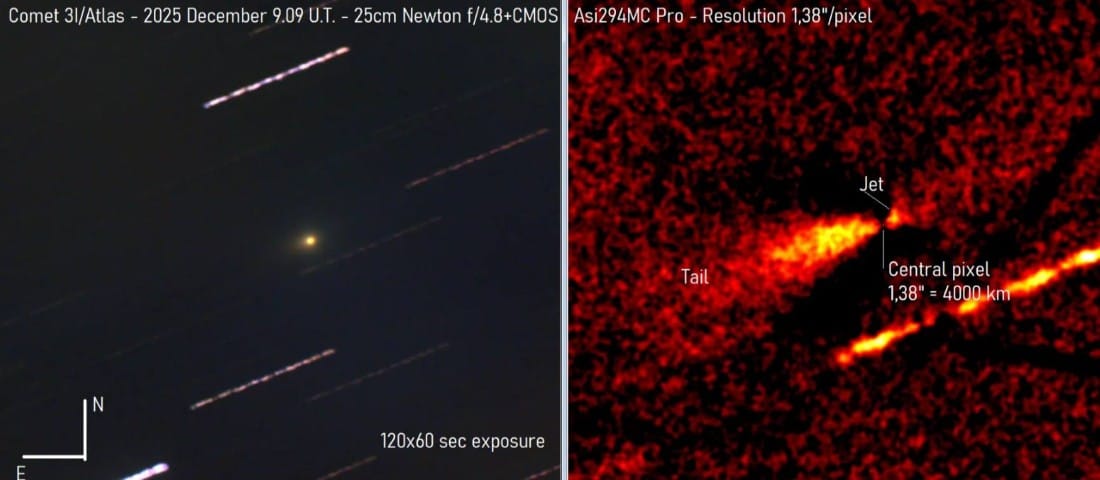
The interstellar comet 3I/ATLAS, detected in July 2025, has attracted the attention of astronomers as it crosses the solar system. Originado outside our galaxy is only the third object of its kind confirmed. NASA and Agência Espacial Europeia (ESA) record its trajectory with detailed images, captured by telescopes and probes. Ele passed the closest point to Sol in October and will approach Terra on December 19, 170 million kilometers away.
Discovered by the ATLAS system on Chile, the comet was 420 million kilometers away when identified. Sua composition, rich in water ice and carbon dioxide, was analyzed by observatories such as NASA’s SPHEREx. Recent Imagens show its coma, a cloud of gas and dust, and elongated tails, indicating greater activity as it approaches Sol.
The observations involve missions such as Hubble, ESA’s ExoMars and the Juice probe, which studies Júpiter. Dados collected until November reveal details about the behavior and structure of the comet, which does not pose a risk to Terra. The flyby is a rare opportunity to study interstellar objects.
- Missions involved: Hubble, SPHEREx, ExoMars, Juice, Lucy, PUNCH and Perseverance.
- Minimum distance from Terra: 170 million kilometers on December 19th.
- Composition: Gelo of water, carbon dioxide and dust.
- Last images: Capturadas in November by Hubble and Juice.
Origin and discovery of the comet
Comet 3I/ATLAS was identified on July 1 by the ATLAS system, operated by Universidade of Havaí and funded by NASA. Localizado in Rio Hurtado, Chile, the telescope scans the sky for dangerous asteroids.
At the time, the comet was 420 million kilometers from Terra, moving towards Sol. Sua interstellar origin was confirmed by its trajectory and speed, distinct from objects in the solar system.
Monitoring by space agencies
NASA and ESA mobilized several missions to observe the comet. The Hubble telescope captured images on November 30, showing the comet as a bright point with stars in the background. The Juice probe, on its way to Júpiter, recorded the object on November 4, 41 million kilometers away.
The SPHEREx observatory, between August 7 and 15, analyzed the chemical composition of the comet, identifying ice and carbon dioxide in its coma. The ExoMars mission, in orbit around Marte, photographed the comet in October, highlighting its bright nucleus against space.
The comet was also observed by PUNCH satellites, the Lucy probe and the Perseverance rover, in Marte. Essas missions provided data on its tail and growing activity.
Characteristics and behavior
Comet 3I/ATLAS displays an extensive coma, composed of gas and dust, and two distinct tails. The plasma tail, made of ionized gas, and the dust tail, with solid particles, were recorded by the Juice probe.
Its greatest activity was observed in October, when it reached perihelion, the closest point to Sol. The proximity intensified the release of gases and dust, lengthening their tails. Dados of Gemini South, in Chile, show detailed images of this active phase.
The comet’s chemical composition is similar to that of local comets, but its interstellar origin suggests that it may have formed in another star system. Estudos continue to map their trajectory after leaving the solar system.
Scientific importance of observation
The passage of 3I/ATLAS is a unique opportunity for science. Apenas Two other interstellar objects, Oumuamua (2017) and 2I/Borisov (2019), have been confirmed before. Analysis of their composition and behavior helps understand the formation of distant star systems.
Next steps for agencies
ESA plans to release new data from the Juice probe in February 2026, with more details about the comet’s structure. NASA will continue to monitor the object with the Hubble and other instruments, tracking its exit from the solar system.
Legacy of comet 3I/ATLAS
The comet’s visit reinforces the importance of systems like ATLAS for detecting space objects. Suas images and data expand knowledge about the universe, connecting our solar system to other regions of the galaxy.



