James Webb reveals ‘impossible’ galaxy that defies current Big Bang model
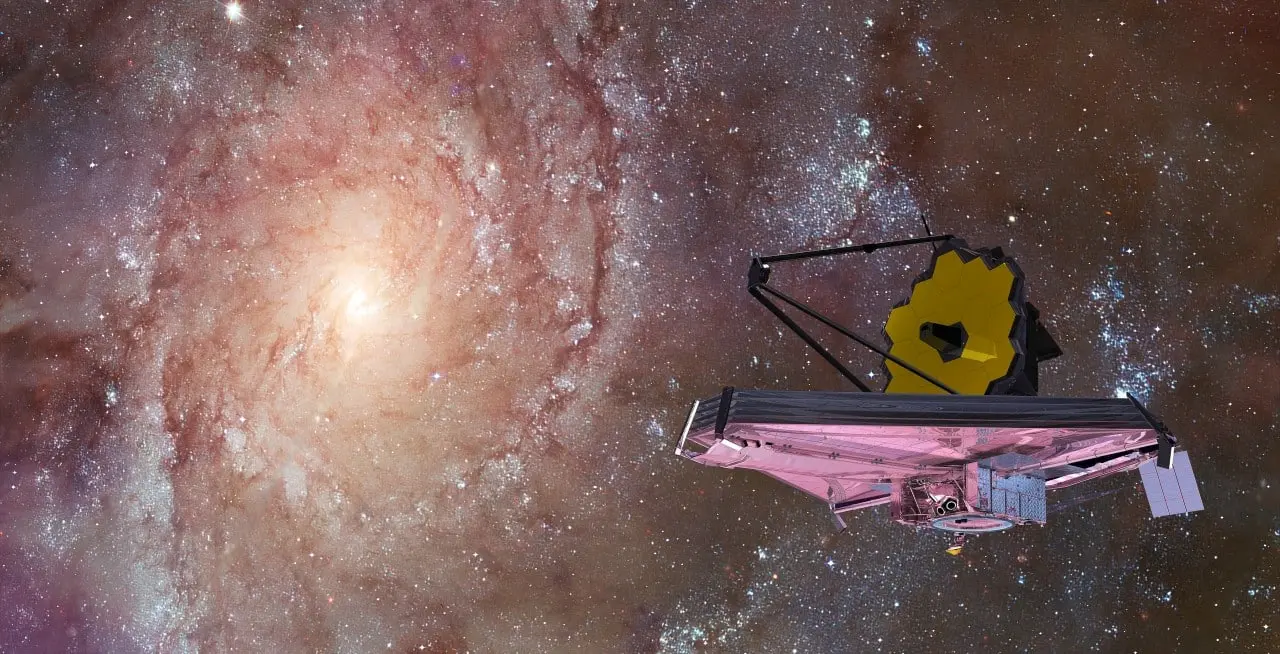
The James Webb space telescope has identified a highly structured galaxy at a time in the universe when current models predict only chaos and turbulence. The observation occurred in a region corresponding to approximately 600 million years after Big Bang.
Named JADES-GS-z14-0, the galaxy presents organizational characteristics that, according to standard cosmology, should only emerge billions of years later. Astrônomos international researchers analyze the data to understand how this structure formed so early.
The discovery forces the scientific community to reevaluate parts of the Big Bang model related to the rapid formation of massive galaxies.
Characteristics of the observed galaxy
The JADES-GS-z14-0 galaxy has a redshift of 14.32, making it the most distant galaxy ever confirmed spectroscopically.
James Webb’s NIRSpec and NIRCam instruments picked up signals of abundant hydrogen and oxygen.
On the same topic: Scientists use James Webb to reveal object with black hole and brightness of 100 billion suns
The structure reveals a rotating disk with defined arms, something rare in such primordial objects.
Context of the cosmic epoch
The universe, just 600 million years old, was going through the so-called era of reionization.
At this stage, matter was dispersed and heated by the first stars and black holes.
Models predict gradual formation of galaxies from smaller clusters.
The presence of such a developed galaxy indicates faster-than-expected accretion and merger processes.
Implications for cosmology
Astronomers from the JADES project (JWST Advanced Deep Extragalactic Survey) have published initial results.
The discovery suggests that massive galaxies may have emerged hundreds of millions of years earlier than predicted.
Researchers evaluate adjustments in the parameters of star formation and dark matter.
More on this story: Webb’s red dots can hide entire galaxies, study says
New observations with James Webb look for other similar galaxies at the same time.
See Also



Detection technical details
James Webb used spectroscopy mode to confirm the high redshift.
The light from the galaxy traveled for more than 13 billion years to reach the sensors.
The apparent magnitude is weak, requiring long exposures to obtain clear data.
Learn more: Object with the most distant black hole ever seen helps solve mystery of Webb’s ‘red dots’
The analysis combined information from multiple infrared filters.
Reactions from the scientific community
Teams from several countries participate in the interpretation of the data collected.
Publications in specialized magazines already discuss possible revisions to the Lambda-CDM model.
Conferences scheduled for 2026 include sessions dedicated to the topic.
Learn more: James Webb Telescope identifies unprecedented cosmic object: a ‘black hole star’
Additional observations are scheduled for the next telescope cycles.
Next steps of the research
James Webb continues to map deep infrared fields.
Programs like CEERS and NGDEEP search for similar objects in different regions.
Updated computer simulations test accelerated formation scenarios.
Additional results should be released in the coming months.
The galaxy JADES-GS-z14-0 represents one of the most significant finds of James Webb since its operational start in 2022. Sua organized structure in such an early period of the universe provides direct evidence that challenges established chronologies. The data indicate a high rate of star formation and the presence of rapidly produced heavy elements. Essa combination suggests more efficient galactic growth mechanisms than current models contemplate. Continuing observations will allow us to refine our understanding of the first billion cosmic years.