
JAXA detects X-ray glow around comet 3I/Atlas for the first time in an interstellar object

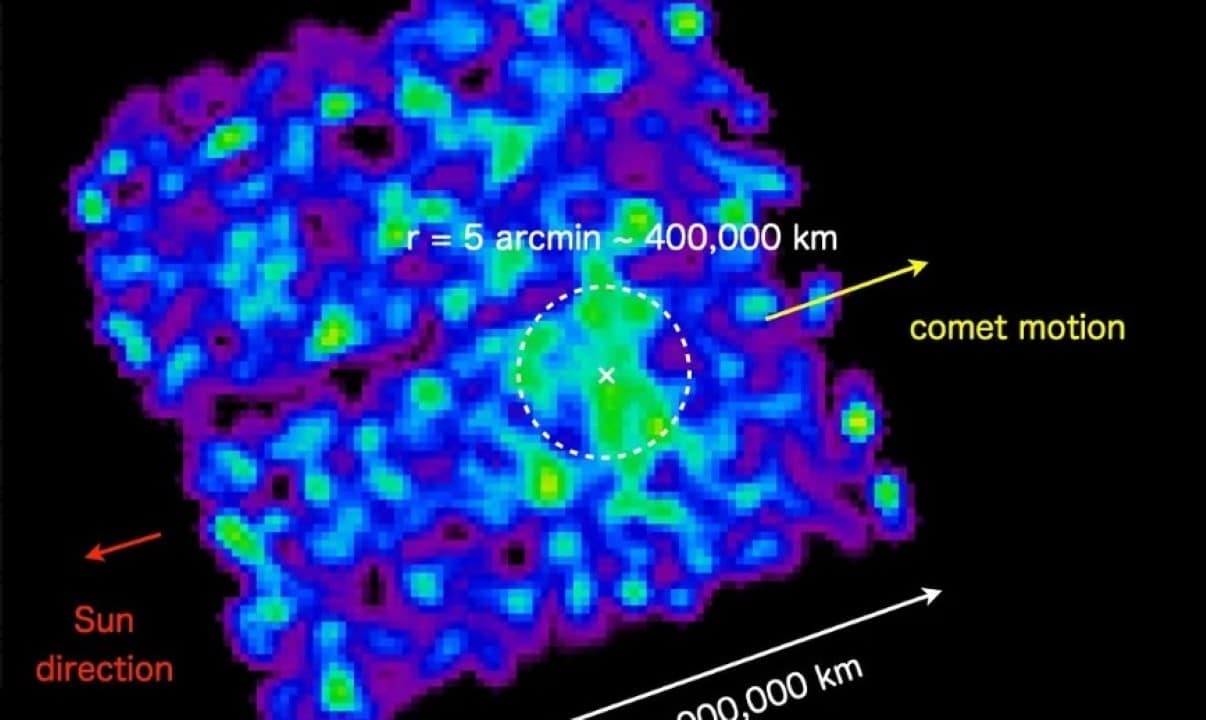
The Japanese XRISM satellite captured signals of X-ray emission around the interstellar comet 3I/Atlas between November 26 and 28, 2025. Essa detection represents the first observation of its kind on an object coming from outside Sistema Solar. The operation, conducted by Agência of Exploração Aeroespacial of Japão (JAXA), accumulated 17 hours of effective exposure as the comet crossed the constellation of Virgem.
The mission took advantage of a short window of safe visibility, as instruments cannot approach closer than 60 degrees to Sol. Initial data shows a faint glow distributed over an area of about 400,000 kilometers around the comet’s nucleus. Essa extension suggests interactions between the gas released by the comet and particles in the solar wind.
Researchers adjusted the satellite’s orientation 14 times to keep the target in the center of the field of view. The comet, discovered in July 2025, is the third confirmed interstellar visitor, after 1I/Oumuamua and 2I/Borisov. Nenhum of the above exhibited detectable X-ray emissions.
Preliminary analysis points to a process known as charge exchange reaction, common in local comets. Íons from the solar wind captures electrons from the cometic gas, emitting X-rays as it stabilizes. In the case of 3I/Atlas, the diffuse structure may indicate a more extensive gas cloud than expected.
Origin and discovery of the interstellar visitor
Comet 3I/Atlas was identified on July 1, 2025 by the ATLAS system at Chile. Sua hyperbolic orbit confirms external origin, with speed relative to Sol greater than 50 km/s. Estimativas indicate that the core measures between 440 meters and 5.6 kilometers in diameter.
Initial observations revealed cometic activity, including a reddish dust coma. Diferente of solar comets, 3I/Atlas shows a high proportion of carbon dioxide in the coma, with traces of water and carbon monoxide. Essa composition suggests formation in an ancient star system, possibly 7 to 14 billion years old.
The trajectory took it to perihelion on October 30, 2025, 1.4 astronomical units from Sol. Agora, it moves away, with maximum approach to Terra on December 19, 2025, at 270 million kilometers. Telescópios as Hubble captured images of a faint dust tail pointing east.
This is X-ray image of the interstellar object 3I/ATLAS captured by the soft X-ray imaging telescope Xtend onboard the XRISM
—Astronomy Vibes (@AstronomyVibes)December 9, 2025
The image shows a faint…pic.twitter.com/m6RpeiHu6M
Observation campaign details
The XRISM team planned the session precisely to avoid solar restrictions. The Xtend instrument, focused on soft X-rays, covered a field of view of 3 million square kilometers. Durante at 5 pm, the comet moved slowly, requiring constant adjustments.
The data was processed quickly, revealing the faint glow centered on the nucleus. The extension of 400 thousand kilometers exceeds the instrumental resolution, indicating a genuine emission. Preliminary Espectros show lines at 0.4 and 0.6 keV, compatible with carbon, nitrogen and oxygen.
This operation marked a unique opportunity as the comet will soon become invisible to XRISM. Resultados were released on December 3, 2025 via The Astronomer’s Telegram, alerting other observatories. Equipes plan follow-ups with instruments such as the James Webb to complement the findings.
The detection reinforces that interstellar comets respond to the solar environment in a similar way to local ones, but with different chemical nuances. Análises future data will be refined to map the plasma-gas interaction.
Solar wind interactions explained
The charge exchange process occurs when solar ions collide with neutral atoms in the coma. Isso accelerates electrons, generating X-rays as they recapture orbitals. Descoberto in 1996 with comet Hyakutake, the phenomenon has been observed in dozens of solar comets since then.
In 3I/Atlas, the diffuse emission suggests an active coma, releasing icy gas under solar heat. The 400,000-kilometer elongated structure may involve plasma and dust interacting on larger scales. Linhas spectra of CVI, NVI and OVII indicate abundance of light elements, aligned with the CO2-rich composition.
Unlike Oumuamua, which did not show a coma, 3I/Atlas displays dust and ion tails. Borisov, in turn, had radio emissions, but no X-rays. Essa detection paves the way to study how interstellar materials adapt to the heliossheath.
Researchers note that the intensity of the glow varies with solar distance, decreasing as the comet recedes. Modelos simulate these interactions to predict emissions in future objects.
- The emission extends over 5 arc minutes, equivalent to 400 thousand km at the current distance.
- Total exposure: 17 hours, divided into night sessions.
- Adjustments: 14 maneuvers to track movement.
- Spectrum: Picos at low energies, suggesting charge exchange.
Comparison with previous comets
The two previous interstellar visitors differ in activity. Oumuamua, from 2017, accelerated without a visible coma, raising hypotheses of hydrogen. Sua lack of X-rays is attributed to inactivity. Borisov, from 2019, released gas like typical comets, but X-ray observations were inconclusive.
3I/Atlas combines features: active nucleus like Borisov, but with an unprecedented X-ray halo. Sua estimated age of billions of years implies prolonged exposure to interstellar radiation, altering the outer crust. Observações from Hubble on July 21, 2025 showed a dust drop shape, with a faint tail.
In contrast, solar comets like Hyakutake exhibit smaller, coma-limited X-ray halos. The size of the halo in 3I/Atlas suggests greater release of volatiles, possibly due to primordial composition. Estudos indicate that its inclined orbit places it in the Via Láctea thick disk population of old stars.
This comparison highlights singularities: while locals formed in the solar protoplanetary disk, interstellars carry signatures from other stellar cradles. X-ray detection validates universal interaction models.
Implications for X-ray astronomy
The observation expands the use of telescopes like XRISM for dynamic targets. The Resolve instrument, complementary to the Xtend, may analyze fine spectra in future sessions. MAXI’s Dados, in Estação Espacial Internacional, mapped the sky in X-rays to contextualize the trajectory.
This emission provides clues about the solar wind in distant regions. The 400,000 km cloud acts as a probe, revealing ion density at 2 astronomical units. Para interstellar comets, rare every decade, each multi-wavelength detection builds a comparative catalog.
Projects like eROSITA contribute background images, isolating the cometic signal. The XRISM mission, launched in 2023 by JAXA, ESA and NASA, prioritizes targets of opportunity like this. Avanços in fast processing accelerates announcements, fostering global collaborations.
The finding reinforces that X-rays are a key tool for comic dynamics, regardless of their origin. Futuras interstellar visits will benefit from similar protocols, refining activity predictions.
Structure observed in detail
The X-ray glow forms an elongated structure centered on the icy core. Processamento removed noise and motion, confirming extension beyond the point spread function. The intensity gradually decreases, with asymmetric peaks suggesting the direction of the solar wind.
Superimposed optical images of DSS and eROSITA show the aligned field of view. The coma, rich in CO2, vaporizes under insolation, fueling the emission. Estimativas indicate mass loss rate similar to moderately active comets.
This configuration allows mapping gas density gradients. Soil Observações, as well as Nordic Optical Telescope, correlate with X-ray data to validate models. The absence of outbreaks until August 2025 indicates stable release.



