
Hubble and Juice record unprecedented details of comet 3I/ATLAS 286 million km from Earth now


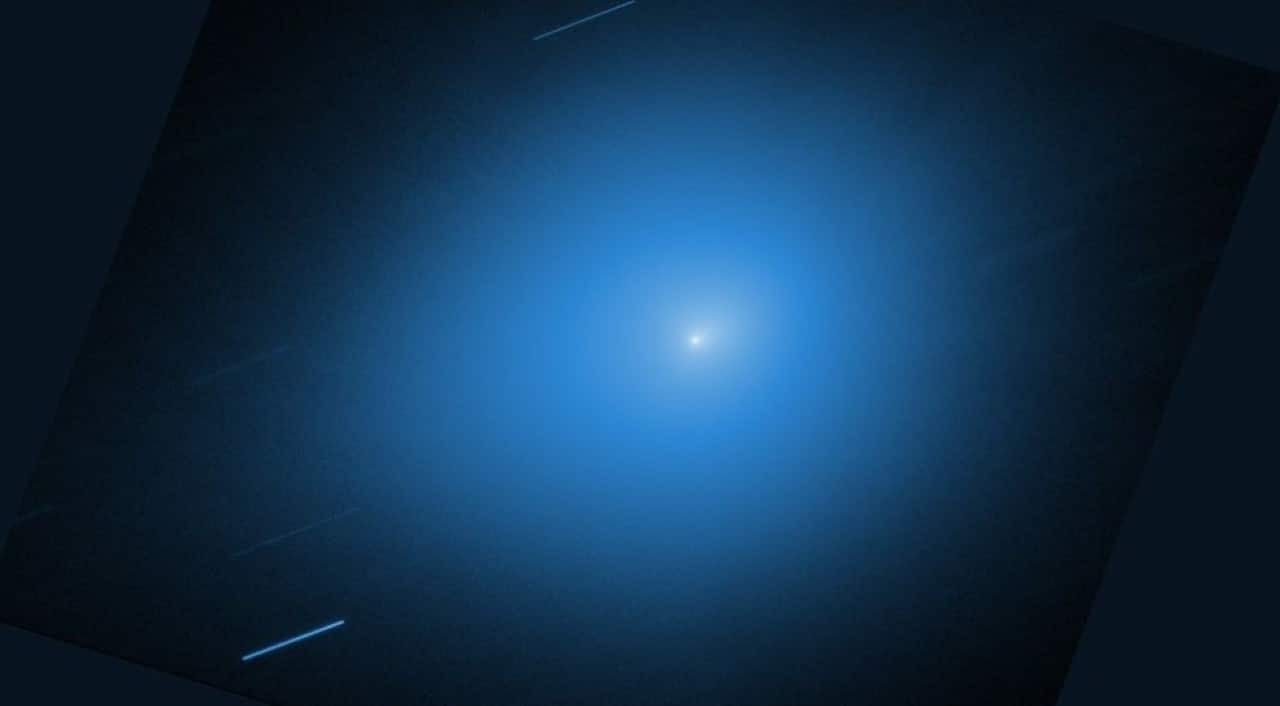
Telescópio Espacial Hubble captured detailed images of the interstellar comet 3I/ATLAS on November 30, 2025, when the object was 286 million kilometers from Terra. Essa observation occurred shortly after the comet’s perihelion, in October, and shows a bright coma in the shape of a water drop, with a nucleus surrounded by gas and dust.
The Juice probe, from Agência Espacial Europeia, also recorded 3I/ATLAS in November, 66 million kilometers away, during its trip to Júpiter. Esses records confirm third confirmed interstellar visitor in Sistema Solar, discovered in July 2025 by the ATLAS system in Chile.
Astronomers from Nasa and Esa coordinate efforts to analyze the comet’s hyperbolic trajectory, which indicates an origin outside of Sistema Solar. 3I/ATLAS travels at around 210 thousand km/h and will reach the closest point to Terra on December 19, 270 million kilometers away, without any risk to the planet.
- Discovered on July 1, 2025 by the ATLAS telescope at Río Hurtado, Chile.
- Estimated core diameter between 440 meters and 5.6 km, the largest among known interstellar objects.
- Composition includes hydrogen cyanide, methanol and nickel at high levels.
Discovery and initial trajectory
Astronomers identified 3I/ATLAS as interstellar due to its open orbit, which does not close around Sol. The initial detection occurred during routine scans of the ATLAS system, designed for warning of terrestrial impacts.
In July, Hubble obtained the first images, revealing a faint coma and a broad tail pointing east. Esses initial data limited the size of the nucleus and indicated dust ejection at varying speeds, from 2 m/s for large grains to 22 m/s for small particles.
The trajectory takes the comet to a minimum distance from Sol of around 1.8 astronomical units in October, activating its sublimation. Subsequent Observações tracked its acceleration and brightness, with variations every 16 hours, suggesting irregular rotation.
Chemical composition revealed
Spectroscopy of Very Large Telescope in August 2025 detected cyanide and nickel in the coma of 3I/ATLAS. Esses elements, with nickel 11 times above solar levels, point to formation in a dense interstellar environment.
The bluish glow in the coma, captured by Hubble, confirms the presence of volatile molecules such as carbon dioxide and water ice. Análises indicate mass loss of up to 60 kg of dust per second during July, with ultraviolet emissions observed by missions such as PUNCH and STEREO.
Preliminary data from Juice, transmitted in November, shows gas emissions with an altered sulfur-oxygen ratio. Esses findings differentiate 3I/ATLAS from solar comets, such as 2I/Borisov, and suggest prolonged exposure to cosmic radiation.
The presence of methanol and hydrogen cyanide reinforces hypotheses about building blocks for organic compounds. Observações from James Webb Space Telescope in August complement these data, identifying irradiated tholins responsible for the reddish color.
Observations from the Juice probe in detail
The Juice probe, launched in 2023 to explore moons of Júpiter, positioned itself between Sol and 3I/ATLAS in November. Sua NavCam camera, intended for navigation, captured a partial image showing visible coma and plasma tail.
This view, from 66 million kilometers, revealed post-perihelion thermal activity, with jets of gas and dust. The probe’s main antenna, used as a solar shield, has delayed sending complete data, expected for February 18 to 20, 2026.
Scientific instruments on Juice measured particles and composition during two days of observation. Esses records include analyzes of dust and gas, contributing to ejection models in interstellar comets.
Coordination with the Hubble allowed for direct comparisons, highlighting the versatility of the Juice. Imagens show two tails: one of anti-solar plasma and the other of curved dust, similar to local comets but with greater intensity.
Contributions of Hubble to the study
Hubble used Wide Field Camera 3 in November to map the 3I/ATLAS coma with a resolution of 0.04 arcseconds per pixel. Essa technique revealed two main jets and a solar anti-tail extending to 60 thousand kilometers.
Ultraviolet spectroscopy determined gaseous emissions and brightness variations. Background stars appear as streaks due to the comet’s rapid motion, allowing precise tracking of acceleration.
Previous observations in July estimated ejection of 6 kg of fine dust per second. Current Dados confirm post-perihelion increase, with fan-shaped solar plume at the core.
These processed images highlight asymmetries in the coma, such as greater brightness on the solar side. The telescope will continue to monitor 3I/ATLAS until its exit from Sistema Solar in 2028.
Collaborations between space missions
Several probes contributed to the monitoring of 3I/ATLAS. Psyche, en route to the asteroids, updated tracking in November, confirming deviations in acceleration.
Marte orbiters, such as Perseverance and Reconhecimento of Marte, observed the comet in October from 29 million kilometers away. Esses data revealed ultraviolet emissions and interactions with solar wind.
Observatório SOHO and Parker Solar Probe recorded tail elongations in September. Missões like Lucy and Europa Clipper added long-distance perspectives by measuring infrared spectra.
- Psyche: Atualizações trajectory in November.
- Perseverance: Visões from Marte on October 3.
- SPHEREx: Detecção of water ice in the core in August.
These collaborations form a global database, accelerating composition analyses.
Future trajectory and visibility
3I/ATLAS will emerge from behind Sol in November and will remain observable until September 2028. Telescópios terrestrials, like Gemini Norte, captured spectra in August, showing ultraviolet and red filters.
Amateurs recorded images in December with 30-cm telescopes, extending the coma to millions of kilometers. The apparent brightness reached magnitude 11.5, visible on average equipment.
James Webb Space Telescope scheduled infrared observations in December, looking for specific ices. Esses final efforts aim to reconstruct the comet’s journey through interstellar space.
The departure of Sistema Solar in 2028 will mark the end of observations, leaving a legacy of data on planetary formation.



