
NASA Tracks Voyager 1 Heading to Historic Distance: 16 Billion Miles in November 2026


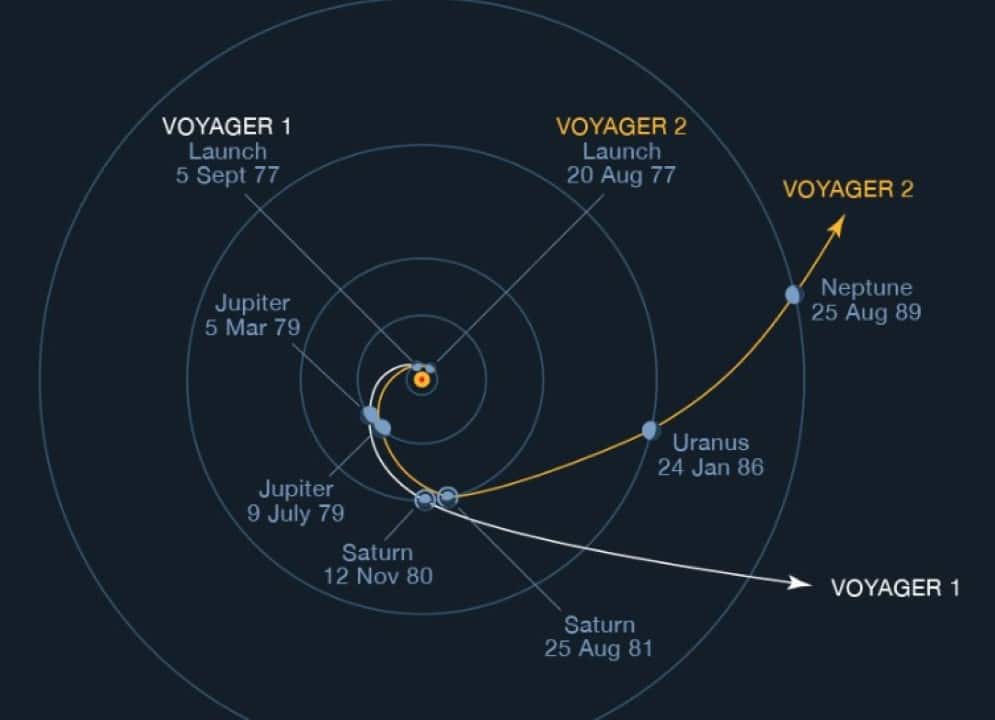
Voyager 1, launched by NASA on September 5, 1977, is currently the most distant human object from Terra. The probe, which initially explored Júpiter and Saturno, is now crossing interstellar space at a speed of 61 thousand km/h. In November 2026, it will reach one light day away, or 25.9 billion kilometers, becoming the first spacecraft to record such a milestone.
This achievement occurs when a radio signal, traveling at the speed of light, will take 24 hours to reach Voyager 1 from Terra. The current distance, of around 25.4 billion kilometers in November 2025, already imposes a delay of more than 23 hours in two-way communications. NASA’s Engenheiros, in Pasadena, Califórnia, prepare adjustments to maintain contact.
The mission, managed by Jet Propulsion Laboratory, relies on radioisotope thermoelectric generators for power, which gradually decline.
- Discovery of active volcanoes on the moon Io of Júpiter in 1979.
- Record of complex structures in the rings of Saturno in 1980.
- Entry into interstellar space in August 2012, confirmed by plasma data.
These achievements consolidate Voyager 1 as humanity’s ambassador in the cosmos.
Current operational challenges
The Voyager 1 faces technical limitations after almost 48 years of operation. In November 2023, a flight data system problem interrupted readable transmissions for five months, resolved in April 2024 by relocating code into working memory.
The probe now sends data at 160 bits per second, comparable to older dial-up connections, requiring multiple Deep Space Network network antennas for reception.
In 2025, engineers revived trajectory correction thrusters, dormant since 1980, to prevent freezing of propellant lines. Essa maneuver, carried out in February, extended the useful life by two to three years.
Power management prioritizes instruments such as magnetometer and cosmic ray detector, turning off others to save money.
Active instruments and data collection
Select instruments continue to provide insights into the interstellar environment. The plasma wave subsystem detects interactions in the heliopause, the boundary where the solar wind meets the interstellar medium.
Data reveals giant magnetic bubbles in the heliosheath, a region beyond Plutão, with variations in the solar magnetic field.
Voyager 1 measures high-energy cosmic rays, which increased dramatically after 2012, indicating transition into space beyond solar influence.
These observations, transmitted via 8.4 GHz frequency, guide models of interaction between the Sol and the galaxy.
In 2025, Cosmic Ray Subsystem was temporarily shut down to save energy, but the magnetometer remains operational.
Exploration of gas giants
Voyager 1 flew over Júpiter in March 1979, 402 thousand kilometers from the planet. Imagens revealed storms on Grande Mancha Vermelha and volcanic activity on Io, the first evidence of extraterrestrial volcanism.
In November 1980, the close approach to Saturno, at 124,000 kilometers, mapped intricately divided rings and discovered six additional moons.
These flybys, part of the 1977 Voyager program, used planetary gravity for acceleration, setting the current trajectory without adjustments since.
Data from Jupiter’s atmosphere showed winds at 600 km/h, while in Saturno they identified a polar hexagon measuring 30 thousand kilometers in diameter.
The mission expanded knowledge about gaseous composition, with hydrogen and helium dominant.
Limits of communication in a vacuum
Communications with Voyager 1 require patience due to increasing delays. A command sent now returns after 46 total hours, and in 2026 it will reach 48 hours exactly.
The 3.7 meter high gain antenna must point precisely to Terra, corrected by thrusters every six months.
Any misalignment, such as hydrazine freezing, would permanently disrupt the signal.
NASA uses three complexes at Deep Space Network – at Califórnia, Espanha and Austrália – for continuous coverage.
In 2027, the 50th anniversary, more shutdowns will occur, prioritizing plasma and wave subsystems.
Contributions to future missions
Data from Voyager 1 informs projects such as Interstellar Probe, planned for 2030, which targets greater distances with updated technology.
Measurements of the heliopause help predict galactic interactions, including the “hydrogen wall” detected in 2018 by New Horizons.
The probe validates solar wind models, with zero speed reported in 2010, confirming magnetic bubbles of up to 1 billion kilometers.
These insights, collected 170 astronomical units away in 2025, benefit exoplanet studies and planetary protection.
Voyager 2, 23 billion kilometers away, complements with data from Urano and Netuno, crossing the heliopause in 2018.
Preparations for the 2026 milestone
Intergenerational teams, including retirees from the 1970s, monitor Voyager 1 daily. Suzy Dodd, project manager, coordinates shutdowns for 2027, maintaining at least one instrument until 2030.
The one-light-day milestone highlights the resilience of the probe, designed for 5 years but active for 48.
In November 2026, celebrations at NASA will mark the event, focusing on the transmission of “Pale Blue Dot”, a 1990 photo that captured Terra as a blue dot.
Software updates, as in 2024, guarantee autonomy in the event of failures.
The mission reinforces the legacy of exploration, with a gold record containing sounds and images of Terra for possible interstellar encounters.



